New model bridges ferroelectric physics and circuit modeling
Circuit designers can now accurately predict ferroelectric behavior under real-world voltages, helping simulate chip performance for next-generation AI computing.

Circuit designers can now accurately predict ferroelectric behavior under real-world voltages, helping simulate chip performance for next-generation AI computing.
A new physics-based analytical model can accurately predict ferroelectric behavior under real-world, complex voltages, according to a study led by University of Michigan Engineering. The model bridges the longstanding gap between fundamental switching physics and practical device engineering.
“We are looking to understand the nature of the behavior of ferroelectric materials and to design it for technology. We have growing interest in the device and circuit aspects of ferroic-materials-based computing which presents the opportunity for logic-in-memory and other novel AI computing schemes with high energy efficiency and throughput,” said John Heron, an associate professor of materials science and engineering at U-M and senior author of the study published in Advanced Materials.
Applying an electric field to a ferroelectric material flips its internal electric polarization direction, pointing positively charged atoms up or down. The directional state acts as a binary 1 or 0, replacing leaky electrical charges used in conventional computing.
Current models of ferroelectric materials assume constant voltages, but applied voltages pulse, vary in frequency and fluctuate in real-world chips.
The research team built the new model to overcome this issue and tested the model on the ferroelectric material HZO, short for hafnium zirconium oxide. The field has been gravitating to HZO because it is compatible with standard silicon manufacturing processes and retains ferroelectric properties when it is extremely thin.
When a voltage surges through a ferroelectric material, the entire material does not flip polarization instantly. It starts with a spark, called nucleation, when a tiny spot flips its direction. The flipped region spreads outward, called growth, causing surrounding atoms to flip as well.
The rate of nucleation and growth spread depends on the strength and consistency of the electric field. To model this complex phenomenon, the researchers built upon the reverse time cone model, developed by a University of Michigan alumni, John W. Cahn. This model works backwards, solving for how much of the material is flipped at any exact moment without counting overlapping regions.
The researchers combined the reverse time cone with statistical thermodynamics. This helps track how voltage pulses vary to accurately predict how nucleation and growth dynamics change.
“Because our model keeps track of the entire voltage history, it naturally captures how these materials ‘remember’ past states. This helps the model stay accurate across any complex voltage speed or frequency,” said Yi Liang, a doctoral student of materials science and engineering at U-M and lead author of the study.
To make the model more useful for circuit engineers, the researchers reduced their physics-based model down to three key parameters without losing physical accuracy. In collaboration with Wei Lu, the James R. Mellor Professor of Engineering in electrical and computer engineering, and doctoral student Soohyeon Kim, the team incorporated this compact model into the standard software that engineers use to design integrated circuits—SPICE, short for Simulation Program with Integrated Circuit Emphasis.
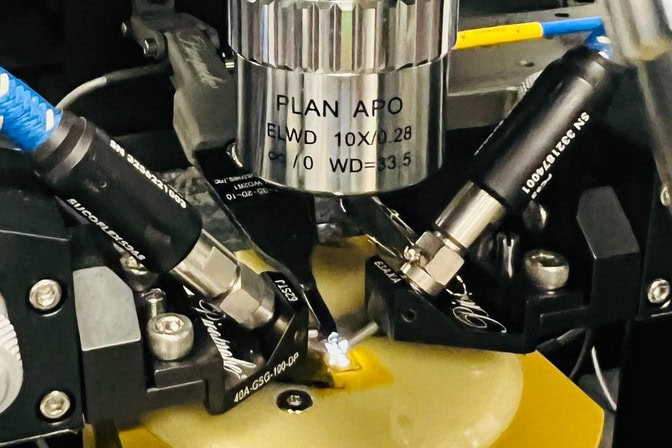
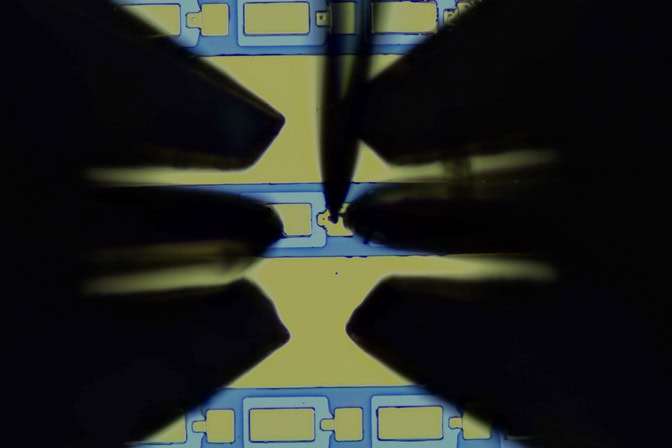
The research team validated the model by testing it against experimental data from HZO devices built in the U-M Lurie Nanofabrication Facility. The model agreed with experimental data using just a single set of material parameters. The new model even helped improve our understanding of HZO ferroelectric switching, providing a new insight into what drives nucleation and growth movement.
With this model, chip designers can simulate billions of ferroelectric memory cells and predict chip performance, like energy consumption and speed, from material properties before a chip is built in a factory.
“The model is particularly valuable for applications involving complex voltage waveforms. For example, in neuromorphic computing, where devices are programmed using pulse trains with varying amplitudes and durations, it can identify waveform conditions that maximize programming efficiency, linearity and readout fidelity,” said Heron.
The research team has made the Python-based simulation code available so that researchers and new learners can benefit from the tool to visualize ferroelectric switching behaviors under customized waveforms.
The HZO device was built in the Lurie Nanofabrication Facility, which is operated and maintained with support from indirect cost allocations in federal grants.
Researchers at the University of Virginia, The Pennsylvania State University and Intel Corporation also contributed to this study.
This research was supported by the Intel Corporation FEINMAN 2.0 program and the Office of Naval Research (N000142612047).