Toughened hydrogels could replace cartilage, skin and more
U-M formula and process allow for the creation of devices and materials for precision medicine.

U-M formula and process allow for the creation of devices and materials for precision medicine.
Hydrogels—polymers that can take in and hold water—are useful in many biocompatible contexts today, including contact lenses and medical dressings. Now researchers from University of Michigan Engineering have made some that are tough enough to potentially replace damaged cartilage and skin, as well as surgical sutures.
“Hydrogels are very good at mimicking the tissue environment, both mechanically and biochemically,” said Sungmin Nam, assistant professor of mechanical engineering. “So we use them as engineering tools that can be placed safely in the body.”
By blending alginate from algae with calcium and polyacrylamide, the team created hydrogels that are both mechanically tough and programmable for properties like adhesiveness and electrical conductivity.
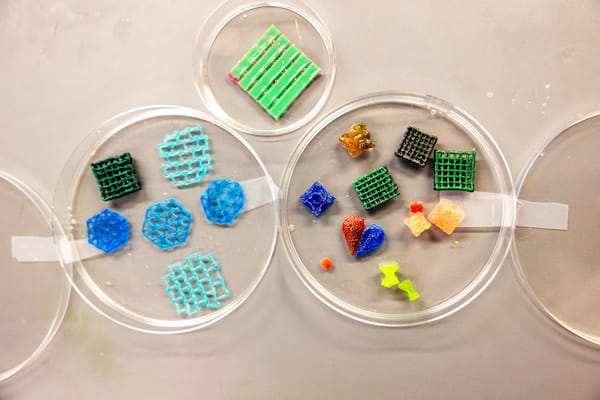
The researchers envision that these enhanced hydrogels could deliver medicines, support tissue growth, and be 3D printed for patient-specific precision medicine treatments.
“Using a 3D bioprinter, we can create with any of these toughened hydrogels, incorporating different types of cells,” said Rogerio Castilho, professor of dentistry. “You can print exactly what’s needed for an individual patient simply by referencing an MRI or a CT scan. One notable feature of these hydrogels is that they are not only mechanically tough but also highly stretchable—much like rubber—and remarkably resilient.”
The team has filed a provisional patent, and is working with Michigan Medicine to confirm the hydrogels are safe and effective and identify the most promising clinical uses.
AI contributed to thishuman-edited summary of the article Toughened gummy bear-like materials could replace cartilage, skin and more by Jim Lynch.