Key structures to metallic glass stability revealed with machine learning
Using the second-nearest neighboring atoms to predict metallic glass stability can help researchers more accurately model the disordered solid with strong, elastic properties.

Using the second-nearest neighboring atoms to predict metallic glass stability can help researchers more accurately model the disordered solid with strong, elastic properties.
Metallic glass stability can be determined by the second-nearest neighboring atoms, according to a recent study led by University of Michigan Engineering researchers.
The disordered atomic structure of metallic glasses creates a unique combination of high strength and elasticity but obscures which features control performance. Two machine learning approaches independently identified the same 5-angstrom (Å) radius as the most important to material properties. The study, published in npj Computational Materials, was funded by the National Science Foundation.

Explore the forefront of AI
at Michigan Engineering
While ductile metallic glass has been molded into components of consumer electronics, medical devices, high-end sports equipment and even spacecraft, expensive processing limits use to these specialized applications. Understanding patterns in how the atomic structure of metallic glass impacts material properties can help researchers discover new, less costly metallic glasses for more widespread use.
“I’m motivated by the challenge of using modern data-driven tools to uncover hidden structural principles in metallic glasses that have been difficult to identify using traditional approaches,” said Muchen Wang, a doctoral student of mechanical engineering at U-M and lead author of the study.
In crystalline metals, structural features in the highly ordered, repeating atomic structure like grain boundaries or dislocations determine how the material will respond to stress. Without an ordered structure to follow in metallic glasses, researchers have turned to small scales to look for patterns.
Recent studies recognize that short-range orders, within the first nearest-neighbor shell, do not provide enough information. However, researchers have struggled to solve how far out from an atom is necessary to capture structural information that really matters.
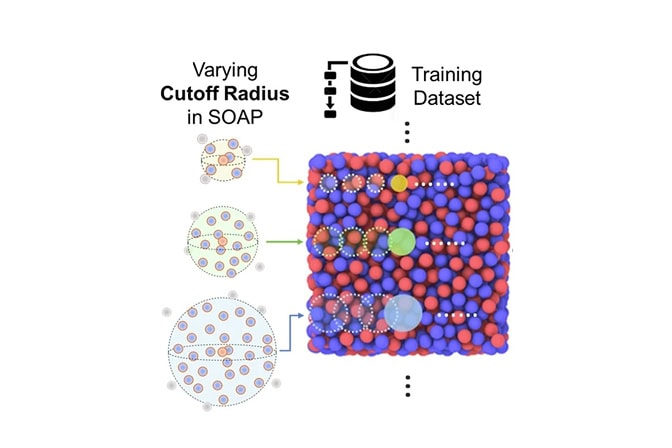
The research team used two machine learning strategies with different modeling philosophies to search for an appropriate length scale. First, they applied a reductionist approach based on physics-inspired structural descriptors. This model systematically probes atomic environments at different spatial scales and evaluates how structural information changes with radius.
Second, the researchers developed an emergentist model that learns structural correlations directly from voxelized atomic configurations. The emergentist model discovers patterns automatically through attention mechanisms rather than requiring predefined structural motifs.
Even with vastly different approaches, both models converged on the same characteristic structural length scale of about 5 Å in metallic glasses.
“That convergence gives us strong confidence that we are observing a real physical feature of metallic glasses rather than an artifact of a specific model,” said Yue Fan, an associate professor of mechanical engineering at U-M and corresponding author of the study.
The scale, dubbed the Radius of Informative Structural Environments or RISE for short, held up across a wide range of compositions and bonding types. It also aligns with several experimental observations of medium-range order in metallic glasses.
By focusing on the critical 5-Å radius, future predictive models may capture the key physics of metallic glasses more accurately while reducing computational complexity. In the long run, the RISE could support AI-driven materials discovery, helping researchers to design new metallic glass compositions with improved mechanical strength, ductility or thermal stability.
Yuchu Wang of University of Michigan Engineering and Minhazul Islam, Yuchi Wang, Yunzhi Wang and Jinwoo Hwang of The Ohio State University also contributed to this research.
This research was supported by the National Science Foundation under grants DMR-2406530 and DMR-2406531.