Providing the Artemis mission with solar radiation forecasts
Machine-learning and physics-based models developed at U-M will warn NASA when solar particle radiation could become hazardous up to 24 hours in advance.

Machine-learning and physics-based models developed at U-M will warn NASA when solar particle radiation could become hazardous up to 24 hours in advance.
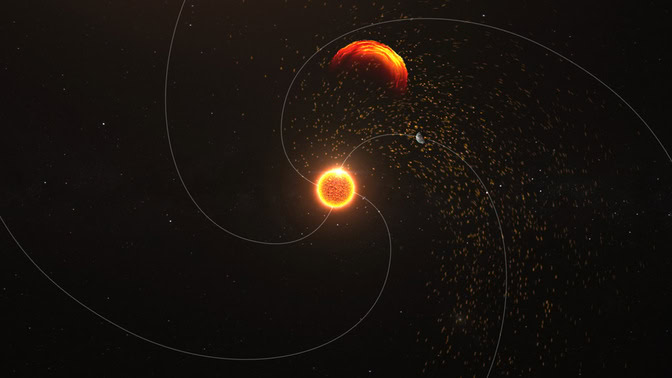
Lulu: When a solar flare occurs, sometimes it will lead to the release of a huge amount of energy into space. And Artemis Missions are launched within the years where the solar activity is very high.
On-screen text: During the Artemis II mission, forecast models developed by U-M researchers are undergoing a demonstration run, predicting the potential for harmful radiation from solar flares.
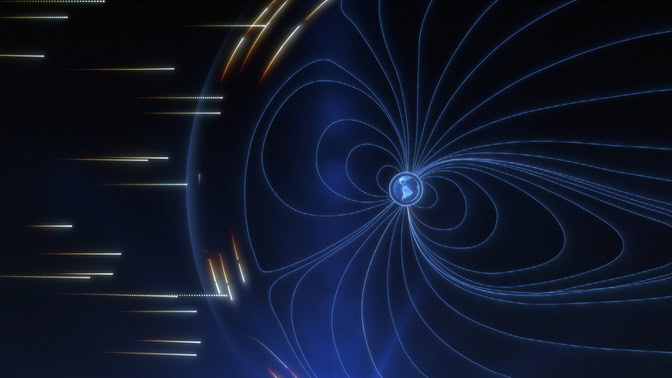
Lulu: When a huge amount of energetic particles reach Earth, the Earth’s magnetosphere serve as an umbrella that protect us from the radiative particles. The further away the Artmeis travels, the higher chance they will receive a high dose of radiation. Exposing to high radiation environment would increase the risk of cancer in the long term. At the same time, acute radiation sickness, including the vomiting and skin burning, would interrupt the normal activities in the space.
On-screen text: To date, no observed solar particle event has been been strong enough to cause acute radiation effects for humans inside shielded spacecraft like Orion.
Lulu: The models we developed will continuously look at the sun and predict the probability of having solar particle events within 24 hours ahead of time. The prediction results would be screened to the website that CLEAR Center has developed, and the NASA operators could retrieve the results in real-time. We hope the Space radiation predictive model could help support the future mission planning, and it will also help protect astronauts from the radiation hazards while they perform activities outside of the spacecraft.
In the Artemis II mission, NASA will test out a pair of new solar radiation forecasts, developed at University of Michigan Engineering, designed to protect astronauts venturing away from Earth. The mission launched Wednesday.
The forecasts will provide warnings of harmful solar radiation released by solar flares and eruptions up to 24 hours in advance. NASA’s Space Radiation Analysis Group, or SRAG, is examining how new solar particle forecasting technologies might provide a faster response to changing space weather conditions during the Artemis missions, which will mostly fly outside the natural shielding provided by the Earth’s magnetic field.
Artemis II is also launching during the most active period of the sun’s 11-year cycle in sunspot count, when eruptions are more common. An energetic solar flare, which is sometimes a precursor to particle storms, occurred just this week.
The harmful radiation comes from protons, the positively-charged particles inside the cores of all atoms. Protons freely fly through the solar wind, the stream of electrically conductive gas that emanates from the sun, and they become especially dangerous when accelerated by the shock waves from solar flares and eruptions. The particles can travel near the speed of light and reach Earth minutes after a solar eruption.
If they hit an astronaut, their high energies could cause DNA strand breaks or cellular damage that may lead to an increased risk of developing cancer in the long-term. At very high doses, associated with only the very rare top 5% of all solar particle events, effects like nausea might be possible without sufficient shielding. However, the Orion vehicle was built to provide significant shielding for the Artemis astronauts that will keep them well below those harmful dose levels.
In the event of bad space weather, the Artemis crew is trained to reconfigure their cabin to reduce radiation exposure, according to a NASA statement. By removing stowed equipment from storage bays and securing it along areas of the cabin, the crew will add a thicker barrier between themselves and the harmful particles. With the extra shielding, the crew can go about their business.
SRAG console operators monitoring radiation sensors in the Orion spacecraft will alert Mission Control to let the crew know if they suddenly need to rearrange the cabin. To potentially provide more prep time, Michigan Engineering’s machine-learning model forecasts the chance of dangerous solar radiation, similar to the hourly percent chance of rain in a conventional weather forecast. Each day of the mission, it will calculate the probability of harmful radiation in a demonstration of the feasibility of this new technology.
The model makes its predictions using satellite images of the sun and corona. Those pictures are snapped by two spacecraft: the Solar Dynamics Observatory, or SDO, which photographs the entire sun and its magnetic field in visible and UV light, and the Solar and Heliospheric Observatory, or SOHO, which photographs the sun’s corona and takes readings of the corona’s particles and chemical elements.
“We are looking at the sun 24/7, specifically the magnetic evolution of the sun and events such as flares and eruptions, to see if any extra energy will be released,” said Lulu Zhao, U-M assistant professor of climate and space sciences and engineering and the principal investigator of the CLEAR Center, which NASA funded to develop the forecasting tools.
The machine-learning model was trained using a catalog of photos compiled from data collected since the launch of each instrument—2010 for SDO and 1995 for SOHO. From the photos, the model learned to identify what the sun looks like right before a particle storm. But the model only calculates the probability of a dangerous particle storm. It doesn’t provide any details on the storm, or how long it will last.
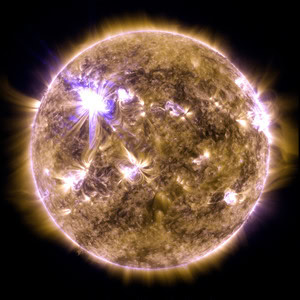
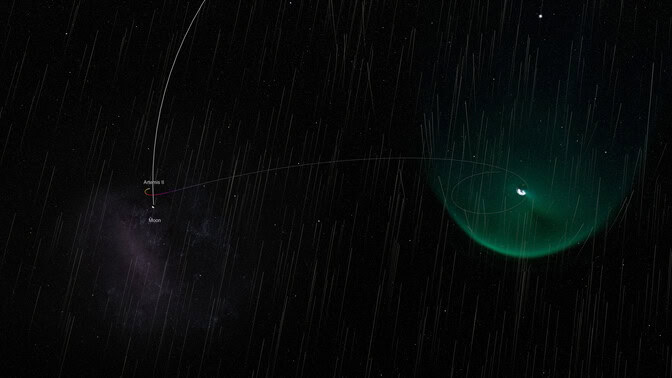
To provide those details, the researchers also developed a physics-based model that estimates when solar flares and eruptions will trigger a particle storm at Earth and the moon, and for how long hazardous levels of radiation will stick around. The model’s predictions are more sophisticated than existing solar particle storm models because it simulates solar energetic particles in the corona, where particle acceleration starts and is strongest.
The new capability comes from a model of the solar corona, published by U-M scientists in 2014. There is only one reliable alternative to model the sun’s corona, but it’s too slow for operational forecasts.
The physics-based model will also constantly run throughout the mission, but it needs to be updated by a human whenever the sun erupts. NASA’s Moon to Mars office will upload measurements of solar eruption speeds to a database. The U-M model will automatically take the new measurements to estimate radiation exposure.
“We asked NASA to reserve 3,000 processing units on their supercomputer for us during the mission, so the model can run as quickly as possible whenever there is an eruption,” Zhao said. “We can’t afford delays because the harmful particles can reach Earth so quickly.”