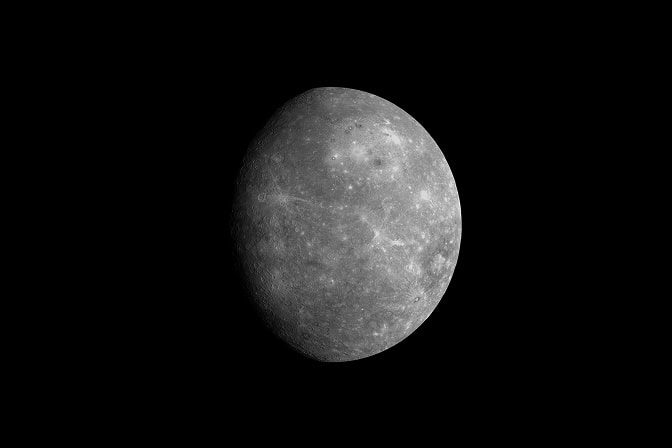
Mercury has part-time radiation belts
Scientists thought Mercury’s magnetic field was disrupted by the sun too often to trap a radiation belt, but new analysis of MESSENGER data says that’s not always the case.

Scientists thought Mercury’s magnetic field was disrupted by the sun too often to trap a radiation belt, but new analysis of MESSENGER data says that’s not always the case.
Mercury was long considered the exception to the rule that magnetic planets have radiation belts similar to Earth’s Van Allen belts, but a new study by University of Michigan Engineering and the University of California, Berkeley, suggests otherwise—Mercury occasionally has such a layer of radiation in its magnetic field.
The radiation belt is present about 50% of the time Mercury is farther away from the sun in its oblong orbit, and about 20% of the time at closer distances. Each belt typically lasts less than eight-to-12 hours, but can persist for several Earth days, the researchers say.
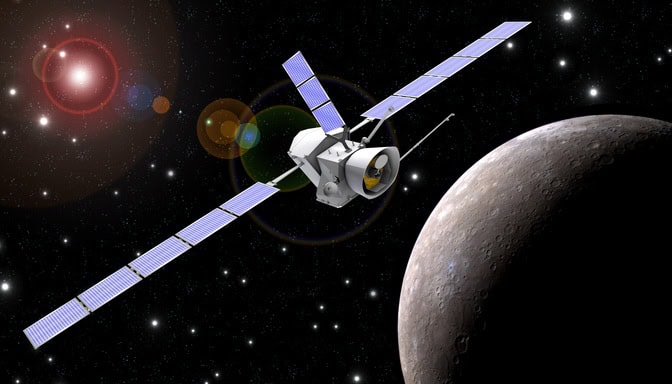
Discovered by analyzing interference with instruments on the MESSENGER probe, the findings could help scientists time operations in future missions to Mercury, including BepiColombo, a joint European and Japanese mission scheduled to enter Mercury’s orbit this November.
“When we think about the future exploration of space, and what instruments we send to Mercury, we’ll want to be aware of this radiation belt and take the right sort of precautions and design around it,” said Ryan Dewey, U-M assistant research scientist in climate and space sciences and engineering and co-first author of the study, which was published in Nature Astronomy and funded by NASA and the National Science Foundation.
All the other planets in our solar system with magnetic fields—Earth, Jupiter, Saturn, Uranus and Neptune—have radiation belts. Instruments that must pass through these belts are designed with radiation shielding, and crewed missions minimize astronauts’ time in the belts.
But scientists didn’t think that Mercury’s relatively weak magnetic field could trap radiation because it is constantly torn apart by the solar wind, the stream of electrically conductive gas that emanates from the sun. Since Mercury is so close to the sun, the solar wind pressure is six to 30 times greater than at Earth, and the sun’s magnetic field—which can break planetary magnetic fields—is four to 10 times stronger.
“Extreme space weather events at Earth are actually normal on Mercury,” said Weijie Sun, assistant research physicist in the Space Sciences Laboratory at UC Berkeley and the corresponding author of the study. “Mercury provides a natural laboratory to infer what the radiation could look like at other planets that orbit close to their stars, as well as distant planets during extreme space weather.”
Despite Mercury’s turbulent space environment, the researchers found that the planet can, at times, hold on to a radiation belt. Mercury’s magnetic field is more likely to trap radiation when it is further away from the sun in its oblong orbit. There, the solar wind blows less strongly, which relieves pressure on Mercury’s magnetic field. The magnetic field expands in turn, providing more space for radiation from the solar wind to accumulate. When Mercury is near the sun, the magnetic field shrinks, and the radiation is squeezed out.
“Mercury’s magnetic field is only about 1% the strength of Earth’s, so there’s not a whole lot of room for the energetic electrons that make up the radiation to survive before being ejected out into space or hitting the planet,” Dewey said.
The researchers found Mercury’s radiation belts while diving into old data collected by MESSENGER, which orbited Mercury between 2011 and 2015. The spacecraft helped researchers figure out what elements were in Mercury’s crust by measuring gamma rays and neutrons with an instrument that converted them into light.
But sometimes, the instrument detected X-rays produced when its metal casing was struck by heightened levels of radiation. The instrument also converted such X-rays into light, but they could only appear in certain channels.
By tracking when and how often the signal was elevated in these channels, the researchers could determine when and where Mercury’s radiation belts appeared. The researchers then compared their measurements to a computer simulation of radiation moving inside Mercury’s magnetic field, which provided insights into how the radiation belt formed and disappeared.
Whether the radiation in Mercury’s belt is strong enough to damage instruments aboard BepiColombo is still unclear, because the researchers only have indirect measurements. However, the study will help the BepiColombo team know when to turn off sensitive instruments and when to turn on instruments designed to better understand Mercury’s radiation levels.
“We don’t know how intense the radiation is right now, but that is something that can be solved by BepiColombo,” said Jiutong Zhao, postdoctoral researcher in the Space Sciences Laboratory at U-C Berkeley and co-first author of the study.