Studying bird flu in the air to protect people and agricultural operations in Michigan and beyond
Understanding the virus that causes bird flu in livestock, and how to kill it, could help industrial farms prevent transmission.

Understanding the virus that causes bird flu in livestock, and how to kill it, could help industrial farms prevent transmission.
Discovering how the bird flu virus degrades in the air around livestock and how engineering solutions can effect that degradation quickly and efficiently are core aims of a new University of Michigan Engineering-led project funded by the U.S. Department of Agriculture (USDA). This work could help prevent or mitigate future outbreaks.
Since 2022, an outbreak of bird flu sweeping across the the U.S. has led to the loss of more than 200 million birds from backyard and commercial flocks. And as of late 2024, has cost the poultry industry 1.4 billion dollars.
Herek: In the past, we would have bird flu outbreaks maybe every ten years. More recently, I think it’s been every couple of years and verging on just a continuous kind of low level presence of bird flu, generally.
On-screen text: The federal government is asking for help from researchers like Herek Clack and his team… to tackle this growing threat from bird flu to protect livestock, farmers, and our food supply.
Herek: In our lab, uh, here at University of Michigan, we’ve been working on using plasmas as an alternative to filters to protect against airborne viral pathogens. And what we’ve shown is that we’re able to inactivate viruses 90 or 99%, but we’re able to do so, uh, without impeding the air flow.
Text: With funding from the U.S. Department of Agriculture, the researchers are first looking at how long bird flu stays infectious in the air, particularly the type of air present in these facilities, which is full of contaminants like odors.
Herek: Traditionally, pig farmers and chicken farmers, especially in winter, have limited how much outside air they bring in in order to minimize heating costs. If influenza is in your birds and if your birds are shedding it in aerosol form, you may be putting yourself at greater risk for influenza spread because the pH of the aerosols is being driven by these high concentrations of ammonia, hydrogen sulfide, to a pH level that preserves virus infectivity rather than promotes loss of effectivity.
Our goal is to examine that process and use a method that we developed in our lab to directly indicate which way do these gases drive pH? Do they drive pH higher? Do they drive pH lower? And does that lead to a retention of virus infectivity, or does that drive a more rapid loss of virus infectivity?
On-screen text: The second part of the project will test plasma technology designed to kill viruses in the air.
Herek: The goal is to develop a device either for building ventilation systems or for PPE (personal protective equipment). If these gases around livestock interfere with the plasma and reduce its effectiveness. Can we increase the power to the plasma to overcome that? So that’s one of the big objectives of this grant.
Detection of bird flu infection within flocks and herds leads to the mass culling of animals, which disrupts food supply chains. The ongoing outbreak of HPAI H5N1 that began in 2022 in the U.S. has led to the loss of 175 million birds and, as of late 2024, has cost the industry roughly $1.4 billion.
The $2 million grant from the USDA’s Animal and Plant Health Inspection Service aims to answer two fundamental questions about bird flu:
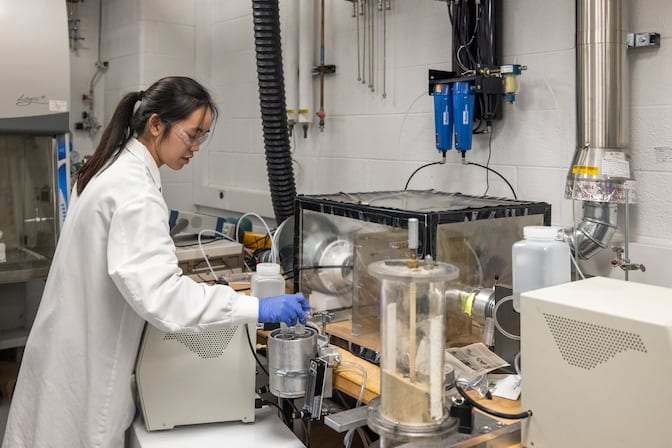
Herek Clack, a U-M associate professor of civil and environmental engineering, will lead the project, conducting tests on how non-thermal plasmas can render aerosols containing the virus that causes bird flu incapable of infecting humans and livestock. His team’s approach essentially exposes air to strong electric fields, temporarily creating free electrical charges that damage viruses and render them harmless.
“Both the USDA and the agricultural industry want a playbook—science-based guidelines—for how to operate under the threat of bird flu,” Clack said. “We’re after a better understanding of how the airborne virus behaves in enclosed livestock operations and what technologies can best protect animals and workers.”
Previously, Clack and his team developed a plasma reactor capable of reducing the number of infectious viruses in the air by 99.9%. Building on that work, they will test how non-thermal plasma inactivates viruses in air that contains traces of pollutants, such as ammonia, that are common around livestock.
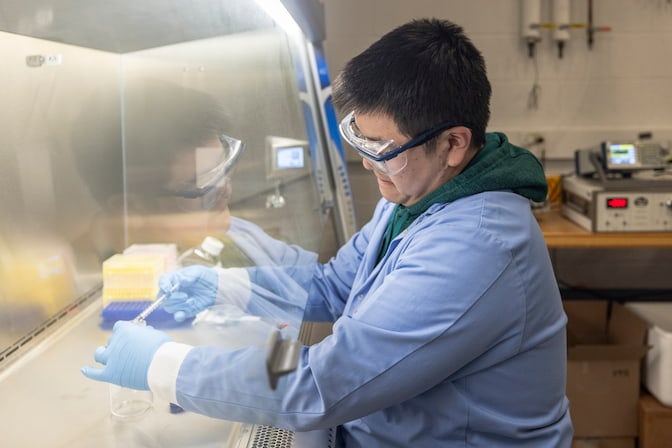
Clack and his team have previously shown that such air pollutants can, at very low concentrations, inhibit the effectiveness of non-thermal plasmas for inactivating viral aerosols. Under this new grant, they will expand the range of air pollutants tested and explore enhancements to the non-thermal plasma that could counteract those pollutants’ effects. Of particular interest is how air pollutants and plasma treatment separately influence the air’s pH, a chemical measure related to acidity.
“A key question we’re looking at is what will happen with pH levels—how do they impact the infectivity of the viruses,” Clack said. “The air pollutants tend to raise the pH in the air, but non-thermal plasma reduces pH.”
If part of the plasma’s effectiveness depends on lowering the pH of the air, it may not be as effective if the air’s pH starts higher.
Allen Haddrell, a research fellow at the University of Bristol in the U.K., will employ a relatively new technology of his own design to answer the question of how long the virus that causes bird flu retains its infectivity in the air. The traditional method for measuring how quickly airborne viruses decay involves filling a cylindrical drum with virus-laden air, then slowly rotating the drum to keep the virus particles in the air. But setup for this method is slow.
“What they miss with that approach is roughly the first 20 minutes of the infectivity decay,” Haddrell said. “Consequently, they can get wildly different results. Different research groups can look at the same virus and come to different conclusions.”
Haddrell will use a technique developed at the Bristol Aerosol Research Centre.
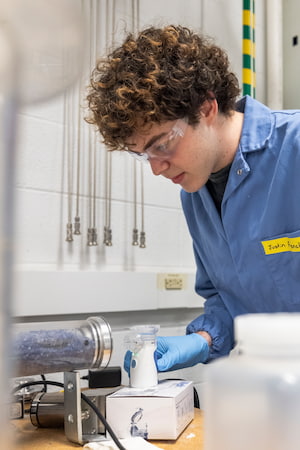
“We levitate virus-containing droplets into an electrodynamic field,” he said. “We expose the population of viruses containing aerosols to different environmental conditions, where we change things like relative humidity or gas composition.
“After a set period, we deposit the aerosol and measure how much the viral infectivity has changed. We use this approach to measure how different environments affect airborne viral decay. And we use this information to figure out the fundamental drivers of decay.”
A better grasp of the decay dynamics associated with the virus that causes bird flu and a proven means of inactivating the virus in ventilation air would give the agricultural industry tools to better deal with the virus’s next appearance. But it will also lay the groundwork for an industry response to the next human pandemic.
“During Covid, workers in these enclosed livestock or processing operations were 50 to 70 times more at risk for contracting the virus, according to a GAO report from 2023,” Clack said. “It told us those close working conditions were the source of greater risk.”
Understanding the decay rate of airborne viruses like those that cause bird flu will help us devise more effective protection for workers and animals from future infectious respiratory diseases.