Academic and industry center to solve digital twin challenges for manufacturing
Digital twins could make manufacturing more efficient with early defect detection, just-in-time maintenance and personalized worker assistance.

Digital twins could make manufacturing more efficient with early defect detection, just-in-time maintenance and personalized worker assistance.

Explore the forefront of digital engineering
at Michigan Engineering
Digital twins, or virtual copies of physical entities, could help manufacturers reduce costs by discovering misbehaving machines faster and timing maintenance more precisely, among other benefits. However, manufacturers developing and adopting the new technology risk wasting effort if they solve the same set of problems independently.
To help digital twins reach their potential faster, the University of Michigan teamed up with the Arizona State University (ASU) to launch an Industry-University Cooperative Research Center, funded by the National Science Foundation (NSF). These centers, which rely on existing university labs, receive $1.5 million over 5 years from the NSF to support administrative costs, while industry partners each pay annual dues of $90,000 to fund research projects.
The founding partners, who helped launch the center in March, are GM, Honeywell, Intel, Applied Dynamics, Applied Materials and the U.S. Army Ground Vehicle Systems Center. Called the Center for Digital Twins in Manufacturing, it continues to welcome new industrial partners.
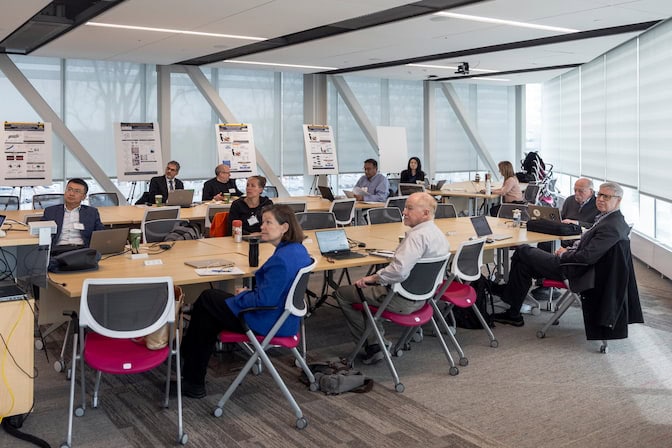
“We’ve been working with industry partners over many years on related projects. Bringing the group of members together with federal support and longer-term funding will enable us to make more significant advances and demonstrate real improvements in industrial operations,” said center director Dawn Tilbury, who is also the Ronald D. and Regina C. McNeil Department Chair of Robotics.
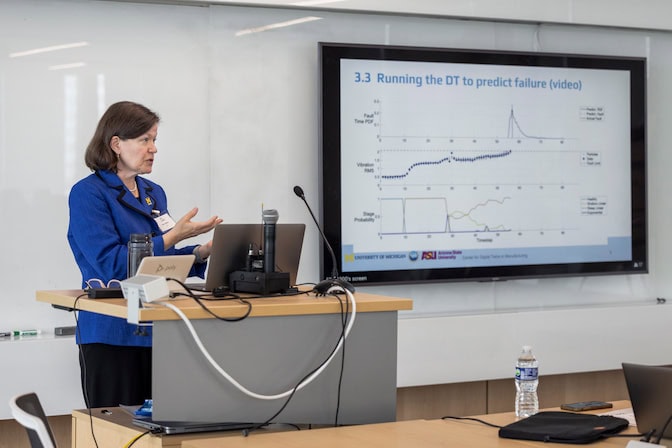
Conventionally, a digital twin is a computer model of a device that communicates with the real device, updating itself to match the state of the device it models. For instance, a digital twin of a milling machine might represent the progress of a part being hewn from a block of metal, checking every tenth of a second to ensure its model is in lockstep with the real machine. The twin could make predictions about part quality, when machine maintenance will be needed and more.
To progress toward that future, the Center has identified four research projects:
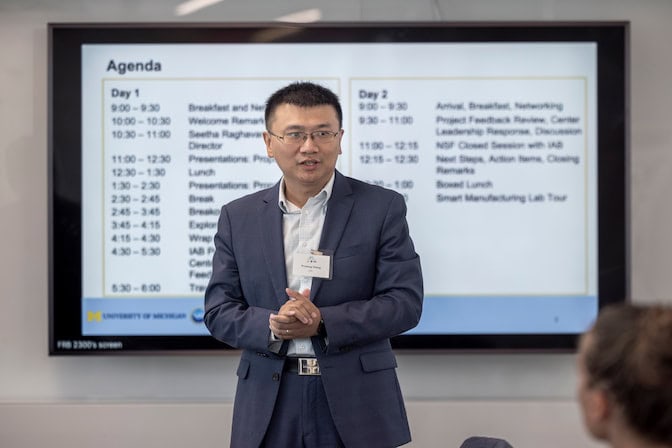
Each project has a co-principal investigator from the other engineering college, leveraging the combined expertise and resources of both universities.
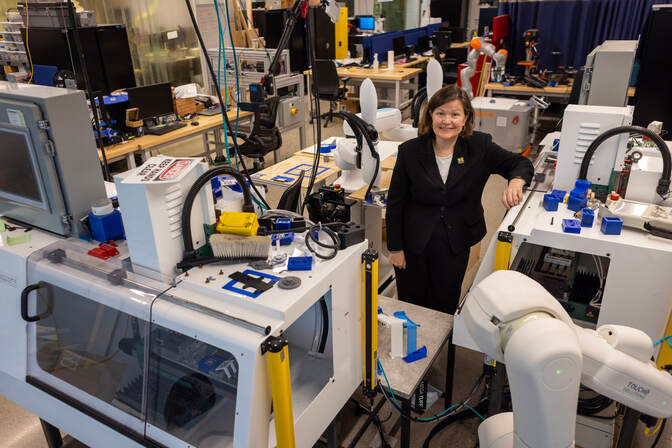
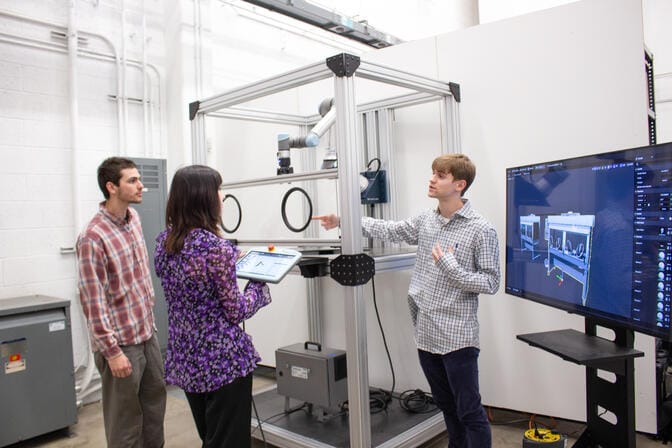
To test out potential solutions and ensure that they operate as intended, U-M offers the SMART 4.0 testbed, featuring a “connected factory” of mobile robots, computer-controlled machines and 3D printers, connected through open process automation. ASU provides its own connected smart manufacturing system that includes robotics, programmable logic controllers, smart sensors and RFID tracking for milling and additive manufacturing.
Tilbury is also the Martha E. Pollack Distinguished University Professor of Robotics, Herrick Professor of Engineering and a professor of mechanical engineering and electrical engineering and computer science. Barton is also a professor of mechanical engineering.
Center for Digital Twins in Manufacturing website.