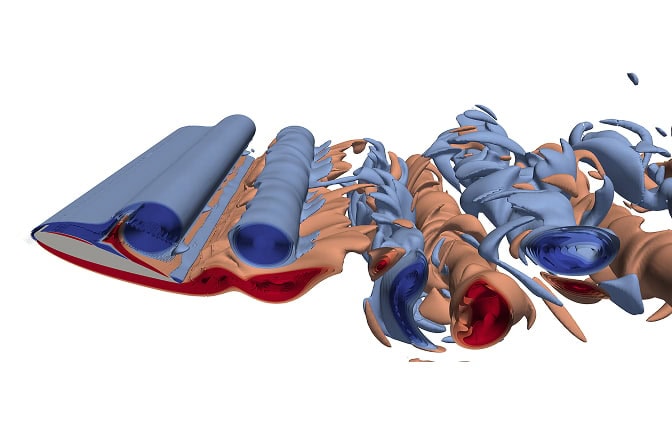
HydroGym trains, assesses AI for actively controlling fluid dynamics
With more than 60 environments, the simulated proving ground aims to speed the development of AI controllers that optimize drag, lift, noise and heat management.

With more than 60 environments, the simulated proving ground aims to speed the development of AI controllers that optimize drag, lift, noise and heat management.

Explore the forefront of AI
at Michigan Engineering
A platform for training and comparing machine learning models for actively reducing drag, improving lift, cutting noise and managing heat has been launched by an international team including researchers at the University of Washington, University of Michigan Engineering, RWTH Aachen University and the Technical University of Munich.
“Fluid flows are central to several trillion-dollar industries, including energy, transportation, health and defense. An improved ability to understand and control these flows could have an immense economic and ecological impact, helping us to enable a better future,” said Steven Brunton, senior co-corresponding author of the study in Nature and the Boeing Professor in AI & Data-Driven Engineering within UW mechanical engineering.
The large number of variables typically makes it impossible to directly calculate fluid behaviors in realistic scenarios. Now, the international team has built a platform focused on solving this problem through reinforcement learning, a form of machine learning that has already revolutionized fields like protein folding and nuclear fusion by training AI agents through interactions with their environments.
By incorporating physics knowledge into the training of AI agents that actively modify fluid flows over surfaces, the new platform reduced the amount of trial-and-error needed to optimize reinforcement learning control strategies by as much as 65%. Called HydroGym, it also compares control strategies on a level playing field, helping identify the best available approaches for solving problems such as improving the efficiency of airplanes and wind turbines, making jet engines quieter and cooling supercomputers.
“I hope this helps move the field from individual demonstrations towards a more systematic and collaborative approach to discovering general principles for controlling complex flows,” said Christian Lagemann, first author of the study and former postdoctoral researcher at UW under Brunton, the HydroGym principal investigator.
“Instead of developing controllers for isolated flow problems with no common framework for comparison, we can now study how control strategies transfer across different geometric shapes and types of flow, or train in inexpensive surrogate environments and test in much more realistic scenarios.”
HydroGym focuses on training and testing active methods for controlling fluid flows, such as shape morphing, tiny flaps or spinning elements, or systems of jets that counter or redirect turbulence. Its development was primarily funded by the U.S. National Science Foundation and the Boeing Co., with additional funding from the University of Michigan and others.
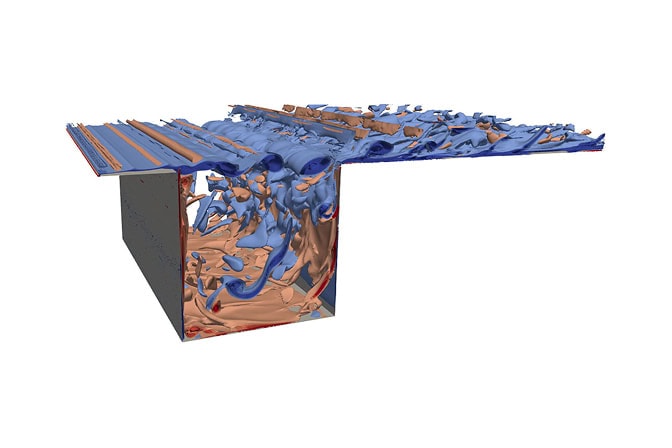
In one demonstration, the team explored how a channel formed of two flat surfaces, peppered with holes like air hockey tables, could keep surface friction to a minimum. They trained a machine learning model to control the air entering and exiting the holes, disrupting the turbulent flows that increase friction while always keeping the incoming and outgoing air in balance.
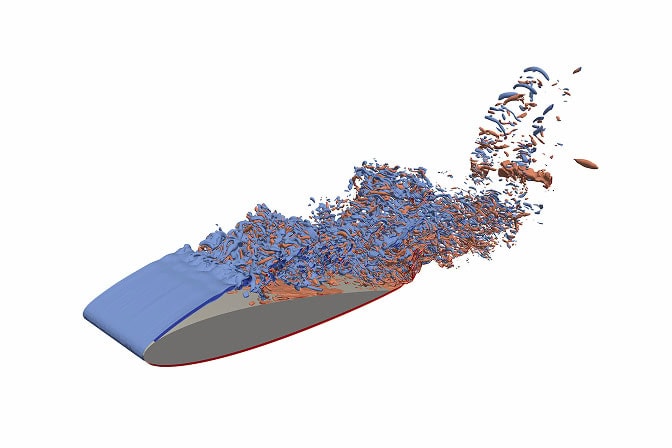
The researchers then applied the controller to a much more complex scenario: a section of a simulated airplane wing. It reduced the surface friction across the wing by 38% and the overall drag by 11%, while training in a simpler scenario was 100 times faster and 10,000 times cheaper than training directly on the wing.
“One of the key findings is zero-shot transfer: in other words, learning in simple geometries to distill the key physics, and deploying the models in very complex geometries with very high control performance,” said Ricardo Vinuesa, co-corresponding author of the study and a U-M associate professor of aerospace engineering.
He served as co-principal investigator of the HydroGym project with Wolfgang Schröder, professor of fluid mechanics at RWTH Aachen, and Nikolaus Adams, professor of aerodynamics and fluid mechanics at TUM.
The ability to apply the model to a new situation without additional training indicates the potential for progress toward a single model of fluid dynamics—one that captures enough physics to apply to different levels of turbulence, on any surface shape, and to liquid and gas flows or even a mixture of the two.
HydroGym is not restricted to models that run as one central “brain.” It can also train and test distributed control systems in which individual controllers manage regions of a surface while coordinating with their neighbors. This is important because on large surfaces, there is too much information for a centralized model to manage. A system of smaller controllers, trained through multi-agent reinforcement learning, takes advantage of the fact that though the flow may differ in time and space, it follows the same rules over the whole surface.
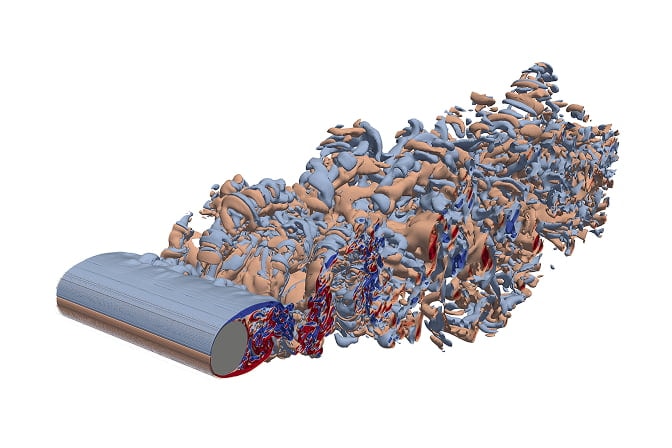
Rather than drawing from historical datasets for model training, HydroGym generates simulated datasets on the fly, enabling users to choose from multiple physics modeling strategies, including lattice Boltzmann, finite-volume, spectral-element and finite-element. Because several of these solvers—including JAX-Fluids—support automatic differentiation, they can be embedded directly into HydroGym’s training loop, opening the door to gradient-based and hybrid optimization strategies alongside standard reinforcement learning.

Explore the forefront of digital engineering
at Michigan Engineering
The team prepared more than 60 testing environments—with various control strategies, surfaces and flows—in which HydroGym users can train their models and compare them against the competition. HydroGym’s code, documentation and full set of environments are freely available on GitHub, and the team is actively growing the platform together with the wider fluid-dynamics community.
The team includes researchers from Inha University, South Korea; KTH Royal Institute of Technology, Sweden; HESAM University, France; Mediatek Research, U.K.; and the German Center for Neurodegenerative Disease.
Adams is also director of the Munich Institute of Integrated Materials, Energy and Process Engineering. Schröder is also dean of mechanical engineering at RWTH Aachen.
Additional funding was provided by the U.S. Army Research Office, the German Research Foundation and the European Research Council.
Brunton introduces HydroGym on YouTube.