Perfectly imperfect: U-M Center for Complex Particle Systems harnesses disorder in nanomaterials
The center has engineered materials with intentionally disordered structures, leading to enhanced properties and easier manufacturing.

The center has engineered materials with intentionally disordered structures, leading to enhanced properties and easier manufacturing.

Michigan Engineering is reinventing U.S. manufacturing for resilience and scale
When designing materials, many scientists focus on perfectly ordered crystals, in which the building blocks are arranged in sequential patterns with uniform spacing. But there can be power in disorder, and one multi-institutional center led by University of Michigan Engineering is beginning to harness nanoscale “imperfections” to create materials with properties rarely, if ever, seen in natural or existing man-made materials.
“Imperfections, big and small, can actually be an advantage, and that might require a change in mindset for how we design and manufacture certain materials,” said Nick Kotov, the Irving Langmuir Distinguished University Professor of Chemical Sciences and Engineering. He is also the director of the Center for Complex Particle Systems, or COMPASS, a National Science Foundation Science and Technology Center.

To help design and build the materials for tomorrow’s technology, COMPASS brings together researchers from 24 universities across 17 countries, 15 companies, and five government labs. Since its launch in 2023, COMPASS has developed a suite of computational tools that allow researchers to engineer a variety of structures that integrate order and disorder from the nanoscale to macroscale, then predict the resulting material properties at the scales in which humans live and work.
COMPASS members have published 59 studies and secured nine patents on nanomaterials designed for high-capacity batteries, ultrastrong and ultralight composites, aviation, and improved dressings for wound healing. Partners from African universities have been using the center’s tools to improve dressings for wound healing, improve soil quality, and design non-toxic lubricants that prevent grain from clogging farm equipment.
The idea that imperfections could be useful in certain materials isn’t entirely new. Engineers sometimes deliberately shift the atoms in solid materials out of neatly arranged lattices and into messier structures, or they will introduce a small amount of impurities, known as “doping.” These modifications are considered defects because they create irregularities in an otherwise perfectly repeating sequence of uniformly spaced atoms.
But as the name suggests, these defects improve performance. Breaking patterns in material structures can improve the strength of steel or the conductivity of a semiconductor, and the combination of different levels of disorder allows many biological materials—such as bones and silk—to be strong yet flexible, something that is hard to achieve in a single ordered material.
“In that sense, imperfections aren’t mistakes; they are an important part of the design. And that fascinates me,” said Kotov. With COMPASS, Kotov is learning how to harness that combination of order and disorder.
“When it comes to combining efficiency and functionality, nature often beats man-made materials, and nature often uses these imperfect structures,” said Kotov. “Is there a way that we can incorporate analogous structures into man-made materials, but also standardize them in some way for manufacturing?”
COMPASS aims to build new materials from scratch and incorporate varying levels of imperfections into the initial design to achieve new properties and make manufacturing more adaptable.
To arrive at such a future, the researchers are working with microscopic building blocks, including virus-sized nanoparticles and nanowires tens or thousands of times thinner than a human hair. Several types of building blocks can be combined into composite materials with unique capabilities that their components alone can’t achieve. Nanoparticle and nanowire structures can also change their arrangements—and by extension their properties—on command.
But control over such building blocks is still indirect. To assemble nanomaterials, engineers can suspend particles in a liquid, then bring them together by evaporating the liquid. In other cases, they spray the liquid onto a flat surface, which is then dried to create a film or coating.
To coax nanoparticles into the desired arrangement, engineers can change how strongly the particles attract or repel each other by modifying the liquid’s chemistry. The approach can be as simple as adding acid or salt, or mixing water and an organic solvent at the right ratio, but it’s often a process of trial and error. A better option would be to design and manufacture particles that create predetermined structures.
“One of the holy grails of nanoscience has been to make designer building blocks out of any material and then dictate exactly how they stick to each other,” said Sharon Glotzer, the John Werner Cahn Distinguished University Professor of Engineering at U-M and a COMPASS member.
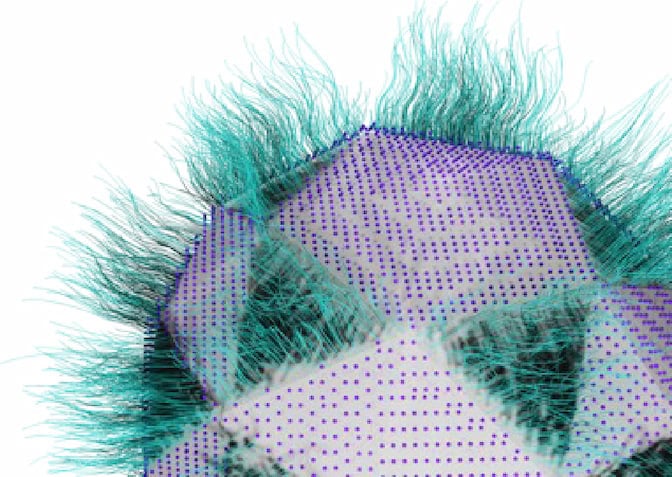
Glotzer’s lab has been improving control over nanomaterial engineering by building computer models that predict nanoparticle assembly, focusing on particle shape and surface properties. With her simulations, other researchers can design and create nanoparticles that combine into a target structure. The collaborative research has resulted in nanoparticles with patches of sticky and flexible molecules that glue together structures unachievable with other methods.
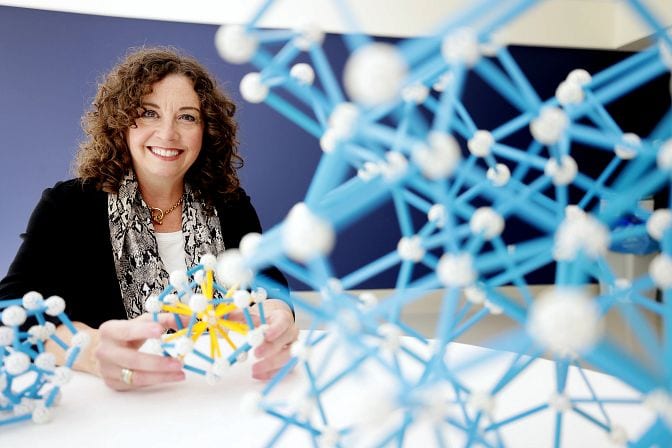
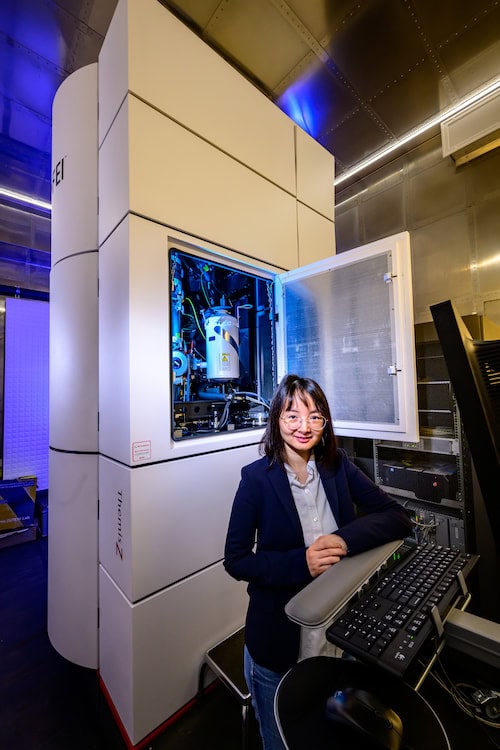
Supported by COMPASS funding, Glotzer has been working with Qian Chen—a COMPASS principal investigator from the University of Illinois Urbana-Champaign—to guide nanoparticle assembly by precisely placing sticky patches on targeted areas of nanoparticles.
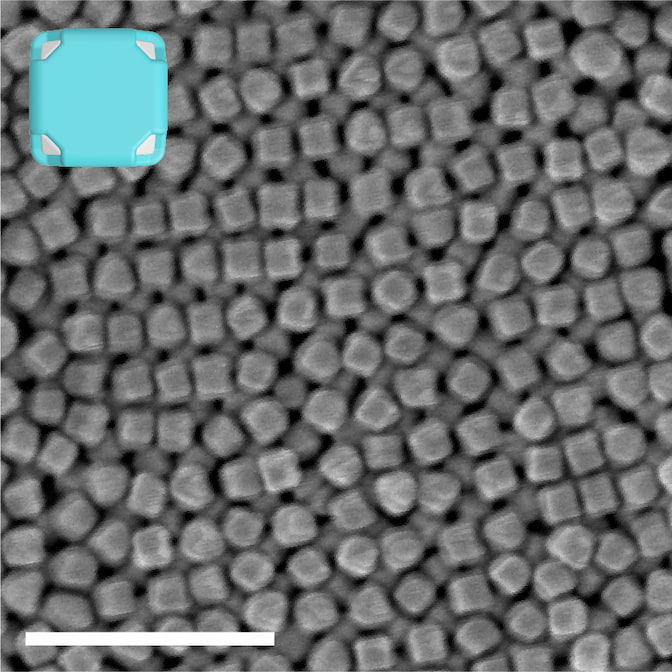
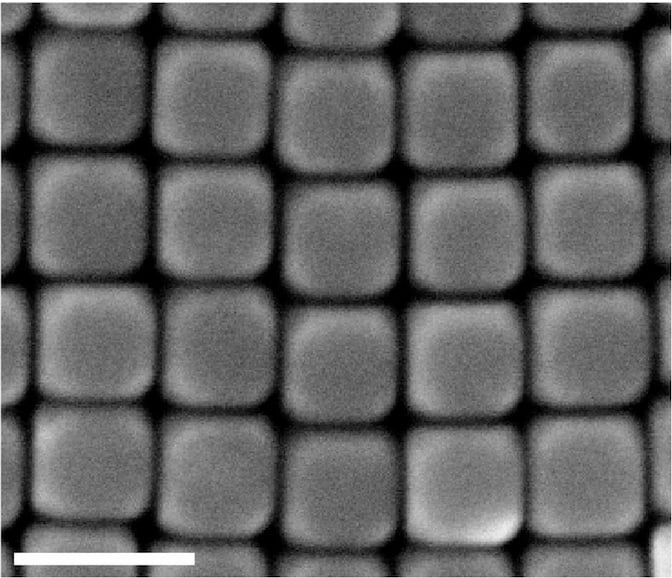
In a 2025 study published in Nature, Glotzer, Chen and their collaborators showed that the sticky molecules caused square nanoparticles to form crystals with more space between particles. In two additional studies that Glotzer and her experimental collaborators published in Science, the researchers showed that the sticky molecules can also stabilize structures that would otherwise quickly fall apart or combine particles that wouldn’t normally fit together.
Shaping nanoscale building blocks can help engineers achieve the structures they want, but how can they determine what structures to build in the first place? Enter Kotov, whose lab has been developing computational tools that allow researchers to incorporate imperfect structures into material design and predict the resulting properties.
The key advance enabling the tools are metrics that describe nanomaterials with chaotic or imperfect structures. Most methods used to calculate material properties are built for perfectly ordered crystals, so they assume that the building blocks are arranged in an infinitely repeating pattern with uniform spacing. When the pattern breaks or the spacing isn’t uniform, the methods work less efficiently, if at all.
COMPASS’s new tools can handle seemingly random arrangements of nanoparticles or nanowires without a supercomputer. To describe arrangements with more randomness, Kotov and his team have turned to graph theory—a discipline already used to understand interactions in large systems, such as ecosystems and social networks.
The graphs are systems of nodes connected by edges. In nanoparticle systems, each node represents a particle. Whenever the particles are close enough to interact, a line is drawn between nodes. The same methods can be used to describe materials made from layers of nanowires. In such cases, edges represent nanowires, and nodes represent points of intersection.
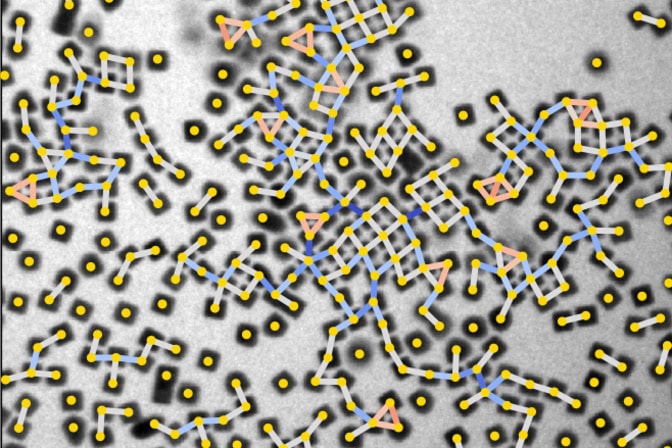
As a whole, the graph shows how the particles orient to one another, which determines the strength of the overall structure, as well as how the structure transports heat and electricity. The collection of nodes and edges can also be condensed into metrics that quantify how interactions between neighboring nanoparticles ripple out through the larger group, as well as how easily the structures could be reconfigured.
“In this way, the graphs represent an almost universal map of a material’s properties, and the same technique can optimize many, or all, material properties at the same time,” said Kotov. “We can accelerate the innovation cycle because our methods provide a shortcut to the best design.”
COMPASS researchers have shown that graph theory can measure the ratio of randomness and order in nanoparticle structures, in a 2026 study in Science. With their metrics, the researchers could find the right balance between order and randomness to cause gold nanoparticle structures to strongly reflect infrared light—something that the same nanoparticles couldn’t do in suspensions and did less efficiently in crystals.
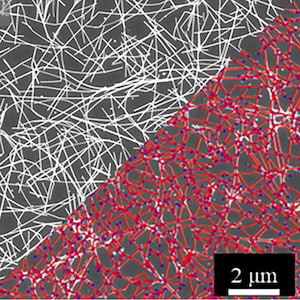
The researchers have also used graph theory to engineer coatings made of nanowires, which are sprayed onto a hard surface to create tangled layers. While the nanowires appear to be randomly arranged, Kotov’s team has shown that nanowire coatings actually have a defined structure that can be described using graph theory measurements of connectivity and clustering. Because those metrics are related to the wires’ shape and composition, engineers could potentially use them to reproducibly manufacture and optimize coatings, Kotov says.
In a demonstration, Kotov’s team used a graph theory measure of long-range connectivity to optimize how well silver nanowires transported electricity from a mock lightning strike. The team is now exploring the coating’s potential to protect drones and other technology from lightning strikes.
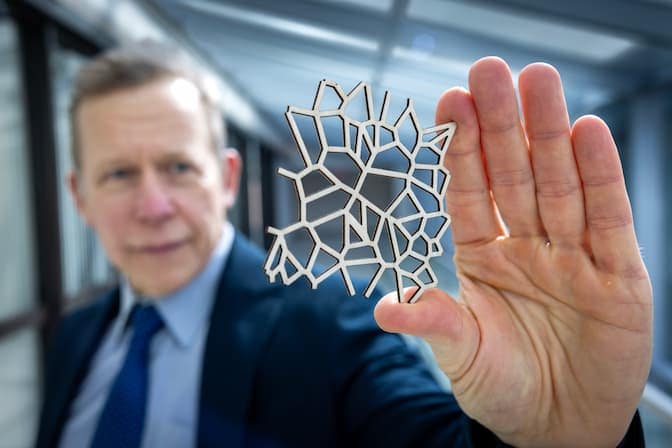
Kotov’s methods can be used to design more than nanomaterials. He and Christopher Soles, a COMPASS partner from the National Institute of Standards, have used them to design strutlattices, which are used to reinforce components of cars, planes and 3D-printed structures. Such lattices are often shaped like honeycombs and other infinitely repeating shapes today. Graph theory allowed Kotov to design a lattice without repeating motifs, improving its resistance to uneven pressure.
“What’s critical about graph theory is that you can adapt the process to many kinds of products,” said Kotov. “It could help us combine some of these designs and eliminate manufacturing bottlenecks.”
In their next chapter, COMPASS researchers plan to leverage their computational framework to design nanomaterials that fulfill a set of requirements and provide several options on how to make them. To accomplish their goal, they will combine graph theory parameters with conventional metrics of a material’s physical properties and geometry. Because there are many different combinations of parameters to choose from, the researchers will also explore how AI can help find the best combination of design parameters for a given application. And the benefits could go both ways.
“Our graph theoretical frameworks can help reduce the huge amount of data needed to train AI,” said Kotov.