Silk made into strong plastic-like materials with 6G potential
The new manufacturing method preserves silk’s crystalline structure and could help upcycle short fibers into telecom equipment.

The new manufacturing method preserves silk’s crystalline structure and could help upcycle short fibers into telecom equipment.
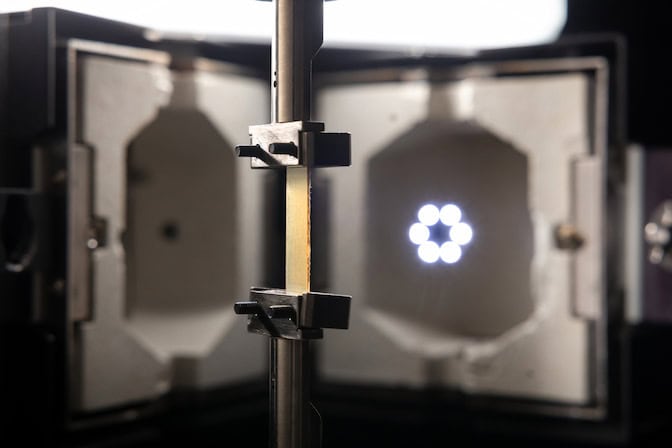
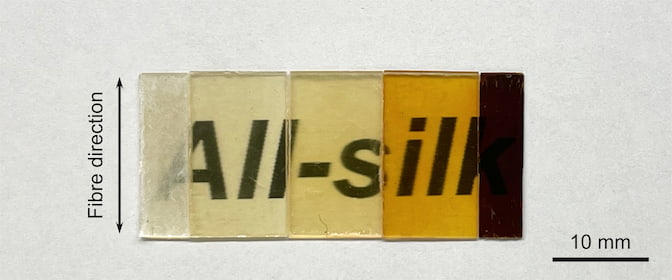
Silk threads can be fused into transparent, plastic-like materials that twist terahertz frequencies of light, according to research led by Imperial College London, University of Michigan Engineering and Tufts University. The findings could enable components of 6G networks to be made from upcycled silk.
The new materials are also lightweight, yet stronger than many metal alloys and conventional plastics produced from fossil fuels. Their mechanical properties could make them useful in sports gear, shipping containers and certain kinds of packaging. In ballistics tests, the new materials were about as puncture-resistant as carbon-fiber-reinforced polymers, which are used in the bodies of airplanes and the chassis of automobiles. And, because the materials slowly degraded when implanted into mice, they could prove useful in temporary medical implants.
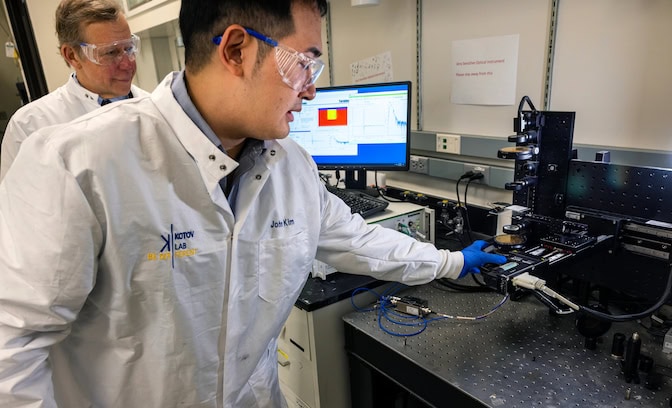
The researchers are particularly interested in the material’s ability to twist, or polarize, terahertz frequencies of light. The 6G band, which could transmit data up to hundreds of times faster than 5G networks and is particularly appealing for rural high-speed internet, extends into terahertz frequencies. Polarization offers another way to encode data, potentially opening up more channels, but achieving the elliptical polarizations seen with the silk material is not usually so straightforward. The team was able to fine-tune the degree of twist by changing the temperature and pressure at which they pressed the silk into the plastic-like material.
“It’s difficult to engineer a material terahertz optical activity that can rotate light while also being nearly transparent,” said Nick Kotov, the Irving Langmuir Distinguished University Professor of Chemical Sciences and Engineering at U-M and a co-corresponding author of the study published in Nature Sustainability. “This composite is unique in that it can do it for the frequencies that are essential for multiple future technologies. Typically, such bioderived materials absorb terahertz light very strongly, so you get very little light out.”
The materials’ properties stem from silk’s chemical structure, which includes alternating regions of order and disorder. The fibers are made of long chains of many different amino acids. In some parts of the chain, the order of amino acids is random and forms an amorphous tangle. In other sections, the amino acids also link up in a repeating pattern, and the chain neatly folds into twisted, crystalline sheets. The combination of crystalline and messy features makes silk tough and flexible.
“It’s surprisingly strong for something so flexible,” said Chunmei Li, a research assistant professor in biomedical engineering at Tufts University and a co-corresponding author of the study. “By processing it, we can go beyond the capabilities of many other biomaterials.”
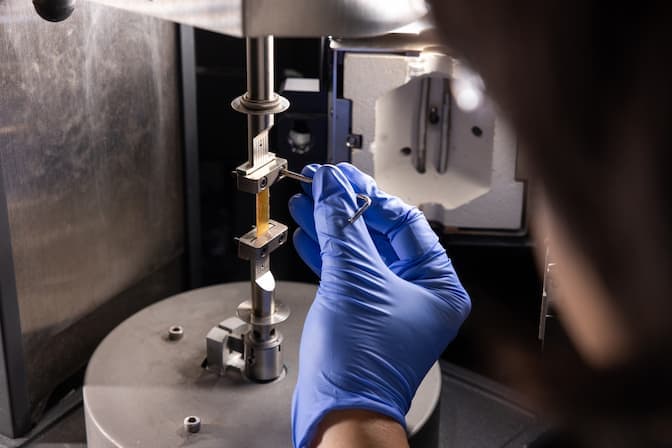
When the fibers are heated between 257 and 419 degrees Fahrenheit and 1900 and 9800 atmospheres of pressure, water evaporates from the silk, and the tangled regions fuse together to create a single sheet without degrading the neat folds inside the fibers.
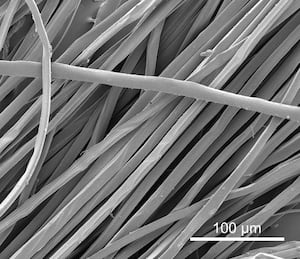
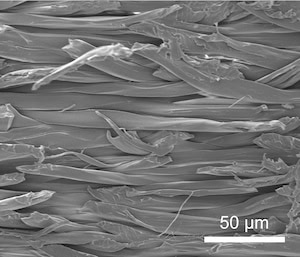
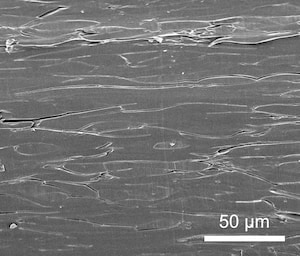
“Silk’s remarkable properties arise from its hierarchical microstructure, where crystalline domains are embedded within a complex multiscale architecture,” said Emiliano Bilotti, an associate professor in multifunctional and sustainable polymer composites at Imperial College London and a lead author of the study. “We wanted to preserve as much of the pristine fibers as possible.”
In contrast, previous efforts to produce plastic-like materials from silk involve dissolving silk in a chemical solvent and then drying it into a powder. While materials produced by heating and pressing the powder are stronger than conventional plastics, much of the crystal structure is lost.
One of the team’s motivations is to reduce waste in the fashion and textile industry.
“If you can retrieve very long threads, you can weave again, but when the fibers get shorter and shorter, there is no other way to recycle them than to dissolve them into a powder,” said Bilotti. “I never believed that was a sustainable solution.”
Instead of requiring large amounts of chemical solvents, salt and water, the only necessary pretreatment for the new method is boiling the silk to remove the natural protein, called sericin, that binds the fibers into threads. Even tiny fibers can be pressed into sheets.
“It can be a very simple, one-step process,” said Li.
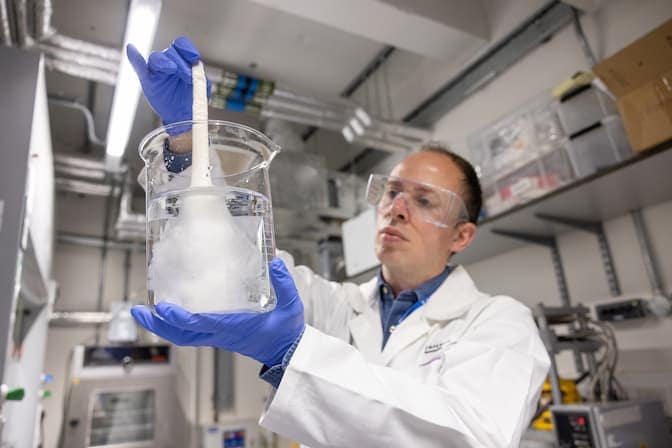
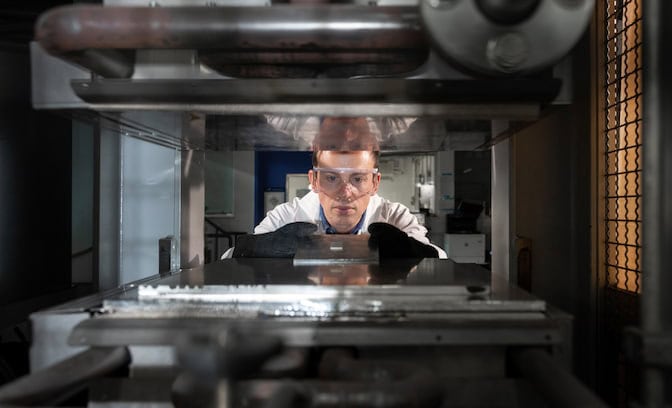
The team is now exploring how to scale their manufacturing process to larger and more complex shapes, alongside lifecycle assessments to quantify the full sustainability benefits. The researchers are also investigating how to incorporate the fused silk into sensors and other applications, and they are seeking industrial and commercial partners to help scale the process and bring the materials to market.
The research was funded by the U-M Center for Complex Particle Systems (COMPASS), a National Science Foundation Science and Technology Center, as well as the Air Force Office of Scientific Research, the Engineering and Physical Sciences Research Council and a Tufts Launchpad Accelerator grant.
Kotov is also the Joseph B. and Florence V. Cejka Professor of Engineering and a professor of macromolecular science and engineering and materials science and engineering.