
A color-changing phosphor for encoding information
Applying heat or a solvent makes a new purely organic phosphor reversibly switch between glowing green and blue at room temperature.

Applying heat or a solvent makes a new purely organic phosphor reversibly switch between glowing green and blue at room temperature.
A new synthetic molecule switches between emitting green and blue light after application of a solvent or mild heat. The color-changing phosphor can be leveraged for a two-layered information encoding platform, according to a study led by University of Michigan Engineering and published in Nature Communications.
“This approach is a clean, controllable way to make light ‘talk,’ which opens the door to things like secure data storage or even displays that can change color on demand,” said Jung-Moo Heo, U-M postdoctoral research fellow of materials science and engineering and lead author of the study.
Phosphors are the chemicals that make glow-in-the-dark toys work. They absorb energy from a light source and then slowly release that energy as visible light. Most phosphors rely on expensive heavy metals like iridium or platinum. Instead, the newly designed molecule, called BrGlu, is entirely organic which reduces cost, toxicity and complexity.
When it first forms, BrGlu glows green after light exposure. The crystals glow blue after treatment with chloroform, a weakly acidic solvent. Heating the blue crystals to about 60 C (140 F) causes them to glow green again.
To understand how this color shift happens, the research team performed experiments and quantum chemical calculations—a computational method used to understand a molecule’s physical and electronic structure. They found the rotation of a single bond drove the color change.
“I was surprised by how small structural changes—just a slight twist in a molecule or shift in packing—could completely alter the color and lifetime of phosphorescence,” said Heo. “It showed us that even subtle molecular motions can have a huge impact on light emission at the macroscopic scale.”
The rotation centers around a bromine—carbonyl bond. A carbonyl is a carbon atom connected to two oxygen atoms. When the bromine and carbonyl groups are on the opposite sides of the central bond, called an anti conformation, the crystal glows green. When the bromine and carbonyl group shifts to be on the same side of the central bond, called a syn conformation, the crystal glows blue.
The structure of the syn conformation raises the molecule’s excited-state energy. The higher energy causes the phosphor to glow blue, a higher-energy color on the electromagnetic spectrum.
The research team demonstrated how this molecule could be used for a hidden-object or a time-lock puzzle. In the hidden-object experiment, a misleading digital display reads “8888” in blue under a UV light. The lines in the display are made of a mix of fluorescent blue dye and BrGlu glowing blue. Applying heat makes the BrGlu lines temporarily disappear, and then reappear as green lines.
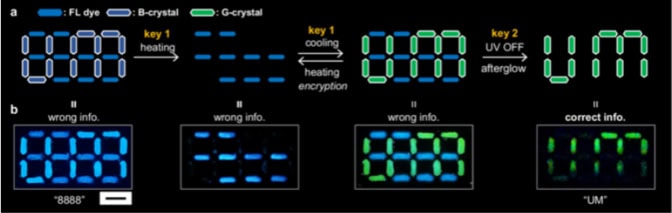
Then, turning off the UV light makes the fluorescent distractor disappear, revealing the hidden message, “UM.” After about one second, the message will disappear as the phosphorescence expels all the energy it absorbed, and the message can then be reset to be encoded again.
In a more complex demonstration, a six-by-six grid of BrGlu glows phosphorescent green with each pixel representing a bit of data—0 for green and 1 for blue. A key denotes which of three solvents—carbon tetrachloride (CCl4), deuterated chloroform (CDCl3) or chloroform (CHCl3)—to deposit in each square.
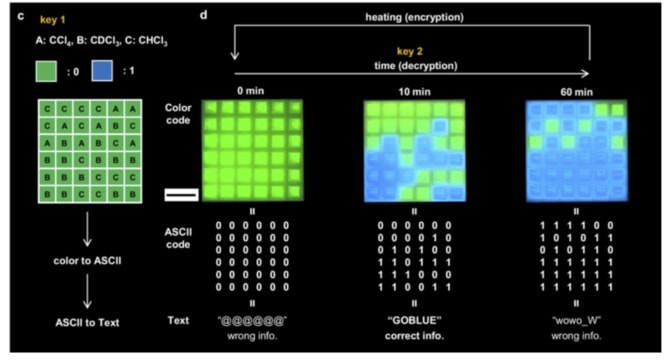
After exactly 10 minutes, the pixels from one solvent (CDCl3) have turned blue while the others have not. Using ASCII, a character-encoding standard, to convert the binary code to letters reveals a hidden message, “GOBLUE.” The message disappears after the 10 minutes have passed as all pixels eventually turn blue. Applying heat then resets the grid back to green.
“This concept can be extended to anti-counterfeiting and authentication systems where color-encoded phosphorescent signals provide unique, tamper-resistant identifiers,” said Jinsang Kim, U-M professor of materials science and engineering and co-corresponding author of the study published in Nature Communications.