Organic glass scintillators: A Q&A with Sara Pozzi
The radiation detection material stands to improve nuclear security by clearly distinguishing radiation types from a safe distance.

The radiation detection material stands to improve nuclear security by clearly distinguishing radiation types from a safe distance.

Advancing nuclear energy
from discovery to deployment
As the demand for nuclear security solutions grows, distinguishing a benign medical isotope from a potential threat is critical. Organic glass scintillators can help meet the need for accurate, cost-effective radiation detectors.
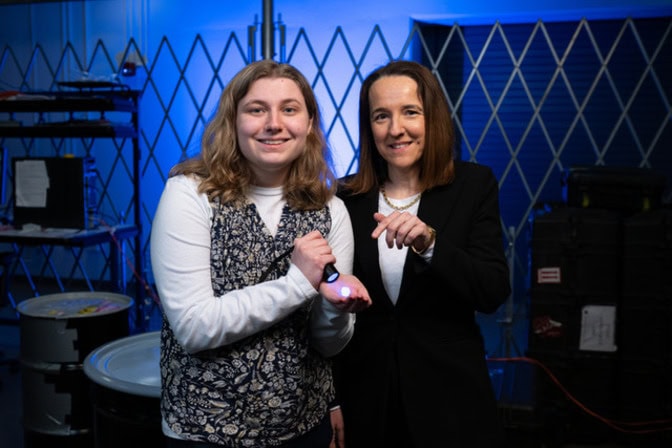
In the past, nuclear security teams have faced trade-offs between the durability, accuracy and cost of radiation detection materials. Sara Pozzi, the Donald C. Graham Professor of Engineering at the University of Michigan Engineering, works with her research group to develop next-generation radiation detection systems that eliminate some of these trade-offs.
The U-M team, along with a collaborator at Sandia National Laboratories, synthesized recent findings in a paper published in Radiation Measurements. Below, Pozzi shares her knowledge on the advantages, drawbacks and applications of organic glass scintillators.
If a suspicious package is intercepted at a port or border, a nuclear security team needs to be able to characterize the potential radioactive contents without opening the container or doing any destructive analysis.
It’s important to be able to use a radiation detector a safe distance from the source and reliably distinguish whether it is a fission material, like uranium or plutonium, or some other radioactive material that may be used for industry or medicine.
Scintillators are the materials within a detector that light up in response to radiation. Their properties influence pulse-shape discrimination, meaning how accurately it can tell between neutrons, indicating a fission material, and gamma-rays, indicating a medical or industrial material.

Cost is a major draw to organic glass scintillators. As the nuclear security field expands, there’s a demand for accurate, low-cost scintillators so that more detectors can be deployed.
Beyond cost, solid scintillators are preferred for field applications because liquid scintillators can leak from the device if it’s damaged. Of the two solid options, organic glass scintillators offer better pulse-shape discrimination than plastics.
Organic glass scintillators are also easy to work with in the lab using standard melt-cast methods. Our students cast the material into molds. We then put it in a controlled oven to cool back to a solid overnight. After taking the material out of the mold, just a few steps turn it into a detector.
A cool thing about organic glass scintillators is that if you drop it or it cracks for some reason, you can cast it again. This is much more difficult to do with plastics that need higher temperatures to reform.
For the imaging application we discuss in the paper, we casted organic glass scintillator bars that are about 5 centimeters tall. Several of these bars are arranged in a row within a handheld detector. There is no real limit to the size of an organic glass scintillator. You can change your mold to cast different sizes as needed.
If a moderator has been placed around uranium or plutonium in an attempt to hide the signal, the material still gives off thermal neutrons. Adding boron to an organic glass scintillator enables thermal neutron detection to uncover obstructed radioactive materials.
A student of mine is currently working on a thesis on tin-loaded organic glasses. The heavier tin atom improves gamma sensitivity, helping detectors parse different sources of gamma rays.
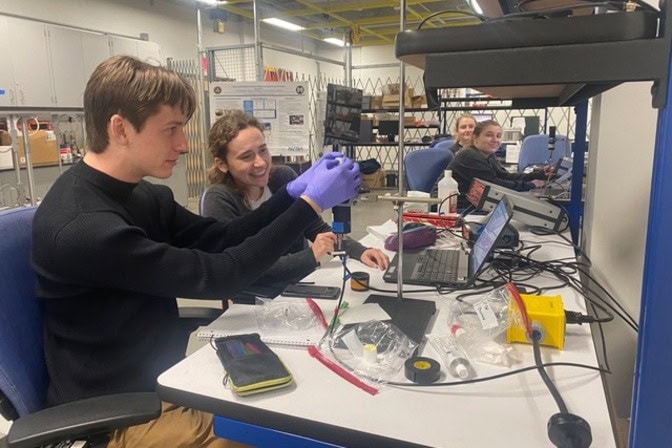
Coincidence timing resolution has to do with the accuracy of neutron energy reconstruction. It’s measured by the time it takes for a particle to move from one detector bar to the next. If we can get really accurate information about how long that travel takes, we can accurately reconstruct the energy of the neutron.
The hope is that the pulse-shape discrimination of organic glass scintillators will continue to improve. As this is a newer material, we also don’t yet know how it will hold up over time. We are simulating aging by putting organic glass scintillators through heat treatments, but we will also monitor how they age naturally.
The ultimate goal is large-scale deployment of organic glass scintillators, but in the meantime, robust prototyping and field testing will pave the way forward.
This research was supported in part by the Department of Energy National Nuclear Security Administration (DE-NA0003920).
Pozzi notes that this project was made possible by collaborations with Sandia National Laboratories, Lawrence Livermore National Laboratory and Radiation Monitoring Devices, Inc.