Bolstering research on “matter by design”: U-M chemical engineering welcomes new researchers
Their work in material design and computational engineering has enabled more effective antibody medicines and smart windows for more energy-efficient buildings.
By combining various microscopic building blocks, engineers are able to create materials with properties impossible to achieve with more conventional methods—including windows that let in light without heat and antibody medicines that don’t clump together at high doses.
Two new faculty bring more of that nanomaterials expertise to Michigan: Delia Milliron, the new Anthony C. Lembke Department Chair of Chemical Engineering and the James and Judith Street Professor of Chemical Engineering, and Thomas Truskett, the Vennema Professor of Chemical Engineering.
Their research complements the department’s strong focus on manufacturing composite materials with particles the size of bacteria and viruses—resulting in matter that can be designed to have different properties depending on the conditions. For example, Michigan Engineers have created badges composed of programmable magnetic pixels that can display images when exposed to a magnetic key. Others in the department have co-developed methods to design nanoparticles that self-assemble into complex structures beyond the reach of conventional methods.
“It’s going to be a really awesome research environment for me,” said Milliron. “U-M has absolutely leading-edge research in each of the disciplines that I focus on.”
Milliron specializes in making materials with unique optical and electronic properties that could help address society’s energy challenges. She has made glass for smart windows that can dim visible light while still allowing warming, infrared radiation to pass through, and vice versa.
“In the summer, you might want to block out the heat, but you still want the daylight,” said Milliron. “In the winter, there might be too much glare, but you want as much heat as you can get.”
Milliron’s lab makes the windows by combining nanocrystals made of several different metal oxides—each of which controls a different portion of sunlight. Her lab determines the amount and types of light that pass through the window by precisely mixing the nanocrystals. The window’s transparency is modified on command by applying an electric current and changing the voltage, which activates the nanocrystals. A smart window might block longer infrared wavelengths at a lower voltage, then shorter visible wavelengths when a higher voltage is applied.
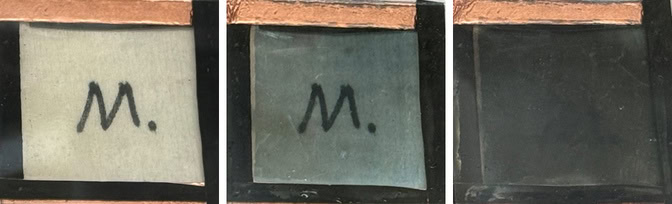
Milliron’s composite glass is transparent when a positive voltage is applied (left). A message written on an underlying piece of paper is visible. The glass becomes tinted and blocks heat (center), then opaque (right) as the voltage becomes negative. PHOTO: Wu Zhang, University of Michigan.
Linking the glass to a thermostat-like system could allow homeowners to change the transparency of their windows to different types of light as the seasons and weather change, reducing their energy use between 5% and 10%, Milliron says. The efficiency gain could have big impacts on climate if applied at scale. In the United States, heating and cooling account for 48% of the total energy used by residential homes and 44% of the total energy used by commercial buildings. Lighting accounts for another 15-20% of building electricity use in the U.S.
Commercializing the windows has been difficult because the glass and electronic components can’t easily integrate into a product with highly customized sizing and proven durability. But while Milliron’s first start-up for commercializing smart windows has closed, she doesn’t sweat it.
“We don’t filter our science by what will be a viable, large-scale technology,” said Milliron. “I think it’s a mistake to avoid learning about something because you can’t immediately see the path for how it’s going to become a business or product.”
Milliron’s desire to learn why composite materials do what they do often connects her with theorists and modelers. Truskett has been a regular collaborator—his lab has made numerical models and computer simulations to uncover the physics that underpin the optical properties of Milliron’s nanocrystal-based materials. By modeling how light interacts with nanoparticles with different spatial arrangements, Truskett can predict the optical properties of nanomaterials before they are made.
“The models and simulations allow us to interpret experimental results in ways that people couldn’t before, and also to guide experimental material design,” said Truskett. “We can now look at inverse problems where someone tells me the optical property they want, and I can try to find a composite material with that property.”
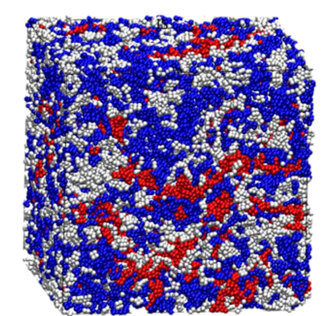
Truskett’s computer simulations show how individual antibody molecules (white) combine into groups of ten or fewer molecules (blue), as well as bigger clusters (red). Clumping antibodies can make medicines too thick to be administered with an IV or syringe. ILLUSTRATION: Thomas Truskett, University of Michigan.
Stemming from his simulations on nanocrystal composites, he and Milliron are developing transparent coatings that could help solar panels stay cooler in the sun. When solar panels get too hot, their power output falls. Heat has a harder time escaping after the solar panel has already warmed the air around it, but the new coating could cause the panels to emit only infrared radiation that isn’t absorbed by air, sending the heat away from the solar farm.
Truskett also works on the medical side of chemical engineering. He develops simulations that predict how antibodies stick to each other and form viscous liquids or gels, which can prevent new medicines for cancer, autoimmune disease and infections from being manufactured or administered via an IV or syringe. Truskett has helped pharmaceutical companies predict when new therapeutic antibodies might become too viscous to flow at target doses, and find ways to prevent gel formation.
“A lot of the predictions relate to the amount of order or disorder present in the glasses or gels,” Truskett said. “So many of the lessons that we learn in one area help us get new insights in the other.”
Studies in mice suggest a new vaccine, made using baker’s yeast, could work with fewer booster shots and without predicting the dominant flu strains each season.