A new rulebook for designing stable dilute alloy catalysts
Selecting strongly binding adsorbates or alloying metals that do not mix keeps the emerging material class stable under high temperatures.

Selecting strongly binding adsorbates or alloying metals that do not mix keeps the emerging material class stable under high temperatures.
Dilute alloy catalysts could improve fuel, plastic and pharmaceutical production, but their instability under heat holds back widespread use. Researchers at University of Michigan Engineering built a stability rulebook for this class of materials that are made of a tiny amount of an active dopant metal dispersed in an inert host metal.
A study that outlines the rulebook is published in the Journal of the American Chemical Society. This research was funded by the U.S. Department of Energy and the National Science Foundation.
Dilute alloy catalysts could help industrial chemical reactions use less precious metals, extend catalyst lifetime and reduce unwanted byproducts.
For conventional single-metal catalysts, strengthening bonds for one reaction step interferes with bonds in the next step, slowing the reaction. Dilute alloy catalysts can break this constraint, known as linear scaling relationships, by distributing the reaction steps onto different active sites.
The active dopant atoms—making up about 1% or less of the metal content—help initiate the reaction by activating the reactants. The resulting intermediate products then spillover to the host metal and the reaction continues there.
While highly active and selective, surface dopant atoms are prone to dissolving into the interior of the host metal under high temperatures, deactivating the catalyst.
“Industrial application of dilute alloy catalysts requires both good activity and good stability. While other works have mostly focused on the activity part, we tackle the stability aspect by identifying the variables that govern catalyst stability,” said Suljo Linic, the Martin Lewis Perl Collegiate Professor of Chemical Engineering and corresponding author of the study.
The research team began their investigation by synthesizing a dilute alloy catalyst made of approximately 18-nanometer-wide gold nanoparticles dotted with platinum atoms. They tested the alloy under two different reactions—ethylene hydrogenation, used in plastics manufacturing, and carbon monoxide oxidation, used in car emission control.
Each reaction was operated under temperatures ranging from 50 C to 250 C while a spectroscopy technique tracked surface platinum atoms in real time. During ethylene hydrogenation, the reaction rate sharply dropped off when temperatures rose past 100 C but continued to increase with temperature during carbon monoxide oxidation.
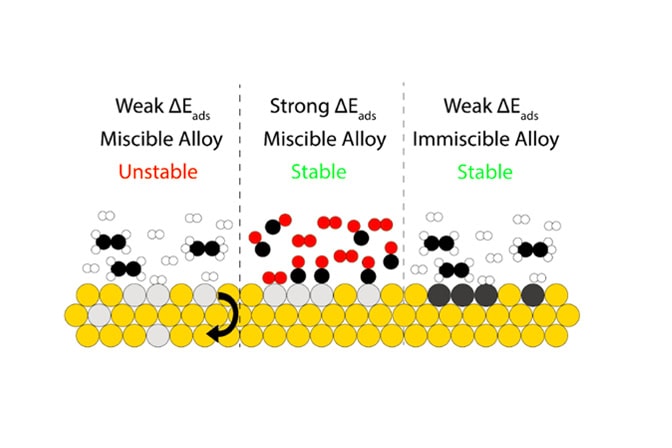
This suggested that adsorbates—molecules that stick to a solid surface—that bind more strongly to active dopant metals would improve stability. Weak-binding ethylene could not hold platinum to its surface, allowing entropy to drive platinum atoms inside the gold particle. Carbon monoxide instead firmly pinned platinum in place, overriding the tendency to sink into the gold.
“This is somewhat like fishing. A fish on the line wants to go deep into the water, and you need a strong grip to pull the fish to the surface. Here, you need a strongly binding adsorbate to hold the dopant metal at the alloy surface,” said Bill Yan, a doctoral student of chemical engineering at U-M and lead author of the study.
Follow-up atomic simulations tested how reactions would change with other combinations of host metals (gold, silver and copper) and dopant metals (iridium, palladium, platinum).
Calculations showed that alloying metal mixing behavior—called miscibility—controls whether the surface dopant dissolves into the host metal. Metals like platinum or palladium favor mixing, causing a tendency to deactivate the catalyst, while iridium resists it, staying active on the host metal’s surface.
To validate the simulation, the research team synthesized gold-iridium dilute alloy catalysts. Experiments using a gold-iridium dilute alloy catalyst backed up the calculations, with zero deactivation up to 250 C for both ethylene hydrogenation and carbon monoxide oxidation.
Together, the results provide researchers with practical rules for selecting the best metal combination and operating conditions to stabilize dilute alloy catalysts.
“Our proposed strategies for enhancing stability can be readily applied to most current dilute alloy systems,” said Linic.
The catalysts were studied at the Michigan Center for Materials Characterization which is operated and maintained with support from indirect cost allocations in federal grants.
This research was supported by the U.S. Department of Energy, Office of Science, Office of Basic Energy Sciences (DE-SC0021008) and the National Science Foundation (CHE-2349887).