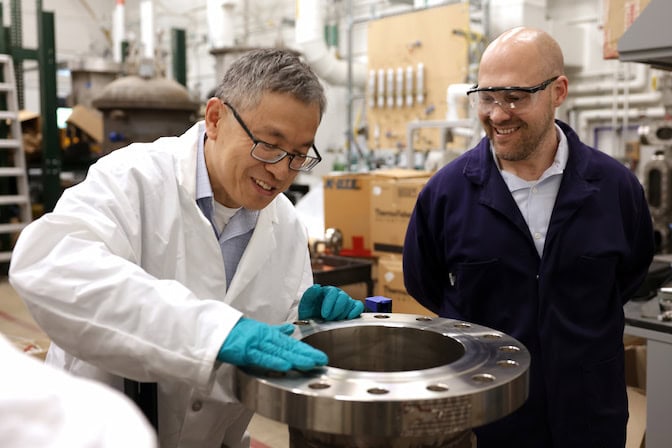
Molten salt reactors: A new testing facility improves pump shaft seals
A rare, long-duration experiment tested a circumferential graphite bushing seal under conditions representing a molten salt reactor for 2,300 hours.

A rare, long-duration experiment tested a circumferential graphite bushing seal under conditions representing a molten salt reactor for 2,300 hours.
Key takeaways

Advancing nuclear energy
from discovery to deployment
Molten salt nuclear reactors may potentially generate energy more efficiently than conventional water-cooled reactors while producing less waste, but the reactors must safely contain the salt’s hazardous byproducts. Experiments on a commercially available shaft seal under molten salt reactor conditions at University of Michigan Engineering showed that, after a 10-day wear-in period, the seal operated successfully for 2,300 hours with minimal corrosion or degradation.
“Reliable pump and seal performance is essential for the safe and practical deployment of molten salt reactor technologies. This study provides valuable experimental data under realistic operating conditions and helps close an important knowledge gap for future reactor design,” said Xiaodong Sun, a professor of nuclear engineering and radiological sciences at U-M and corresponding author of the study, published in Progress in Nuclear Energy and funded by the U.S. Department of Energy.
The researchers performed the experiment in a custom-built Shaft Seal Test Facility. They found that radial clearance, the distance between the shaft and the circumferential seal, was the largest driver of shaft seal performance while speed and temperature had a minimal impact. Argon performed the best among the protective cover gases tested.
“These results help turn an under-studied pump component into a measurable engineering problem and provide guidance for future seal design, optimization and scale-up for molten salt reactors and other advanced energy systems,” said Shuai Che, a doctoral graduate of nuclear engineering and radiological sciences at U-M and lead author of the study.
Molten salt reactors use coolant or fuel salts similar to the kitchen variety (NaCl) and a type found in toothpaste (NaF). The salt is heated until it melts into a high temperature liquid, referred to as molten salt. Because molten salts typically have such high boiling points, such as 1,413 C for NaCl or 1,704 C for NaF, these Generation IV reactors can operate at higher temperatures and at much lower pressures than conventional light water reactors. This avoids the risk of pressure-driven accidents while improving thermal efficiency when converting heat into electricity.
Molten salts can be highly corrosive and produce radioactive and toxic gases—including lethal hydrogen fluoride—depending on the application. To reduce this risk, molten salt reactors continuously inject an inert gas into the reactor in the space above the molten salt. The inert gas, called a cover gas or a blanket gas, displaces oxygen and moisture while sweeping out hazardous gases to a treatment system.
The research team focused on measuring the performance of the shaft seal, which surrounds the rotating shaft, and selecting the best cover gas. The shaft seal is the key component keeping highly corrosive salt vapors and radioactive gases safely contained inside the reactor.
To create conditions representative of a molten salt reactor, the researchers built an apparatus named the Shaft Seal Test Facility. It consisted of two tanks made of a highly durable stainless steel connected by pipes.
A bottom, secondary tank acts as a storage location for the FLiNaK salt—a mixture of lithium fluoride, sodium fluoride and potassium fluoride salts—which closely mimics radioactive core salts. Differential pressure transfers salt up into the main tank where experiments are conducted.
A long shaft goes through a seal chamber and connects to an electric motor positioned on top of the primary tank. A commercially-available circumferential graphite bushing seal encircles the shaft, keeping vapors inside while allowing it to rotate. Experiments tested seal performance when exposed to FLiNaK salt vapor and different cover gas mixtures while operating at elevated temperatures up to 550 C and shaft speeds up to 1,500 RPM.
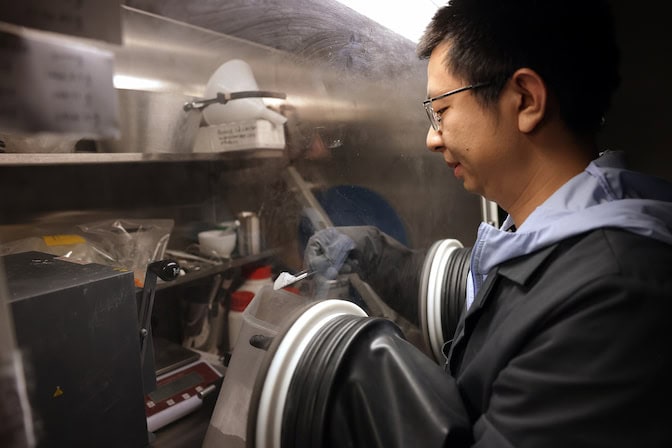
The Shaft Seal Test Facility successfully operated for approximately 2,300 hours with 32 kg of FLiNaK salt, with a post-test inspection showing no significant corrosion or seal degradation.
Experiments showed that the seal went through a wear-in period during the first 10 days, where friction between the spinning shaft and seal created a tiny gap between them, which shifted the internal pressure. After this phase, the seal reached a more stable operating condition.
Shaft speed and temperature had limited effects on seal performance, while cover gas type played a more important role. Argon outperformed nitrogen and helium, maintaining a higher tank pressure at the same gas flow rate.
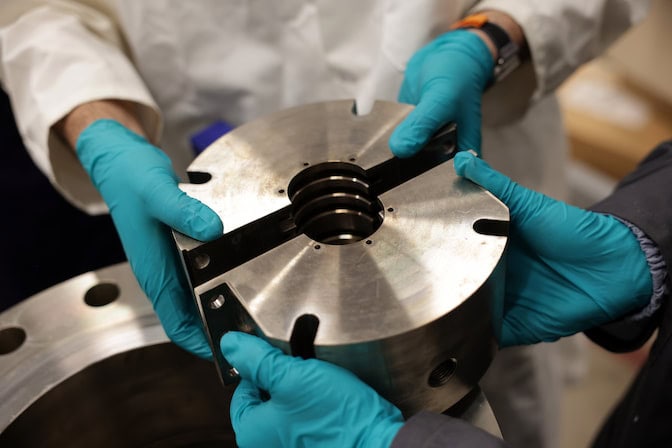
Long-duration molten salt experiments at this scale remain rare, especially in academic laboratories. Many studies use small salt inventories or short test campaigns.
“The success of the Shaft Seal Testing Facility shows that focused academic teams can address practical engineering barriers that are critical to the development of molten salt reactors and other high-temperature molten salt technologies,” said Adam Burak, an associate research scientist of nuclear engineering and radiological sciences at U-M and co-author of the study.
Study results can guide future shaft seal improvements for advanced reactors, like a molten salt cooled reactor under construction in Oak Ridge, Tenn. in April 2026.
“This work demonstrates how focused, long-duration experiments can provide the engineering data needed to advance molten salt reactor technologies. By better understanding the performance of key components such as shaft seals, universities can support safer, more reliable designs for future advanced reactors,” said Sun.
Muyue Li of the University of Michigan Engineering and Minghui Chen of the University of New Mexico also contributed to the study.
This research was supported by the U.S. Department of Energy Office of Nuclear Energy’s Nuclear Energy University Program (DE-NE0008977).