Fine-tuning nanoscale heat flows in molecular materials
Researchers demonstrate how swapping out a single atom can cut the thermal conductance in half without changing electrical properties.

Researchers demonstrate how swapping out a single atom can cut the thermal conductance in half without changing electrical properties.
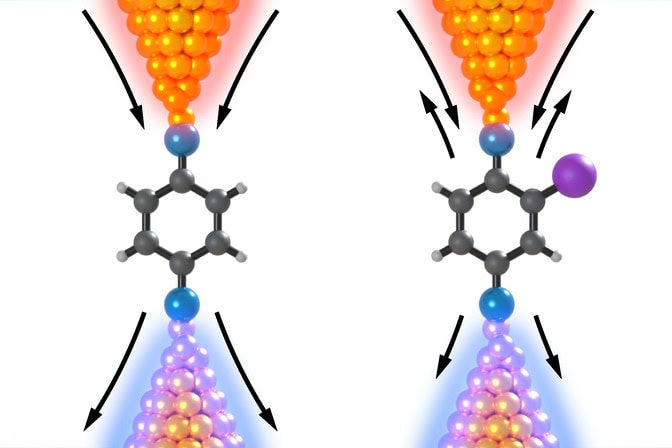
Swapping a single atom can fine-tune the thermal conductance of single-molecule junctions without affecting their electrical conductance, according to a study led by University of Michigan Engineering with collaborators at the University of Augsburg published in Nature Materials.
To study heat flow through single molecules, the researchers trapped a small organic molecule between two gold electrodes and systematically replaced one hydrogen atom with progressively heavier halogens: fluorine, chlorine, bromine and iodine. Each swap to a heavier atom resulted in further reduction of heat transport through the junction, which cuts heat flow in half upon iodine substitution.
“This is a powerful demonstration that heat flow can be controlled with atomic precision—a capability that could transform how we design thermoelectric devices and molecular materials for thermal management,” said Pramod Reddy, a professor of mechanical engineering and materials science and engineering at U-M and co-corresponding author of the study.
This research was funded by the Department of Energy, Office of Naval Research and the Army Research Office.
Heat transport at the nanoscale departs from the predictions of classical physics. As modern devices feature nanometer-sized dimensions, understanding nanoscale heat flow is increasingly critical for thermal management of electronics and engineering novel energy conversion and solid-state cooling devices.
Currently, researchers lack a fundamental understanding of how heat transfer can be tuned on the atomic level. To overcome this barrier, the research team trapped individual molecules to measure both thermal and charge transport at the smallest possible scale.
As a first step in their experimental process, the research team integrated a niobium nitride thermometer into a calorimetric probe. Niobium nitride’s electrical resistance changes more significantly with temperature than platinum, used in previous thermometers, which enables detection of temperature changes within a few millionths of a degree.
The research team then attached a single-crystal gold wire to the tip of the probe, and sharpened it down to a 10-nanometer tip radius using a focused ion beam. The tip is designed to trap individual molecules between two electrodes, allowing simultaneous electrical and thermal transport measurement.
Crucially, the calorimetric probe integrated with the nanometer-radius tip reduced the thermal background—essentially external heat “noise”—to below 1 picowatt per kelvin (pW/K). This is well beneath the experimental uncertainty needed to measure the heat flow of a single-molecule junction, which is about 10-20 pW/K. Probes used in all previous studies buried the signal in noise with a thermal background of 100 pW/K or more, the researchers said.
“Our calorimetric scanning probes, developed at the Lurie Nanofabrication Facility, achieve picowatt resolution at cryogenic temperatures—nearly ten times better than previous approaches. This level of sensitivity not only made the current findings possible but opened an entirely new experimental window into thermal transport at the atomic and molecular scale,” said Edgar Meyhofer, a professor of mechanical engineering at U-M and co-corresponding author of the study.
Within a cryostat, the researchers brought the sharp gold tip of the calorimetric probe into contact with a gold substrate coated with benzenediamine, or pBDA for short. Slowly pulling the tip away breaks the connection between the gold tip and substrate and traps individual pBDA molecules between them. Once the single-molecule junction was formed, the electrical and thermal conductance was measured simultaneously.
The researchers then repeated this process with a series of pBDA-derived molecules where one hydrogen atom was replaced with a halogen atom of increasing mass: fluorine, chlorine, bromine and iodine. A clear trend was observed where each substitution to a heavier atom cut the thermal conductance of the molecule more, allowing less heat to get through, which was reduced by up to half upon iodine substitution.
“As we move from fluorine to iodine, the thermal conductance drops systematically while the electrical conductance remains unchanged. That clarity in the data gave us real confidence that we are seeing a genuine single-atom effect on phonon transport, and it validated the years of effort we put into pushing the limits of our measurement platform,” said Yuxuan Luan, a postdoctoral fellow of mechanical engineering at U-M and lead author of the study.
Detailed first-principles computations, performed by research collaborators at the University of Augsburg, showed that heavier atoms disrupt how thermal phonons move through the molecule. This works similarly to an out-of-tune violin creating dissonance in an orchestra and blocking vibrational flow.
The ability to fine-tune heat flow through single-molecule junctions can help researchers develop individual molecules as circuit components for nanoelectronics. Beyond single molecules, these insights can be harnessed to tailor thermal properties of next-generation molecular materials like covalent organic frameworks (COFs) and metal-organic frameworks (MOFs). These synthetic molecules are being explored for gas storage, catalysis and ultra-low dielectric layers in electronics.
Equally important are the experimental advances themselves, which open the door to systematically exploring heat transport through single-atom wires, polymer chains, 2D materials and quantum devices at cryogenic temperatures. All of these are becoming increasingly relevant as quantum computing technologies demand precise thermal control at the nanoscale.
This research was funded by the Department of Energy (Basic Energy Sciences award number DE-SC0004871), the Office of Naval Research (award number N00014-24-1-2132) and the Army Research Office (award number W911NF2310260).
The device was built in the Lurie Nanofabrication Facility and studied at the Michigan Center for Materials Characterization, both of which are operated and maintained with support from indirect cost allocations in federal grants.