OLED lighting: Corrugated panel design extends longevity and efficiency
The new design uses microscale ridges to pack more OLED into a given lighting panel area and lasts 2.7 times as long, with 40% higher efficiency, compared to conventional devices.
Professor of Electrical and Computer Engineering and Physics
The organic light emitting diodes—known widely as OLEDs—that create vibrant smartphone displays could illuminate rooms, but current designs burn out too quickly at the high brightness needed for room lighting. A new approach overcomes this tradeoff by building OLEDs on a corrugated surface, packing more emitting material into a given lighting panel area to produce the same amount of light while operating the OLED itself at lower brightness.
This corrugated panel strategy increased device lifespan by a factor of 2.7 compared to flat panels operated at the same current, according to a study led by the University of Michigan in collaboration with OLEDWorks and The Pennsylvania State University and funded by the U.S. Department of Energy.
“While the problems we solved along the way were daunting, in the end the new device performed tremendously better than predecessors. It’s rewarding to see our ideas point towards a valid path to improve the efficiency and lifetime of OLED lighting,” said Max Shtein, a professor of materials science and engineering and chemical engineering at U-M and co-corresponding author of the study published in Nature Communications.
Moving from 2D to 3D OLEDs
Indoor lighting has steadily increased the use of LEDs, made with inorganic materials like gallium nitride, because they are more efficient and longer lasting than incandescent light bulbs. OLEDs could complement LEDs on the market by leveraging the active material’s flexibility and thinness to create innovative shapes that curve, fold or twist. The new design also leverages the unique flexibility of OLEDs to overcome previous longevity issues.
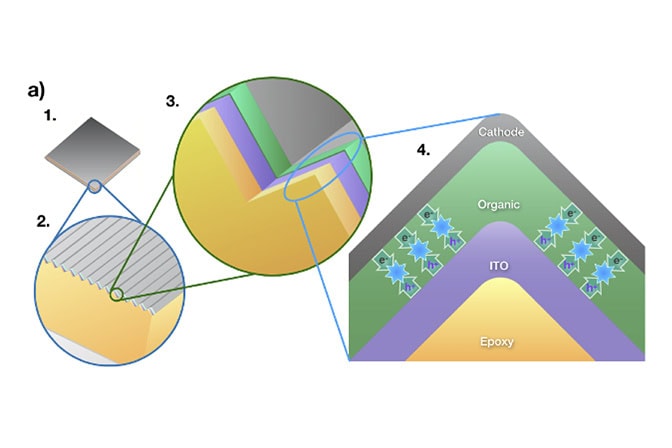
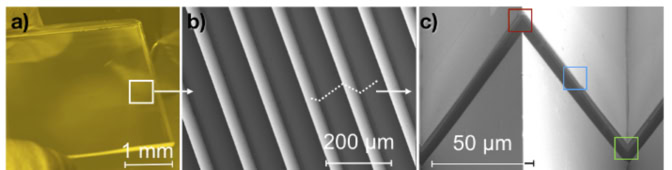
To assemble the prototype, the University of Michigan research team first constructed the surface of the light panel by molding tiny corrugated ridges in a thin layer of epoxy on top of a sheet of glass. The ridges are just a tenth of a millimeter tall—so small that the panel appears flat to the naked eye. And yet, the OLED layers themselves are usually a thousand times thinner, thinner even than a human hair.
OLEDs layered on a corrugated surface last 2.7 times as long as conventional devices, according to a new study published in Nature Communications. The graphic shows the high aspect ratio OLED device from the panel level (1) to the nanoscale (4). Credit: Wang et al., 2025.
The textured glass was then shipped to OLEDWorks to finish assembly. Engineers there deposited a layer of soft, flexible organic material between a transparent electrode made of indium tin oxide and a reflective metal electrode. The resulting OLED has a high aspect ratio because the roughly 100-micrometer height of the triangular ridge is comparable to the width of its base, resulting in a larger area of OLED on the ridge facet.
“Normally when people build OLEDs, they go through a lot of trouble to make sure they have a pristine, flat surface. Our corrugated OLEDs exploit the third dimension and work surprisingly well even with tiny microstructural imperfections,” said Chris Giebink, U-M professor of electrical and computer engineering and physics and co-corresponding author of the study.
Longer lasting, efficient OLEDs
The researchers compared the longevity and efficiency of green and blue OLEDs with a flat panel against their corrugated design with 1.4 times more surface area.
Because blue OLEDs typically degrade the fastest, they measured how long blue devices of each design took to drop in brightness—known as fade testing–which revealed lifetimes 2.7 times longer. This lifetime increase occurs because the current passing through each unit of corrugated OLED was lower than for the standard flat devices.
Just a tenth of a millimeter tall, the ridges (panels b and c) are so small they cannot be seen by the naked eye (panel a). The corrugation packs more OLEDs in a given lighting panel area, producing the same amount of light while operating the OLED itself at lower brightness. Credit: Wang et al., 2025.
Using calculations and a computational technique called ray tracing, the research team confirmed the corrugated OLEDs also had a 40% higher external light extraction efficiency—meaning more light output for each unit of electricity input. As the internal layers of the OLEDs were identical, the researchers concluded that the corrugation helped light bounce out of the device instead of getting trapped inside.
While the design was tested on blue and green OLEDs, the research team aims to develop high-quality white light OLEDs by stacking multiple organic layers of red, green and blue emitters.
“High aspect ratio OLEDs represent a practical and elegant solution to a longstanding challenge in solid-state lighting. Together with our research partners, we are accelerating the development of durable, energy-efficient OLED solutions for the market,” said Marina Kondakova, director of R&D, lighting, at OLEDWorks.
This research was funded by the Department of Energy Building Technologies Office (Award No. DE-EE0009694).
The devices were studied at the Michigan Center for Materials Characterization, which is operated and maintained with support from indirect cost allocations in federal grants.
A new VPN auditing framework, MVPNalyzer, found many popular Android VPNs transmit sensitive data without encryption, some leak traffic and most fail to protect user IDs.
The new framework replaces approximations, accurately modeling current crowding and spreading resistance in 2D materials to improve high-performance semiconductor devices.