Soft robotics: Actuated fabric lowers the barrier to entry
A fabric sheet with a grid of inflatable pouches can be cut, sealed and stapled to form soft robots able to contract, bend, twist, rotate or stiffen.

A fabric sheet with a grid of inflatable pouches can be cut, sealed and stapled to form soft robots able to contract, bend, twist, rotate or stiffen.
Key takeaways:
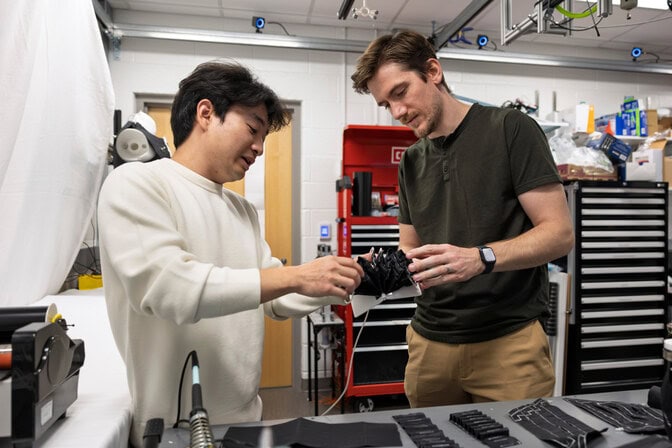
A custom process quickly produces the actuated fabric sheets, called FaBrick, on a patterned, heated roller. Typically, making a new actuator requires starting from scratch with a one-time laboratory build. With FaBrick, users can build actuators that contract, bend, twist, rotate or stiffen from the same material to form soft robots. Credit: Jeremy Little, University of Michigan Engineering.
Richard: We are able to replicate the major type of actuation methods that’s in the soft robotics field right now. You only need a pair of scissors, soldering iron, and a stapler.
On-screen text: This fabric sheet, embedded with inflatable chambers, can be easily configured for any soft robotic actuation you need. Called FaBric, it was developed by Michigan Engineering researchers to simplify the construction of soft robots.
Richard: A loty of projects happening in the soft robotics field, are kind of a one-off thing.
Daniel: For most soft actuators, you need a specialized way to manufacture each different type.
On-screen text: This requires using seperate molds, materials and something a new machine.
Richard: It’s not getting much traction on commercialization.
On-screen text: Inspired by Lego, FaBrick gets its name from the modularity of the beloved building blocks.
Richard: This material is like a one-for-all type of solution. What it is, is basically air chambers that are interconnected. So when you inflate it, the entire sheet inflates up.
Daniel: It comes out in one big sheet and then one of the advantages of this is that once you have that big sheet of material to make different soft actuators, you don’t need any additional sophisticated equipment. All you need is to cut it to the size you want, fold it in the specific pattern you want, and then staple certain edges together. You can get all of that functionality from a single piece.
On-screen text: The actuators can then be combined to build practical soft robots. Using a patterned heat roller they can produce the sheets of any length desired.
Richard: This makes the entire platform scalable. We wanted to make an easily accessible and easy to work with platform so that people who don’t have the expertise of making soft robots would be able to also participate in the advancement of the field. I hope it would become something that opens up the soft robotics field to the door of commercialization.
Soft robots that contract, bend, twist, rotate or stiffen can be built from the same pneumatically actuated fabric with easily accessible tools, according to a University of Michigan Engineering study funded by the National Science Foundation.
The fabric, embedded with a grid of inflatable pouches, earned the name FaBrick as the design drew inspiration from modular building blocks like LEGO® bricks.
“In soft robotics, the way you get a new motion today is to design a new actuator, which usually requires a new mold, a new material or sometimes a new machine,” said Mingyuan (Richard) Li, a doctoral student of mechanical engineering at U-M and lead author of the study published in Science Advances.
“With FaBrick, the same roll of fabric can give you a muscle that contracts, a finger that bends, and a wrist that twists, using just a few simple post-processing tools: scissors, a soldering iron and a stapler,” added Li.
The researchers developed a custom process that quickly produces FaBrick sheets. A roll of two TPU-coated fabric layers passes through a patterned, heated roller on top and a rubber roller below. The heat and pressure laminate the material only at the raised regions, forming sealed pouches while leaving connecting channels open. Made with roll-to-roll manufacturing, FaBrick could be easily mass-produced in sheets of any size.
A finished FaBrick sheet resembles a chocolate bar, with rectangular inflatable motor cells arranged in columns and rows. When connected to an air inlet, each airtight pouch inflates into a bulged shape, shortening its length and generating force, similar to a muscle flexing.
Up to this point, most soft actuators have been one-time laboratory builds, specialized for a unique function. Fabrication expertise becomes a barrier as it takes time to learn techniques, like silicone molding, and get consistent results.
Rather than starting from scratch, users can create different actuators from a FaBrick sheet. FaBrick sheets start with open channels between neighboring cells, meaning a single air inlet can inflate the whole sheet. Strategically closing off connecting channels can produce actuators that contract, twist, bend, rotate and stiffen.
“The actuated material approach pushes fabrication difficulty upstream into a more scalable heat-rolling process that happens once. Instead of needing to learn a bunch of fabrication methods, a user can make all sorts of devices through just cutting and sealing cloth,” said Daniel Bruder, an assistant professor of mechanical engineering at U-M and senior author of the study.
In a series of demonstrations, the researchers show how combining several FaBrick actuators can create practical soft robotic systems. A gripper cut from a single FaBrick sheet can conform to whatever item it holds. The flexible actuated fabric is particularly suited for handling fragile or irregularly shaped objects that a conventional rigid robot may struggle with.
The thin, lightweight fabric holds promise for wearable assistance and rehabilitation. The team created a FaBrick sleeve that assists elbow, shoulder and wrist motion without adding bulk. In future devices, these motions could support physical therapy for stroke recovery, Parkinson’s disease, post-surgical rehabilitation and more.
A soft robot with four legs, each made of a FaBrick cylinder, walked by contracting different sides of each leg to make it bend and step. In uneven or fragile terrains, a lightweight soft robot could adeptly navigate as it conforms to surfaces.
With FaBrick dropping the barrier to entry, a high school or undergraduate class could easily develop a soft robot without needing specialized equipment. A team working in the field could also build a soft robot on the fly with just three tools, no longer needing a lab with molds and 3D printers.
“I wanted something generic, a material you can pull off a roll and cut into whatever actuator you need, as close as possible to a one-size-fits-all solution. The same sheet can serve many applications, from wearables to locomotion to gripping, so testing a new idea isn’t held up by a week in the shop,” said Li.
This research was supported by the National Science Foundation (2530528).
The team has applied for patent protection with the assistance of U-M Innovation Partnerships and is seeking partners to bring the technology to market.