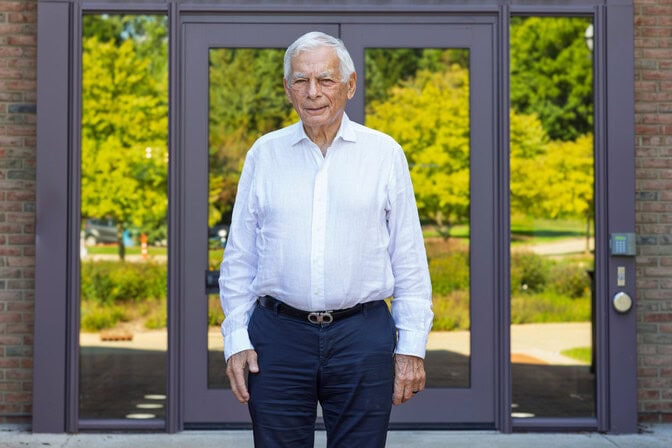
Building businesses and futures for seven decades
At 91, U-M alum Joel Tauber is still doing the work he loves for the University and beyond.

At 91, U-M alum Joel Tauber is still doing the work he loves for the University and beyond.
“The objective of life is peace and happiness.”
It’s something Joel Tauber is fond of saying. But for the 91-year-old University of Michigan alum, businessman and philanthropist, it’s much more than words. It’s a philosophy that he has put into action through decades of business success, millions of dollars in charitable giving and a long history of hands-on involvement. He has been a major contributor to numerous U-M causes, helped Jewish refugees thrive and much more during a philanthropic career that spans seven decades and counting.
“The question I encourage people to ask about giving back to society is ‘Are you working at it or are you just supporting?’” he said. “I’ve found that working in the philanthropy or the company or the institution is where the rewards come in. And it also makes you feel good.”
Few are more familiar with Tauber’s brand of action than Racheli Tadesa Malkai. In 1991, Tauber helped then 8-year-old Malkai escape violence and religious persecution in Ethiopia and emigrate to safety in Israel through Operation Solomon, a massive airlift that enabled more than 14,000 Ethiopian Jews to start new lives.
Tauber played a key role in Operation Solomon. He galvanized an effort that raised more than $30 million, successfully negotiated with the Ethiopian government and coordinated with Israel. When Malkai, her seven brothers and her parents reached safety, Tauber was on the tarmac to greet them.
“It was a remarkable experience,” he said in a 1991 interview with the Detroit Jewish News. “A lot of people, including some tough soldiers, were crying. We were all touched by the beauty of the scene.”
While coming to Israel was the realization of a life-long dream for the refugees, day-to-day life in a new country was difficult. The oldest of eight siblings, Malkai says she “grew up fast,” earning money for the family and quickly learning a new language so she could translate for her parents. As the years went on, she began to envision a broader role serving the community and, encouraged by her mother, she went to university to study social work.
“I remember my mother sat me down and said ‘This is our country and we’re not leaving it. But if we want a better future, we need to change our lives. Nobody is going to do that for us,’” Malkai said.
She began an initiative helping Ethiopian women start small businesses and encouraging them to buy from one another. Still, she knew more was possible. She reconnected with Tauber in 2017, and what had seemed like a happy ending back in 1991 proved to be just the beginning of their work together.
The two worked to build an organization offering a wide range of social services to Ethiopian families in Israel. Tauber’s support and mentorship helped Malkai turn Empowering Ethiopian Women into a formal non-profit organization in 2020.
“I was in awe of this woman and what she had accomplished with the Ethiopian community,” Tauber said. “And to have helped someone back in 1991 and then to meet her and see how she’s become a leader—it was just such a beautiful moment.”
Today, Empowering Ethiopian Women counts more than 17,000 members and offers financial and entrepreneurship counseling, empowerment workshops, English classes, computer science mentorship through a partnership with Microsoft and more. Tauber is still its biggest beneficiary.
“I like to say that you just need one person to believe in you and open the way forward, and Joel was that person for me when I founded Empowering Ethiopian Women,” Malkai said. “Because of that, I’m now able to be that one person for others.”
Operation Solomon is just one of the large-scale relocation efforts in which Tauber has helped protect Jewish refugees. He was also involved in Operation Exodus, launched in 1990 to bring Soviet Jews to Israel, and Operation Promise, which rescued Ethiopian Jews who had converted to Christianity.
Tauber has brought his philosophy of deep involvement and long-term commitment to U-M, where he is the chief supporter of the Joel D. Tauber Institute for Global Operations. A joint program between U-M’s Stephen M. Ross School of Business and College of Engineering, the Institute engages students in hands-on, immersive projects inside leading companies.
The roots of Tauber’s involvement in the Institute stretch back to the early 1960s, when he was invited to take over a manufacturing company. Fresh out of business school, he recognized the need to learn more than his academic education had taught him.
“I had to develop my own training program because what I learned at business school didn’t prepare me to understand the whole organization,” he said. “So I worked midnight shift and I worked shipping and I worked in sales and I worked everywhere for a couple of years learning the business. I screwed up plenty, but it was a learning experience.”
That experience paid off — Tauber’s company, Key Manufacturing Group, Inc. grew exponentially in the years that followed. Tauber, who ultimately earned BA, MBA and law degrees from U-M, soon realized that he could help others succeed by creating new kinds of learning opportunities at the University. He worked with Gilbert Whitaker, then the dean of Ross, to develop programs that gave students hands-on experience inside companies. His partnership with U-M grew with his involvement in the Michigan Joint Manufacturing Initiative, created in 1993. The project was a first-of-its-kind collaboration between Ross and the College of Engineering, and Tauber believed in it so deeply that he made a $5 million pledge to ensure the efforts were sustainable. The University honored him by renaming the program the Joel D. Tauber Manufacturing Institute in 1995.
In 2005, Tauber was one of the first recipients of the Hermelin Award, the University’s highest recognition for fundraising volunteers. The award is named for David Hermelin, a devoted alumn, Detroit area entrepreneur and philanthropist, and one of Tauber’s best friends.
“David was unique because he had a love for people that I’ve never seen in anyone else,” Tauber said in a 2016 interview with U-M. “He had a passion for the causes that he was involved with. He was a strategist. He was a generous donor. He was involved intimately in all of his philanthropic organizations. What a fantastic legacy.”
The Institute was renamed the Joel D. Tauber Institute for Global Operations in 2007, and today, Tauber continues to work directly with students and faculty. He recently helped expand the Institute’s reach to work with newly minted startup companies
“Someone might have a great idea, but they have no idea how to run a business,” he said. “So we provide entrepreneurs with expertise, and we enable students to learn in a very cutting-edge business environment. It’s been very successful, we did two programs last year and are doing two more this year.”
Tauber’s eye for creative partnerships has also brought U-M and Empowering Ethiopian Women together, with a collaboration between U-M psychology professor Fiona Lee, Hebrew University business professor Lilach Sagiv and Empowering Ethiopian Women. Lee has spent decades working with refugees, and her research has found that helping them thrive isn’t always about money. Meaningful assistance often starts with understanding and communicating.
“It’s very important to think about a group’s cultural values, and to define wellness and thriving on their terms, not on ours,” she said. “And if you can help people define and affirm those values, every other intervention is going to be more meaningful and successful. We’re working with Empowering Ethiopian Women on some new kinds of interactions to facilitate that.”
The team hopes to complete the study in 2027. In the meantime, Lee has found that the work itself holds its own rewards.
“Working with refugees is inspiring to me because they tend to be so positive about life,” she said. “Many of these groups are not doing well by traditional measures like income. But they certainly are engaged with life and have a sense of fulfillment that some of us with a lot more money and education and financial stability don’t have.
“It’s also just really inspiring to work with Joel and his team. In 30 years of research, I’ve never worked with a research funder who has shown this much involvement in the process of the research; not just the outcomes but the process of doing it. It’s just amazing.”
Peace and happiness, indeed.