Shoulder exoskeletons for manufacturing workers: How to boost adoption
To reduce injury risk without slowing productivity, exoskeletons must balance static overhead support with freedom for dynamic movements.

To reduce injury risk without slowing productivity, exoskeletons must balance static overhead support with freedom for dynamic movements.
Shoulder exoskeletons designed to help manufacturing workers with overhead tasks need to allow for more dynamic movement before workers reliably use them, according to two studies led by University of Michigan Engineering and the Boeing Company.
Certain manufacturing environments, like assembling an aircraft wing, require overhead drilling and wiring work. Lightweight, passive shoulder exoskeletons provide extra upward force to relieve strain on upper body muscles and joints. But workers have been reluctant to adopt the technology when made available during a trial run.
“Workers are not voluntarily using the exoskeletons, and we wanted to understand why,” said Dongjoon (DJ) Kong, Ph.D., a technical fellow at Boeing and co-author of the studies published in the International Journal of Industrial Ergonomics and Applied Ergonomics.
Two experiments—a hand-eye coordination task in a lab setting and a drill-fastening task in a manufacturing training facility—sought to find the barriers and understand the effect of wearing exoskeletons.
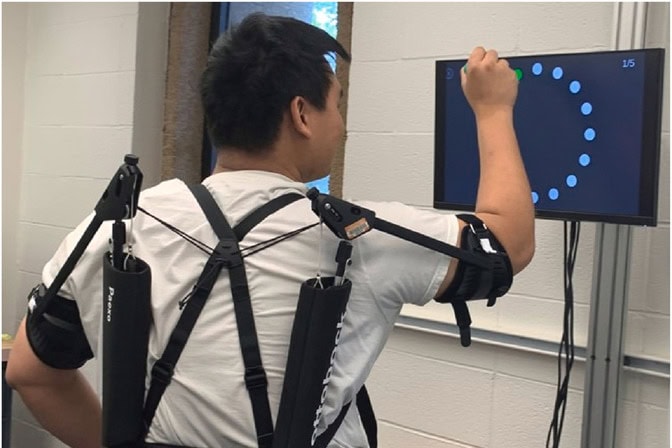
In the lab study, participants wore the Ottobock Paexo Shoulder, which offsets the load with bungee-like springs in the torso of the device.
To test hand-eye coordination, participants tapped targets arranged in a circular array as quickly and accurately as possible in a predetermined sequence both with and without the exoskeleton. The array was positioned first at shoulder level and then at a more fatiguing position 40 degrees above shoulder level.
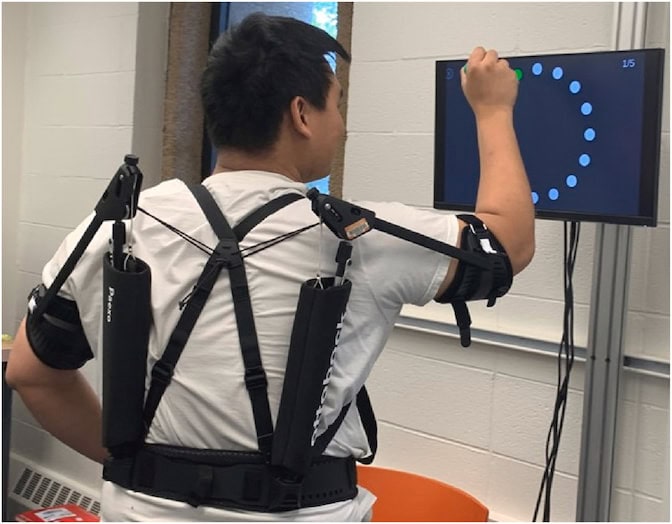
Participants noted lower discomfort when using the exoskeleton, and the device had no negative impact on accuracy, error rate or precision. However, movement time slowed by 3.7% at shoulder height and by 9.7% above shoulder level when wearing the exoskeleton. These small delays could add up quickly in a manufacturing setting, reducing throughput when employees are expected to meet production targets.
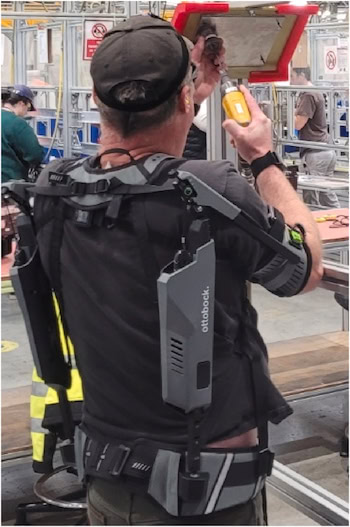
In the second study, trainees in a manufacturing training facility performed an overhead drill-fastening task, both with and without the exoskeleton. The task required participants to drill, countersink and fasten screws, changing bits within steps.
Trainees wore sensors on the forehead, back, upper arms and wrists to help assess position and musculoskeletal injury risk on a scale aligned with the Rapid Upper Limb Assessment (RULA), a tool ergonomists use to characterize injury risk.
The exoskeleton led to a decreased torso flexion across all four subtasks, meaning less bending forward or to the sides, which can reduce back injury risk. The level of risk to the shoulder varied by subtask, with the exoskeleton nominally able to provide support during these tasks based on the postures taken.
“Posture during a task does not provide enough information to select an appropriate exoskeleton. The presence and direction of movement is important too. Just knowing that the arms are overhead while drilling doesn’t mean that a passive shoulder exoskeleton is aligned with the job,” said Leia Stirling, a U-M professor of industrial and operations engineering and robotics and senior author of the studies.
During dynamic tasks, like those that involve lowering arms to change the drill bit, the sensors revealed that participants had to actively work against the exoskeleton support mechanism at times. Passive exoskeletons continually push upwards, forcing workers to use extra muscle effort to pull their arms down during non-overhead movements.
The trainees’ discomfort ratings did not drop for all workers for the regions of the body where the exoskeleton should be providing support. Some workers perceived a small decrease in discomfort, some perceived no change, some perceived more discomfort.
The limited difference could be due to the short trial duration, as baseline discomfort was already low. Still, the researchers think the sensor readings illuminate an important insight. Intermittently working against the exoskeleton during a full day of work could ultimately become more frustrating and tiring than helpful.
“We did not observe a consistent perceived benefit, as would be desired from this system. There’s room for improvement to make exoskeletons better suited for the task,” said Jianyang (Joe) Tang, a doctoral student of robotics at U-M and lead author of the studies.
To improve adoption, researchers suggest altering the exoskeleton to give workers the ability to disengage supports during downward arm movements. This functionality could be adjusted by the user or automatically by measuring the user’s movement. They recommend that, when implementing exoskeletons, manufacturers consider the dynamic nature of the tasks workers perform.
“We believe exoskeletons can be valuable in reducing musculoskeletal injury risks for workers, but not all exoskeletons are appropriate for all tasks. It is important to create requirements for exoskeleton designers that support worker needs across their job tasks,” said Stirling.
This research was supported by the Boeing Project Agreement UI-22-001.