Embolism treatment developed at U-M receives FDA clearance
New device eases the removal of blood clots from vessels with a combination of suction and agitation.

New device eases the removal of blood clots from vessels with a combination of suction and agitation.

Michigan Engineering is advancing
critical technologies for a healthier world
Patients with persistent blood clots require frequent medical interventions just to survive. Yet despite this critical need, there have been few advancements in how these patients are treated.
That will change thanks to a pioneering effort at the University of Michigan.
The Hēlo Thrombectomy System, a medical device that quickly and efficiently removes blood clots in the lung for patients with chronic venous thromboembolism, was recently cleared by the U.S. Food and Drug Administration. Commercialization efforts are being led by Endovascular Engineering, a U-M startup.
Narrator: This new catheter could change the way surgeons remove blood clots from the lungs.
Following recent FDA clearance, the device may soon be used in hospitals to treat pulmonary embolism, a potentially deadly condition in which clots in the deep veins of the legs break free and travel to the lungs, blocking blood flow.
Of the 900,000 blood clot cases in the U.S. each year, pulmonary embolism is responsible for 60,000 to 100,000 deaths. Removing these clots with traditional catheters can be challenging.
Luis: When you need to remove clots from the pulmonary arteries, you have to navigate through the heart and its valves, which are very delicate.
But once you get there, you’re facing massive amounts of clot. You need a technology that enables you to transport large amounts of clot outside the body.
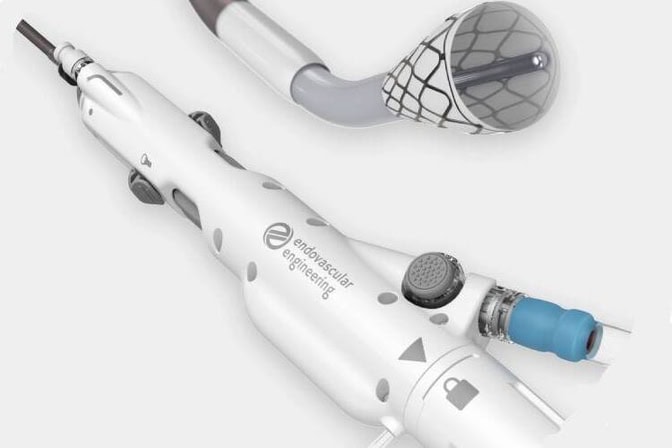
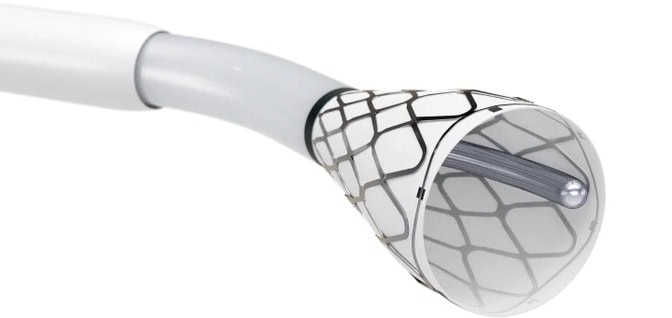
Narrator: Adapted from stroke intervention technology developed through a collaboration between University of Michigan Engineering and Michigan Medicine, Endovascular Engineering’s Hēlo Thrombectomy device can navigate to the lungs as a small catheter and, once there, expand into a large funnel that captures the clot.
A rotating shaft then orbits and twists the clot as the funnel applies suction, stretching and thinning the clot so it can be drawn through the catheter and removed from the body.
The idea originated in the lab of mechanical engineering professor Albert Shih, a leader in minimally invasive medical device design. Luis Savastano, a neurosurgery resident at the time, reached out to understand why thrombectomy devices were failing when used on stroke patients.
Luis: We had several complications. We had bleeding, we had damage to the vessels, and we couldn’t really tell why the devices were failing.
Albert: The Biomedical Manufacturing and Design Lab fosters deep collaboration between engineering and clinical teams.
Since beginning work with the University of Minnesota in 2010 and receiving a grant from the National Science Foundation in 2012, Shih’s lab has been recruiting top student talent to innovate and develop commercial medical devices used to treat patients worldwide.
Combining engineering expertise with medical knowledge, three engineers from Shih’s lab teamed up with Savastano and discovered that using thrombectomy devices to grab and pull clots could damage blood vessels. They developed a tool that would allow neurosurgeons to safely navigate the delicate arteries in stroke patients’ brains and gently remove clots while minimizing damage.
Savastano went on to found Endovascular Engineering in 2020.
Luis: The same problems encountered in the brain’s arteries, which are very delicate, also apply to pulmonary embolism, so it was a perfect fit.
Albert: The University of Michigan is a rich environment for medical device innovation and commercialization. We are very proud that Endovascular Engineering has received FDA clearance.
Luis: We are very fortunate on the medical side to have engineers who are willing to work with us. We did a lot of work together because we shared a mutual understanding that this technology could have a tremendous impact on patient care.
[End of transcript.]
The Hēlo Thrombectomy System originated from a unique collaboration between engineering and medical expertise at U-M. The approach to clot removal was developed at the Biomedical Manufacturing and Design Lab, which is led by Albert Shih, the Yoram Koren Collegiate Professor of Engineering in the College of Engineering.
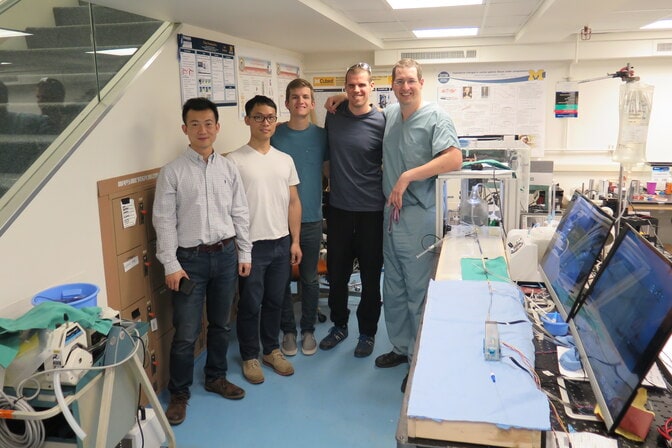
Three former engineering Ph.D. students played central roles: Yihao Zheng, now an associate professor at Worcester Polytechnic Institute; Yang Liu, now an associate professor at Shanghai Jiao Tong University; and Jeffrey Plott, now an assistant research scientist for the U-M Cardiac Surgery. The engineering team worked closely with Luis Savastano, a former U-M neurosurgery resident and now assistant professor at the University of California, San Francisco, who played a pivotal leadership role, and Aditya Pandey, the Julian T. Hoff M.D. Professor of Neurosurgery at U-M.
“We have the unique ability to collaborate between advanced clot cutting and endovascular neurosurgery at the University of Michigan,” Shih said. “It is a Michigan Difference that our collaboration with Cardiology and Neurosurgery has created a series of interventional neurocardiovascular devices starting from a 2012 NSF advanced manufacturing project and continuing today.
“It has been incredible seeing the impact of the Hēlo system on patients’ lives with pulmonary embolism by providing them with a minimally invasive treatment, which was not possible before. Endovascular Engineering is one of three successful startups in the past six years commercializing ideas from this collaboration, developing many promising new minimally invasive medical devices for cartilage removal, heart pumping assistance and chronic blood clots crossing in the leg veins, with the promise to help many more patients.”
Originally designed for stroke intervention, the technology has evolved to remove lung clots, which are also known as pulmonary embolisms and one of the forms chronic venous thromboembolism can take. The Hēlo Thrombectomy System utilizes suction to draw the clot into its catheter and an agitator, allowing for targeted and efficient removal.
“It is an ideal start before the technology advancement and commercialization of more complex stroke treatment devices,” said Shih, professor of mechanical engineering and biomedical engineering.
Endovascular Engineering was founded in 2020, with critical support from Innovation Partnerships, the Coulter Translational Research Partnership Program and the MTRAC Life Sciences Innovation Hub, all of which helped accelerate E2’s journey from lab innovation to market launch.
“The FDA clearance of the Hēlo Thrombectomy System marks a transformative advancement for pulmonary embolism patients,” said Kelly Sexton, U-M associate vice president for research—innovation partnerships and economic impact. “This significant milestone demonstrates the tremendous power of interdisciplinary innovation at U-M, where engineers and clinicians come together to tackle urgent clinical challenges. We’re proud to support startups like Endovascular Engineering, driving breakthrough technologies like Hēlo from university research to patient care.”
Since its founding, E2 has raised $42 million in Series B financing and $80 million Series C financing. The company also recently reported positive results in their ENGULF trial, a key clinical trial evaluating the Hēlo system for treatment of pulmonary embolism, helping to pave the way for the Hēlo system to attain FDA clearance.
Pandey and the University of Michigan have a financial interest in E2.
Written by Alana LaRoche, U-M Innovation Partnerships.