New U-M master’s programs address industry needs
Online and in-person programs provide graduates expertise that’s highly valued in the workforce.

Online and in-person programs provide graduates expertise that’s highly valued in the workforce.
As the needs of industry change with the times and technologies, University of Michigan Engineering has added new master’s programs to equip students to meet them and advance their careers at the same time.
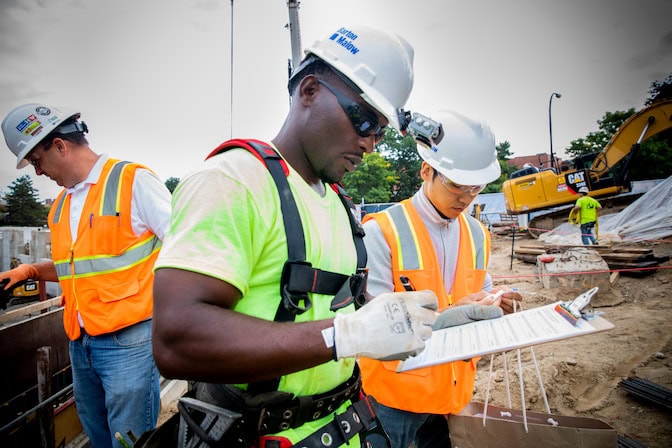
The construction industry faces a shortage of qualified engineers and construction project managers and a new online master’s degree in construction engineering and management from U-M aims to help close the gap.
In a 2024 Associated General Contractors of America poll, 81% of responding firms indicated that filling construction project manager positions was difficult.
“Construction management involves oversight of people, materials, schedules and subcontractors, and these projects are becoming more complex and more expensive,” said Carol Menassa, a U-M professor of civil and environmental engineering. “But a lot of companies we talk to say that senior people—the ones who have amassed all of the needed skillsets to do this work—are retiring and taking that acquired knowledge with them without passing it on.”
The new online M.Eng, or master of engineering, program complements the flagship residential MSE, or master of science and engineering, degree in construction and engineering management U-M launched in 1954, the first degree of its kind in the nation.
Students can complete the new 26-credit online degree in eight months full-time, and up to five years part-time. They can also start with a stackable certificate.
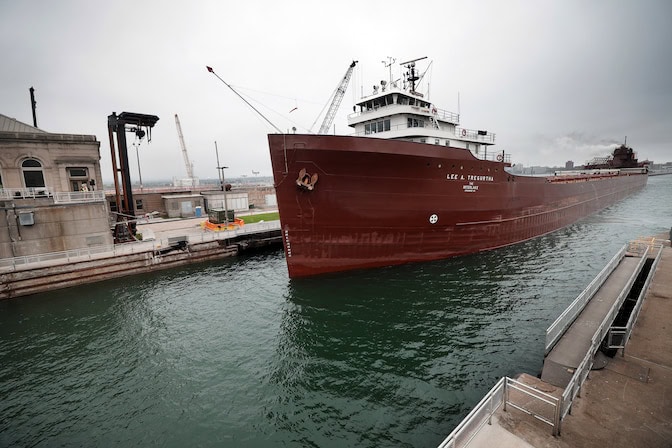
As the U.S. looks to revitalize its shipbuilding industry, a new U-M dual degree will prepare graduates to navigate emerging international environmental regulations and design tomorrow’s maritime solutions with a systems-level perspective.
U-M’s master of science in engineering/sustainable systems program now offers two naval architecture and marine engineering tracks. Students can specialize in either sustainable energy systems or sustainable design and manufacturing. They graduate with a Master of Science (MS) in environment and sustainability and a Master of Science in Engineering (MSE) in naval architecture and marine engineering. All admitted students receive fellowship support.
“The status quo for the last two and a half decades—where we use heavy fuel oil and diesel engines—is now changing,” said Thomas McKenney, an associate professor of practice in naval architecture and marine engineering and co-director of the Great Lakes Maritime Initiative. “Because of that, we need a closer connection between ship design and sustainable systems.”
The industry faces a new spate of environmental regulations and challenges. The International Maritime Organization set a target to achieve net-zero emissions by 2050.
“I think the program will really differentiate naval architects and marine engineers. Engineers who focus on sustainability and have systems-level thinking are very in demand,” said Owen Baldwin, a contributor to the state of Michigan’s Maritime Strategy that McKenney led.
A new master’s program offered by U-M’s Department of Industrial and Operations Engineering (IOE) offers a concentration in data and decision analytics designed to help unlock layers of data for tomorrow’s engineering and business leaders.
According to the U.S. Bureau of Labor Statistics, data analysts earn a median annual salary of $112,590. And the bureau predicted data analytics, as a field, will grow 34% between 2024 and 2034.
“As companies continue to integrate advanced analytics into their global operations, the demand for professionals that can bridge the gap between heavy data science and practical business execution has never been higher,” said Mike Miller, COO of international at Toast, a cloud-based management company for restaurants. “The University of Michigan’s new master’s, with its focus on data and decision analytics, tackles this workforce gap head-on with a highly-relevant, applied curriculum.”
The depth of analyses industrial engineers are capable of has been enhanced by the proliferation of artificial intelligence and other tools.
“Graduates will be well-positioned to lead data-informed innovation efforts, develop intelligent systems and contribute to the digital transformation occurring across manufacturing, healthcare, mobility, energy and other sectors,” said Eunshin Byon, a professor of industrial and operations engineering and IOE’s director of master’s programs.
Courses in the 26-credit Master of Engineering (MEng) in Industrial and Operations Engineering program are offered in-person and online.
The program expands on more than 70 years of education in the industrial and operations engineering space at U-M.
“We have a lot of alumni who went into the industry after earning their undergraduate degree, but have realized their job requires additional analytics skills,” Shen said. “For many, the solution has been going to business schools, but those curriculums include courses that aren’t necessary for engineering.”
A new professional master’s degree and certificate program combines AI fluency and deep domain expertise to prepare students to lead in tomorrow’s workforce. The AI+ (AI “plus”) Engineering programs offer on-campus and online options for a 30-credit master of engineering (M.Eng.) degree and a 12-credit graduate certificate with stackable credits.
“AI is pervasive, and not only is the core technology advancing rapidly, it’s enabling rapid advancement in other fields,” said Krista Wigginton, associate dean for graduate and professional education at Michigan Engineering. “As a result, engineering employers and students alike are looking for AI expertise. As a leading institution for engineering education, part of our role is to identify workforce development needs and meet them.”
The on-campus master’s programs will launch Fall 2027, with remote options beginning either simultaneously or at a later date.
Students can pursue either the master’s degree or the certificate on its own, or start with the certificate and stack credits toward the master’s degree in the same program area.
“The AI+ curriculum consists of coursework in AI fundamentals and their intersection with specific engineering disciplines,” said Vineet Kamat, director of graduate degree programs. “An interdisciplinary approach is essential to develop systems capable of perception, planning and interaction with physical objects and spaces in pursuit of design objectives, while integrating AI into engineering frameworks and system applications to create discipline-specific outcomes.”