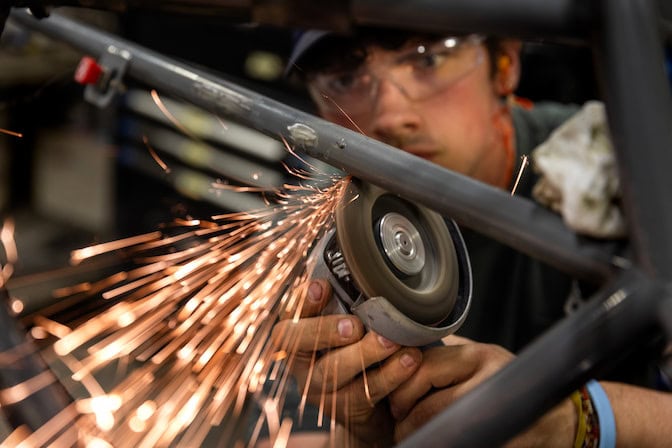
U-M program pairs students with small- to medium-sized manufacturers
University of Michigan students have a new paid opportunity to fill resumes with real-world experience.

University of Michigan students have a new paid opportunity to fill resumes with real-world experience.

Michigan Engineering is reinventing U.S. manufacturing for resilience and scale
Smaller-scale manufacturers can tap the expertise of University of Michigan students to solve specific problems through a new program—one designed to give students a new opportunity to earn money while building their resumes.
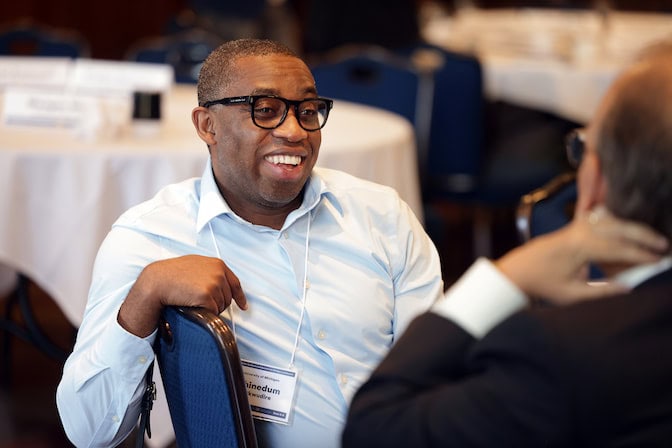
U-M’s Manufacturing Innovation (MI) Fellows Program connects small- to medium-sized companies with students for a minimum of 12 weeks to focus on a single project. Companies of these sizes make up 98% of the manufacturing sector, says Chinedum Okwudire, director of the University of Michigan Advanced Manufacturing Institute (UMAMI) and a professor of mechanical engineering.
“Large universities like ours typically focus our involvement with projects connected to larger companies,” Okwudire said. “But in manufacturing, those small to medium businesses are the lifeblood—supplying all the larger companies—and they have lots of interesting R&D needs that our students are well-equipped to address.”
The program will match companies and students in project areas that include:

“We know that one of the barriers to finding the right job for new graduates can be not having industry experience,” said Daniel Cooper, associate professor of mechanical engineering and MI Fellows Program Lead. “So with this program, we’re testing the hypothesis of whether there’s a better way to get them that paid practical experience by directly building their curriculum vitae.”
The program is open to all engineering students, as well as those not in engineering with relevant skills. Interested students can join the MI Fellows Talent Network to be contacted whenever a project aligns with their skill sets or interests.
Companies can fill out a Project Interest Form to share descriptions of the task they’re looking for engineering help with. Then UMAMI and company officials will meet to clarify the objectives that can be met in the 12-week fellowship.
At that point, UMAMI identifies the right qualified student for the project and assigns a faculty instructor with expertise in the subject area. The students are compensated with funds provided by the company at about $17 per hour, comparable to the pay many earn in jobs on and around campus. All developed intellectual property will be assigned to the sponsoring company.
While the fellows program is intended for current students, in rare cases, recent graduates can participate.
Vaishnavi Harikumar, 28, earned her master’s degree in aerospace engineering from U-M in 2023 and promptly landed a job with Applied Dynamics in Georgia. It was a challenging position that allowed her to work with the company’s client, Gulfstream Aerospace, but it was less aligned with her background in guidance navigation and control and her general career interests.
After two years, Harikumar was caught up in a round layoffs and found herself starting over. This year, she received an email from the MI Fellows program about a company looking for engineers to work on R&D problems.
Firefly Drone Shows, a drone manufacturer located in Auburn Hills, Mich., was looking for help building an algorithm that enables the relative positioning of drones in areas without GPS access. Harikumar fit the bill and landed the fellowship.
“This work is research-heavy and requires a great deal of coding and exploration of different algorithms,” said Harikumar, who is constructing what she hopes is the well-rounded resume of a future astronaut. “I feel like this was the perfect opportunity to pivot into software development within the aerospace and robotics field—the career direction I want to pursue.”
The program aims to be a win for the participating small- to medium-sized businesses too.
“We couldn’t be happier with how the MI Fellows program has worked out for Firefly Drone Shows,” said Kyle Dorosz, Firefly’s president. “Vaish brought some fresh perspective to our work and a truly professional mindset from day one. She jumped right into the deep end, taking on complex problems and learning very quickly. Now she’s making a big impact while also teaching us new things along the way.”