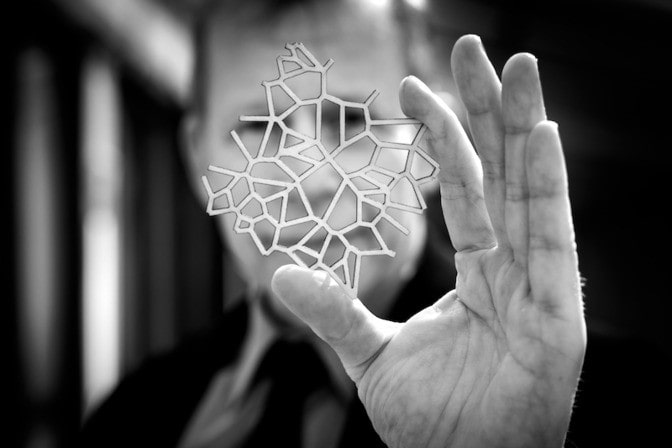
Bringing nature’s complexity to engineered materials.
NAE profile: Nicholas A. Kotov, chemical engineering.

NAE profile: Nicholas A. Kotov, chemical engineering.
Inspired by how new complex materials are produced and in biology, Nicholas A. Kotov developed methods to deduce Nature’s laws in the service of engineering super-materials from nanoscale components. His cross-disciplinary, collaborative work created a single mathematical framework that explains how material structures—whether natural or synthetic—self-assemble from the nano- to macro-scale, including the development of chiral structures. His contributions also harness disorder to make materials that are more than the sum of their parts.
For scalable methods for the self-assembly of anisotropic nanoparticles and multifunctional nanocomposites that led to commercially viable advanced materials, Kotov was elected to the National Academy of Engineering in 2025. View the NAE citation.
Beyond this foundational work, Kotov’s entrepreneurship includes tough membranes for safe, high-capacity batteries and chiral LIDARs for robotics.
About Nicholas A. Kotov
In addition to startups in energy and robotics technologies, and a patent in health tech, Kotov leads a Science and Technology Center funded by the National Science Foundation. The research team has formalized methods for designing bioinspired nanomaterials for light and strong structures for aircraft bodies, dressings for faster wound healing, and chiral sensors for early detection of cancer.
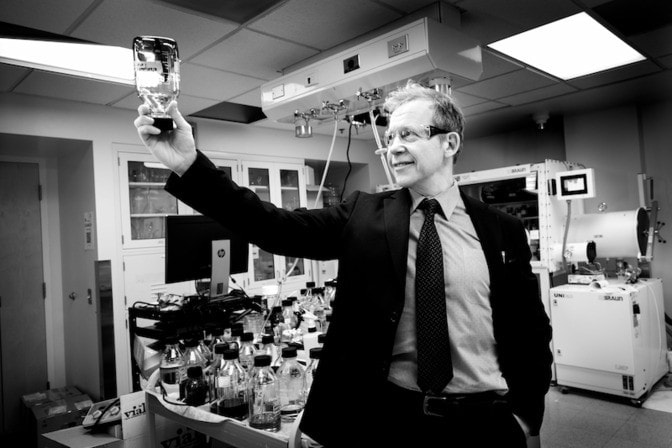
Kotov: I’m a scientist. Understanding Nature in its beauty and contradictions is where my soul and mind belong. I have wanted to be a scientist since my childhood. I’m just lucky that I’m doing what I like to do for as long as I can remember. Looking back, I could potentially be a scientist in multiple fields. I participated in various competitions in mathematics, chemistry, biology, programming and even geology. Eventually, I decided to study chemistry. This discipline was the right choice for me because it has a portion of every other science. When you are a chemist or a chemical engineer, you can be a mathematician, a physicist, a biologist, an engineer, or a computer scientist. This is on top of having a good idea of how to make molecules that people need. I liked that aspect of universality and openness because it did not close any path I might want to take in the future. Perhaps sometime later, I also realized that I have to develop my own identity in science—not just capitalize on trends, but think about what contribution I can make—and chemistry and chemical engineering was the right place for me.
Kotov: I grew up in Moscow, and my mom and dad were a chemist and a physicist. They were quite polar in many things but united in their dedication to their work. My family had a small country house, and I spent a lot of time in the forests and fields around it, picking mushrooms and berries, and just playing in the woods. I learned about animals and insects firsthand—plants, algae, fishes, mollusks, ants, butterflies and many other creatures. It was fun to explore. My dad and I also engineered and built different things, which also gave me a lot of joy.
When I was in early teens, my mom took me into her chemistry lab, and I was sold almost immediately. I loved even the smells. For everyone even remotely familiar with organometallics, it may sound weird, but so it was. My dad also made his mark. He always insisted that mathematics had to be part of anything, and physics is the queen of sciences. As I learned later, this is not always true, but it helped to me to dig deeper and develop the graph theory of nanomaterials.
Kotov: I work on nanoscale structures that have peculiar duality. They’re inorganic, but they also have many properties from the biological side, and the combination of these two chemical identities creates an amazing array of new effects and new possibilities. The inorganic nature of the nanoparticles imparts them with properties of metals or semiconductors, while the short biomolecules attached to their surfaces make them closer to living matter. The basic content of my work is how to make this duality useful and create complex biomimetic materials that combine properties that would otherwise be impossible to attain.
Applications of such materials in different fields of technology—the engineering aspect of the biomimetic nanomaterials—provide one measure of the impact. Our work on the self-assembly of nanoparticles of graphene oxide and montmorillonite clays helped create materials that are strong, conductive, store a lot of electricity, and control the transport of ions, while being structurally similar to the shells of mollusks. Many planar nanoparticles, also known as two-dimensional nanomaterials, can self-assemble into similar shell-like structures. My group and I also developed cartilage-like materials by self-assembly of aramid nanofibers that can be described as one-dimensional nanomaterials. They are tough, strong, and permeable, which are the key attributes of cartilage, while being made from simple non-biological materials. The membranes from aramid nanofibers can make batteries charge faster, store more electricity, while increasing their safety by helping prevent fires.
Engineering, to me, is about making a difference in the world and helping people. It is exciting to see ideas developed here at the university move into companies and, potentially, products that people use every day.
Kotov: For every student, I try to give different advice because all students in my group are unique. When I have a new person in my group, I always ask them what they want to accomplish. Being an adviser, it’s not about my vision of the world—it’s what they plan for themselves, what they consider to be successful, and how it is aligned with the funding I have. But if you are asking to give general advice to all the students, then I would suggest they be different. I encourage the graduates from my group to have their own identity, their own universe, while being a part of the team. Being different, and at the same time a part of the group, is never easy. In fact, it is always a tough battle—both internal and external. You do not need to be afraid of the tension it creates. Instead, learn how to direct this energy toward making a difference in the world.
Kotov: I recently had a birthday celebration of 60 years and the National Academy election. To commemorate these events, there was a special session at the American Institute of Chemical Engineers where students from many years back came from many countries. I realized that I did something right in the previous years. I realized that the effort I put into my students and collaborators—sometimes erratic, sometimes very focused—eventually contributed to their independently flourishing careers. What felt like ‘crazy ideas’ were eventually not so crazy, and people continue working on them in many parts of the world.
Simple pleasures also come from the work itself. Uncovering how nature is built is exciting and reminds me of the small discoveries that my dad and I made in the forests when I was a kid. When you have those ‘aha moments’—‘oh, that’s how it works, that’s how it all fits together’—I think that’s the greatest feeling on Earth.
Kotov: I anticipate that AI will be the source of both humongous challenges and opportunities. Since knowledge is the greatest capital that rich countries have, AI may be a worldwide equalizer because the cumulative intelligence of all current and prior generations of humans in all its dark and bright sides will now be available to everybody. Now the accumulated content of all the books over centuries will be shared, which will accelerate the development of people everywhere. It may be an optimistic point of view, but I choose it consciously. Having said that, I’m worried about the unintended consequences of AI we would never wish for. As scientists and engineers, we have an obligation to anticipate potential harms and proactively mitigate them beforehand.
Quotes edited from interview transcript between Nicholas A. Kotov and Marcin Szczepanski.