A self-cleaning device for oceanic carbon capture
Cyclic pH swings wash away electrode fouling, and a ridged flow channel swirls water to reach an industrial-scale current density.

Cyclic pH swings wash away electrode fouling, and a ridged flow channel swirls water to reach an industrial-scale current density.
A new electrochemical process can rapidly strip dissolved carbon dioxide from ocean water while self-cleaning its own mineral buildup, according to a University of Michigan Engineering study published in Environmental Science & Technology. Because one step produces energy while another consumes it, the method could also help flex the load on the grid.
“The ocean has absorbed roughly 40% of all the carbon dioxide we’ve emitted, which is already increasing ocean acidity and damaging corals and marine life. Our work takes a critical step towards oceanic carbon capture that can work on a large scale and survive in salt water over a long period of time,” said Rohini Bala Chandran, an associate professor of mechanical engineering at U-M and senior author of the study.
Industrial-scale oceanic carbon capture could help reduce ocean acidity back to its baseline while harvesting carbon for other uses like concrete or jet fuel. Several hurdles prevent scale up: electrode fouling (mineral buildup similar to the hard water residue on a faucet), slow mass transport of salts and prohibitive electrical resistance.
A new prototype solves the first two hurdles and outlines a plan to overcome electrical resistance issues.
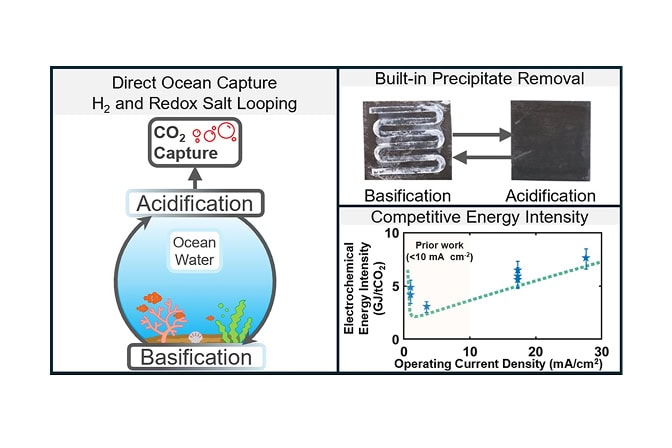
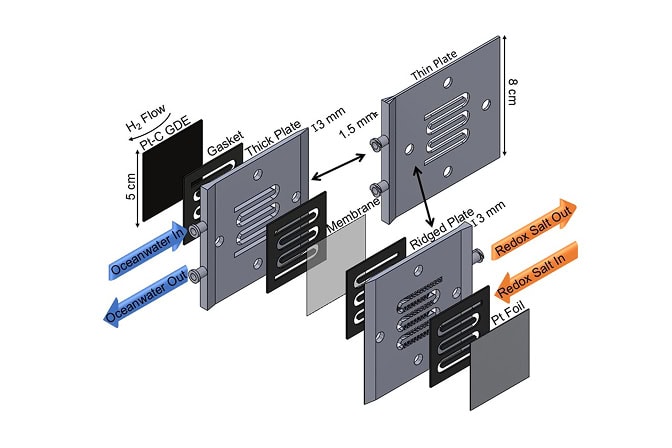
A new electrochemical process that combines hydrogen gas and redox salt looping is experimentally tested to achieve pH-swings and capture carbon dioxide in ocean water. The electrochemical device sandwiches an ion-exchange membrane between two 8-cm-tall flow cell plates with serpentine channels. This creates two liquid flow compartments, one for ocean water and one for redox salt.
To start the process, ocean water and a redox salt are pumped into the flow cell. Supplying hydrogen gas to the ocean water through a porous, gas diffusion electrode starts the acidification phase. This shifts the pH to an acidic 4, reduces the redox salt while also producing electricity. Spraying the acidic ocean water into an evacuated chamber causes carbon dioxide to bubble out for capture.
After carbon dioxide recovery, the ocean water is pulled back into the flow cell to start the basification phase by reversing the polarity of the electrodes in the same cell. This step consumes electricity, swings the pH to 10.7, produces hydrogen gas and oxidizes the redox salt back to its original state.
In practice, the ocean water would be given time after the basification step to re-equilibrate with the atmosphere, absorbing more carbon dioxide to reach the natural baseline of 8.1 pH. The next cycle starts in the same flow cell, reusing the redox salt and hydrogen gas in a chemical looping process.
The research team put their design to the test in simulated ocean water, made by dissolving aquarium sea salt into deionized water. Running four back-to-back cycles proved the self-cleaning mechanism side-steps fouling problems.
Through a single cycle, magnesium and calcium precipitates covered 25% to 42% of the electrode surface after the basification step. Running another cycle starting with acidification dropped fouling coverage back to about 7%.
“Our process can remove 86% of fouling coverage with no acid wash and no downtime. We are excited that the approach could reframe fouling from a maintenance liability into something that can be handled on its own by the process,” said Bala Chandran.
The self-cleaning mechanism helped the energy intensity, defined as the energy input per unit ton of carbon dioxide captured, stay constant across the four cycles. Prior approaches lost 67% of its performance by cycle four due to fouling.
Active redox salts must continuously reach the electrode surface to drive pH swings, but redox salts typically diffuse slowly in a laminar flow. To speed up reactions, and therefore the operating currents, the research team modified the redox salt flow plate with 1-mm-thick fins protruding at a 30-degree angle around the serpentine channel.
The ridged flow channels swirl the liquid as it passes, delivering redox salt faster. The design achieved a flow rate of 50 mL/min, reaching an industrial-scale current density of 100 mA/cm².
The researchers note the prototype’s electrical resistance was 100 times too high for real-world deployment. This was driven by the plastic outer plates creating high electrical contact resistance and the wide-gap architecture that leaves fluid between the electrodes and membrane.
As a next step, the researchers plan to swap the outer plates with metal and adopt a near-zero-gap architecture, where the electrodes and membrane touch, to reduce electrical resistance.
Because the design has electricity-producing and electricity-consuming phases, it could double as a grid-flexible asset, able to shift electrical load away from high-demand hours.
“If implemented on a large scale, the design could combat ocean acidification while harvesting carbon for industrial uses and offering grid-balancing services,” said Bala Chandran.
The porous electrode materials were characterized at the Michigan Center for Materials Characterization, which is operated and maintained with support from indirect cost allocations in federal grants.
The team has applied for patent protection with the assistance of U-M Innovation Partnerships and is seeking partners to bring the technology to market.
This research was in part supported by the National Science Foundation (DGE 1841052), the W.M. Keck Foundation, and University of Michigan College of Engineering startup funds.