Community co-designed wave energy prototypes demonstrated in Lake Michigan
The prototypes—designed with and for the remote island community of Beaver Island—were showcased during the island’s 11th annual sustainability fair.
STORY BY:
PHOTOS BY:
Key takeaways
- University of Michigan Engineering is designing wave energy converters using feedback from residents on Beaver Island, a remote island community in Lake Michigan.
- The researchers hope the prototypes can provide emergency lighting to the island’s airport, which is essential for moving mail, supplies and people to and from the island.
- By advancing wave energy, the researchers hope to improve energy independence and security for the island and nation.
In The News
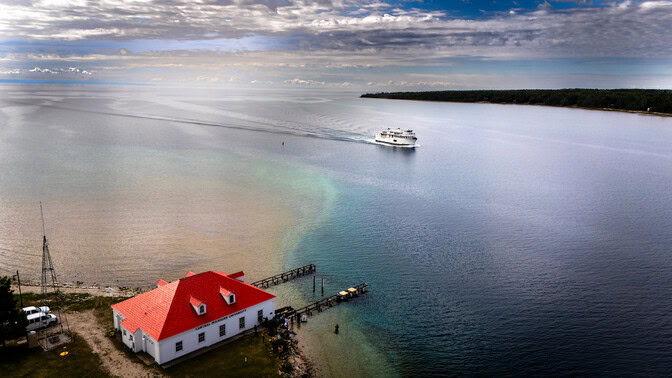
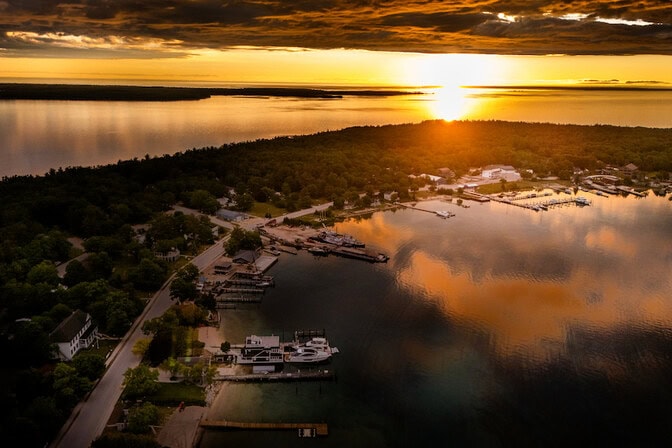
The crystal-clear waters of Lake Michigan lapped against the rocky shore of Whiskey Point, Beaver Island, as twenty or so locals gathered near Central Michigan University’s boathouse, with cookies from the nearby farmers market in hand.
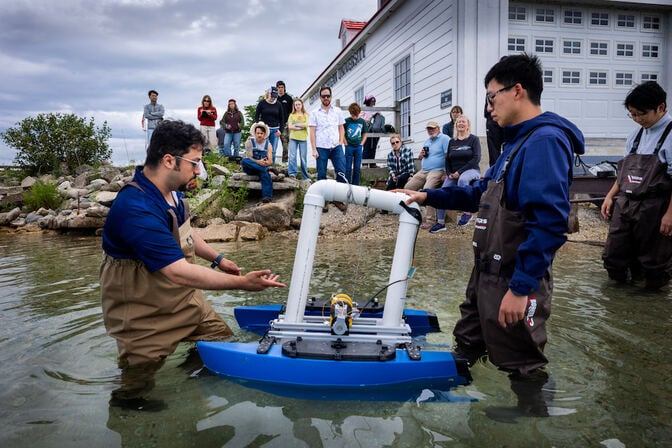
The group centered around four wader-clad researchers standing about knee-deep in the lake. One man stood near a floating device that looked like a three-foot catamaran built around a PVC frame. An inflatable buoy sporting the Michigan block M was tied to a dock further from shore.
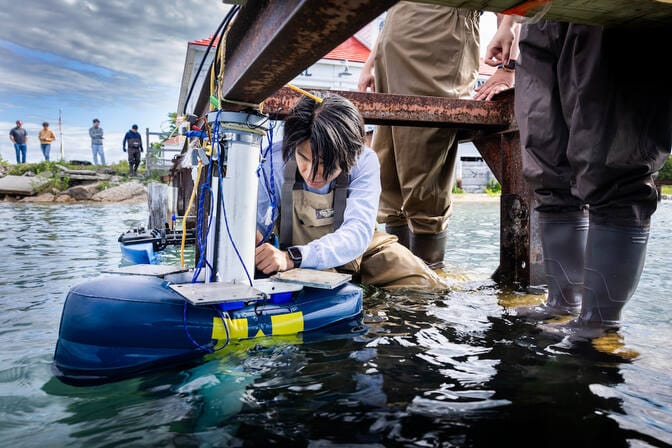
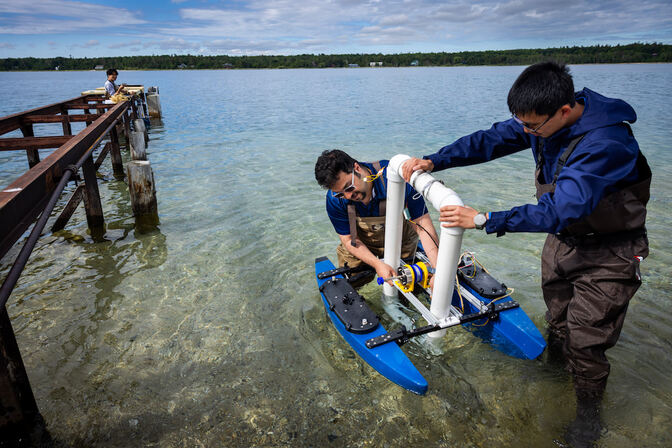
The researchers from University of Michigan Engineering had come to demo prototype wave energy converters during the Island’s 11th annual sustainability fair Saturday, June 20. But this wasn’t a generic technology demonstration—the U-M team had designed their prototypes based on use cases envisioned by Beaver Island residents.
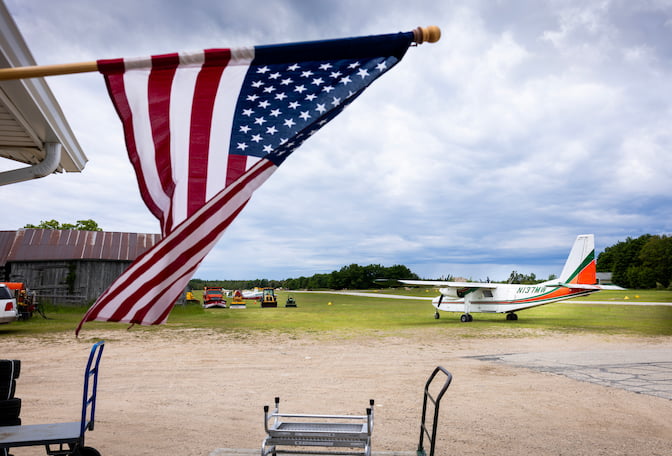
In earlier visits, residents had proposed emergency lighting to the local airport, which is crucial for transporting people, mail and supplies. The researchers demoed a prototype designed for this application. The work, including the gathering of community input, is funded by the National Science Foundation.
Winds brought only a few small waves to the harbor that morning, but the researchers didn’t let that slow them down. Saeid Bayat, a postdoctoral researcher in naval architecture and marine engineering, pushed down on the catamaran to simulate wave motion. An LED near the top of the PVC frame flashed on as he pumped his arms.
“Slow down! It’s only built for nine watts, and you’re strong enough to make 20,” doctoral student Weihan Lin joked from the dock.
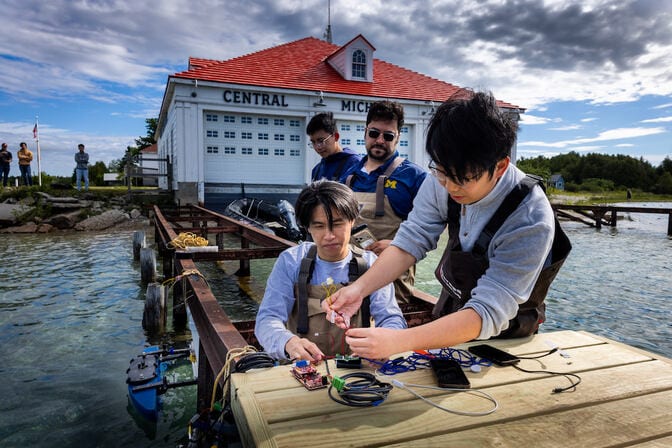
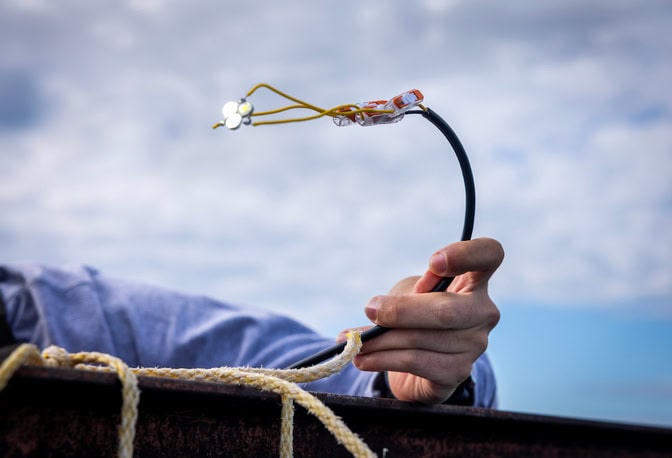
The attendees seemed unbothered by no-show waves. They uttered “oohs” and “ahhs” as the inflatable buoy charged a smartphone. Many attendees were eager to ask questions and share ideas. One attendee was delighted at the prospect of charging car batteries, equipment and personal items with energy from a choppy lake.
“We spend a lot of time developing and testing these technologies, so it was rewarding to share them directly with community members and hear their perspectives,” said Bayat.
Community-centered design
By generating excitement around their half-sized prototypes, the researchers hope to get community buy-in for larger-scale tests in public water. The west or south ends of the island would be ideal. There, waves are more common and swell to larger sizes.
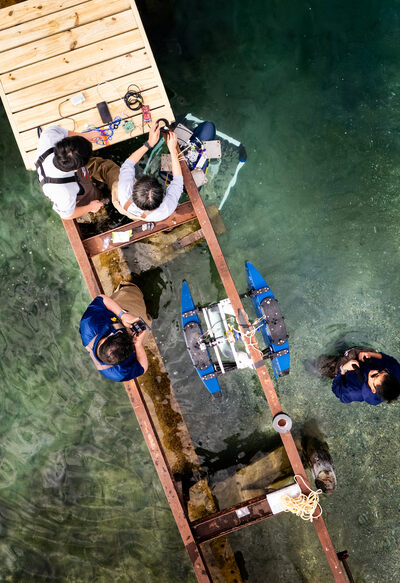
The researchers have taken their community-centered approach from the very beginning because they know public acceptance is essential to the success of energy technologies.
“A five-megawatt wind turbine is more than enough for such a small community. However, nobody wants to see one from their backyard,” said Lei Zuo, the Herbert C. Sadler Collegiate Professor of Engineering and the principal investigator of the project. “We need to work with the community to identify their needs and preferences.”
Zuo first reached out to residents in 2023, when he started thinking about how he could improve energy systems for rural communities. He asked Tara’s Meadow, the educational center that organizes the sustainability fair, to schedule a webinar for the community. The partnership has continued to grow since.
“Living on an island, that captivates us all to think about what if we could capture all that energy from the waves, and enjoy it,” said Seamus Norgaard, director and board president of Tara’s Meadow, which organizes the sustainability fair.
Building energy independence
Some residents’ interest stems from a hunger for energy independence. In 2022, High winds toppled aerial cables connecting the island’s power plant to the underwater cable to the mainland grid, which the residents unaffectionately refer to as their “umbilical cord.” Residents outside the town of St. James lost power for two to three days, according to a report issued by the township. Residents lost power again in 2025, during a dangerously cold ice storm.
“It would be really nice to have sustainable, reliable power on our own, here,” said Beth Crosswhite. She has lived on the island year-round for more than 40 years and became a co-chair of the researcher’s advisory board to help advance the technology.
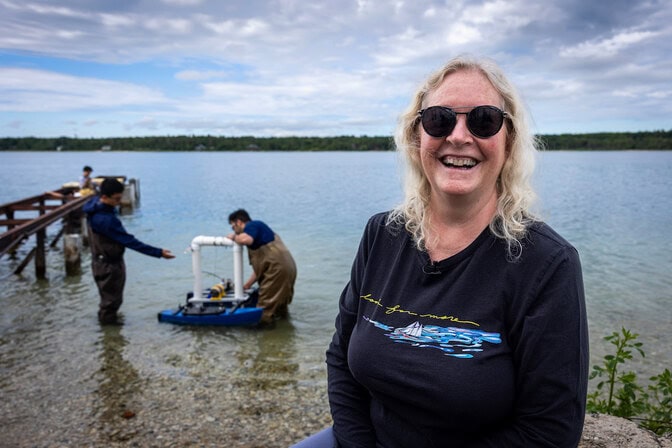
In the long term, Zuo hopes his work with Beaver Island will help unlock the full potential of wave energy. Ocean waves in the United States have enough energy to cover 63% of U.S. energy generation. The Great Lakes are an ideal test bed because the waves aren’t as strong as on the coasts, so they won’t break early prototypes, yet, they pack about as much energy per meter as waves on the coasts of Japan, South Korea, and the South China Sea, Zuo said.
“Helping the island achieve energy independence is important, but it’s important for the country too,” said Lei. “Using more local sources of electricity rather than relying on imports from other countries is important for energy security.”