A manual for efficient wave energy converter prototyping
An open-source, standardized methodology aims to streamline efforts to design small-scale wave energy converters, moving closer to harnessing offshore renewables.

An open-source, standardized methodology aims to streamline efforts to design small-scale wave energy converters, moving closer to harnessing offshore renewables.
Converting wave motion into electricity holds enormous potential as a renewable energy source, but a lack of standardized prototyping is holding back technological development. A research team led by University of Michigan Engineering designed two small-scale wave energy converter prototypes accompanied by a standardized methodology in an effort to fast-track high-quality wave energy converter research.
The study published in the Journal of Mechanical Design included collaborators from Cornell University, Georgia Institute of Technology and Princeton University.
“This is the first design methodology presented for wave energy converters. Having this standardized methodology will reduce repeated mistakes in early development, launching the technology further towards commercialization,” said Maha Haji, an assistant professor of mechanical engineering at U-M and senior author of the study.
Unlike intermittent wind and sunshine, ocean waves are consistent and predictable. The U.S. waters alone hold enough extractable power to meet 34% of the country’s electricity consumption if the resource can be tapped.
“We are driven to use the vast ocean resource to create sustainable power for humanity. Wave energy has been long overlooked. It is predictable, constant and 100 times more power dense than wind. It is time we advance this technology past benchtop testing,” said Olivia Vitale, a doctoral candidate of mechanical engineering at Cornell University and lead author of the study.
Most wind turbines look the same—a tall tower attached to a rotor with three blades—because they have converged on an optimal standardized design. Wave energy converters come in all shapes and sizes. Design knowledge is often undocumented or scattered in different institutions, leaving researchers to reinvent the wheel every time a new prototype is built.
To work towards convergence, the research team centralized, streamlined and validated two small-scale wave energy converter prototypes: a heaving point absorber, which bobs up and down with waves, and an oscillating surge wave energy converter, which rotates about a hinge.
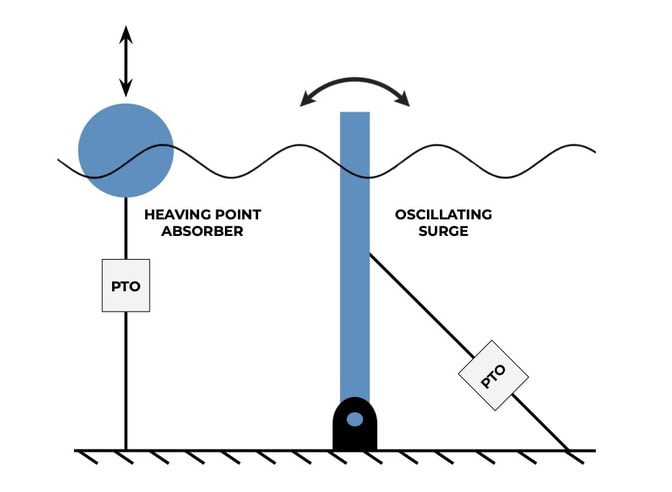
The research team compiled and prioritized design steps for small-scale prototyping to capture system physics before a full-scale launch. While mechanical and electrical goals can be added, the most basic steps are to determine the appropriate fluid physics and scaling, resonance and mooring.
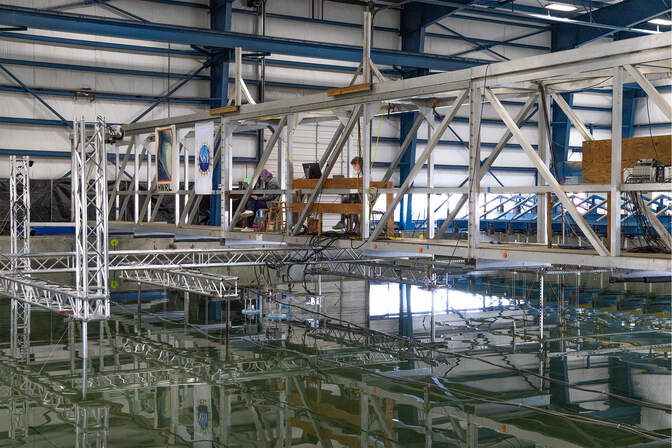
Understanding the test facility dimensions is a critical first step in any prototyping as the water depth influences wave behavior, hydrodynamic forces and model scaling. For this study, the Oregon State University O.H. Hinsdale Wave Research Laboratory allows a maximum water depth of 137 cm. Considering the facility’s constraints and what would best represent ocean parameters, the researchers applied Froude Scaling, a method used to scale physical models where gravity is the dominant force. The team arrived at a 1:50 scale, which means that a 1-meter-tall prototype equates to a 50-meter-tall full-scale device.
With these critical parameters defined, the prototype then must be built to resonate, or align motion, with the waves. Last, the mooring that secures the device, preventing it from floating away, must not interfere with the device’s natural motion.
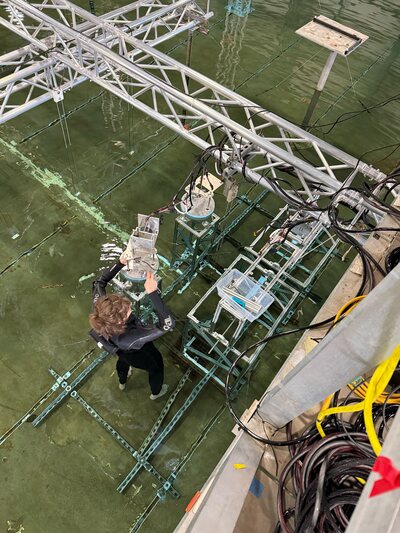
Because mechanical friction is disproportionately large at a small scale, friction must be minimized for the power take-off mechanism, which converts wave motion into the rotational motion needed to generate electricity.
The researchers recommend a rack-and-pinion power take-off as best for reducing friction. In a rack-and-pinion, a fixed cog or a toothed bar engages with a smaller cog. This is the same mechanism used in car steering systems.
Beyond friction, electrical current measurement resolution also becomes a limiting factor on the small-scale. The power produced is often in the milliwatt range, which standard motor controllers are unable to measure precisely. To overcome this, the research team added a highly programmable controller that can record motor current in real time. Moving forward, the researchers recommend higher resolution sensors can help further reduce measurement errors.
By consolidating scattered design knowledge into a unified, open-source methodology, the research team has provided a blueprint for more rigorous and efficient laboratory testing. This standardization ensures that future researchers can focus on innovation rather than troubleshooting common hurdles.
This research was funded by the Cornell Atkinson Center for Sustainability Summer Mentored Research Grant 2023, FAST Grant 2024 and 2030 Project; Sea Grant Regional Research Project (R/ATD18-NESG); United States Department of Energy Testing and Expertise in Marine Energy RFTS 12; and the National Science Foundation (DGE–2139899).