Air quality: rainfall history matters as much as where the air came from
A 19-year ‘goldmine’ of cloud and rainwater samples collected from a New Hampshire mountain provides fresh insights about air pollution.

A 19-year ‘goldmine’ of cloud and rainwater samples collected from a New Hampshire mountain provides fresh insights about air pollution.
Rainfall history is just as critical to predicting air pollution as where the air came from, a team led by University of Michigan Engineering researchers, in collaboration with scientists at the Appalachian Mountain Club and Plymouth State University, has discovered.
The findings give meteorologists a physical benchmark to improve simulations that predict changes in pollution levels over complex terrains. It also shows how air pollution can be deposited in sensitive mountain environments, with downstream effects for waterways fed from the mountains.
The research team analyzed cloud and rainwater samples collected over 19 summers (1996-2014) at the top of Mount Washington, New Hampshire, by the Appalachian Mountain Club. The rare, long-term sample series contained markers of human pollution and rainout—how much it rained before the air mass arrived in New Hampshire.
“Mount Washington is the tallest peak in the northeast and experiences extreme weather. This isolated, remote region provides unique data that helps us study how pollution comes into the area,” said Lauren Richards, an undergraduate student at U-M majoring in climate and meteorology and lead author of the study published in Earth and Space Science.
Adriana Bailey, an assistant professor of climate and space sciences and engineering at U-M and co-author of the study, describes the long-term, cloud and rainwater samples as a “gold mine.”
In most cases, physical samples are not available, and researchers rely on complex simulations to estimate microscale flows that influence air pollution patterns. While useful, these need a lot of computing power, are limited in their spatial resolution, and require a lot of customizing for specific sites, using data that may not be available at the location of interest.
“It’s a valuable piece of the scientific puzzle to have these physical samples to directly tell you something about where the air came from and what pollutants it carried,” said Bailey.
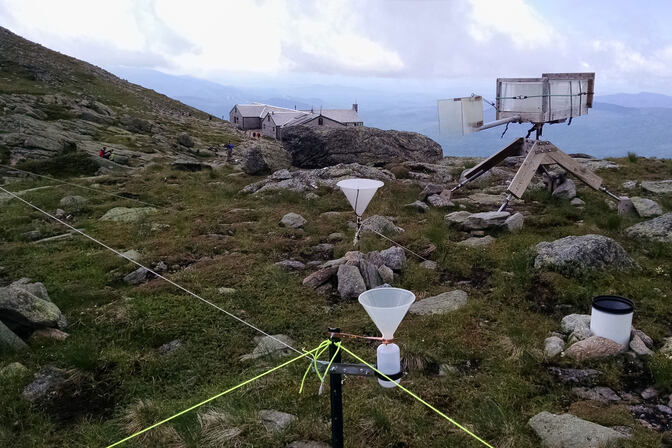
While rainwater is simple to collect in a funnel, cloud water collection requires special equipment. The Lakes of the Clouds hut, run by the Appalachian Mountain Club, uses a series of teflon strings on a swivel that move with the wind. As clouds pass through, water condenses on the strings and dribbles into a collection vial.
“Our goal in monitoring cloud and rain water chemistry on the mountain was to understand acid deposition at higher elevations. This allowed us to share data with federal land managers and educate the public about the causes of acid rain, as well as the remedies,” said Georgia Murray, Appalachian Mountain Club Senior Scientist.
As many samples had been in storage for several decades, the research team began with a quality control step, removing samples with signs of evaporation.
The research team chose sulfate ions (SO42—) as a proxy for atmospheric pollution concentrations. Sulfate is a common marker in air pollution studies, allowing easy comparison, and it presented the strongest signal compared to other pollutant ions like nitrate or ammonium.
To figure out how much rain the clouds had previously produced, they looked at “isotopically heavy” hydrogen and oxygen atoms in water that carry extra neutrons in their atomic nuclei. If a cloud has a history of rain, it has a smaller proportion of heavy water molecules, enabling the team to understand how much rainout occurred upwind in the air masses sampled at Mount Washington.
To test the sampling method, the researchers combined Mount Washington water data with three-day NOAA wind models to see if knowing where an air mass came from was enough to predict its pollution levels.
On its own, knowing which of the five regions the wind came from, such as the industrialized southwest versus the cleaner northeast, accounted for 40% of the doubling and halving of the sulfate ion concentration among measured clouds and rain. However, factoring in both where the air came from and how much it rained along the way captured 55.6% of sulfate pollution patterns.
“We found that precipitation is just as important as the source of the air mass in determining the pollution concentrations. We did expect precipitation would have an impact on pollution, but showing it quantitatively was really interesting to see,” said Richards.
As a follow-up, the Appalachian Mountain Club began collecting river water samples alongside rain and cloud water to gather an integrated understanding of regional pollution. This is important because the pollution in rain flows into these waterways, affecting both sensitive mountain environments and ecosystems downstream.
Researchers from Plymouth State University and the Appalachian Mountain Club also contributed to the study.