
UK’s Royal Society elects Stephen Forrest, engineer and entrepreneur
Forrest’s work underpins commercial fiber-optic communications and OLED displays, with an eye to future generations of photovoltaics.

Forrest’s work underpins commercial fiber-optic communications and OLED displays, with an eye to future generations of photovoltaics.
The world’s oldest scientific society in continuous existence has named University of Michigan Engineering professor Stephen Forrest a fellow. Founded in 1690, Britain’s Royal Society has counted Isaac Newton, Benjamin Franklin and Albert Einstein among its members. The 2026 class includes more than 90 leading researchers from around the world.

Forrest’s impact began at Bell Labs, where he played a crucial role in developing fiber optic communications. He created the first stable light detector for long-haul communications—a design still used today. As a university researcher, his work in organic electronics has spanned fundamental physics and photonics as well as applications in lighting, displays and solar cells.
“I have been very fortunate to have worked on problems that turned out to have impact in such a diverse collection of fields. For this, I credit so many excellent students and professional colleagues with whom I have collaborated over the years. And I never have underestimated the importance of good luck!” said Forrest, the Peter A. Franken Distinguished University Professor and a professor of electrical and computer engineering, physics, and materials science and engineering.
Many of his findings have been commercialized through Universal Display Corporation—Forrest participated in the company’s founding in 1994. For example, his work has underpinned Samsung’s OLED displays since the company first introduced OLED screens on its flagship Galaxy phones in 2009.
His work in photovoltaics introduced transparency, opening the possibility of electricity-harvesting windows, and addressed problems related to the efficiencies and lifetimes of these devices. His recent work in thermal photovoltaics aims to help solve the intermittency problem with renewable energy, converting energy stored as heat into electricity. He co-founded Heat2Power to bring the technology to market.
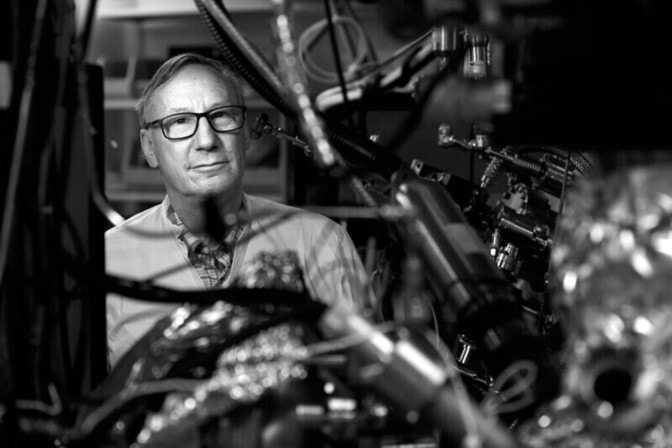
“Professor Stephen Forrest is recognized globally for his limitless ingenuity and deep impact on communications. He is more than worthy of election to the Royal Society. We are proud to call him an alumnus and longtime member of our community,” said Domenico Grasso, president of the University of Michigan.
Forrest joins more than 1800 Royal Society fellows worldwide, including U-M’s Mark Newman, the Anatol Rapoport Distinguished University Professor of Physics, and Margaret Kivelson, a research professor of climate and space sciences and engineering.
Forrest started his academic career with a BA in Physics from the University of California, followed by a master’s and PhD in Physics from the University of Michigan. He was first hired as a professor at the University of Southern California in 1985. In 1992, he moved to Princeton as the James S. McDonnell Distinguished University Professor of Electrical Engineering and then chaired the department from 1997 to 2001. He returned to Michigan in 2006 as the university’s vice president for research until 2014.
In addition to Universal Display Corporation and Heat2Power, Forrest has participated in the founding of Epitaxx, Inc., Sensors Unlimited, NanoFlex Power, and Apogee Photonics. He served on the Board of Directors and the Growth Technology Advisory Board of Applied Materials and currently serves on the Board of Governors of The Technion, where he holds an honorary doctorate.
His fellowships and memberships include the National Academy of Engineering, National Academy of Sciences, American Academy of Arts and Sciences, National Academy of Inventors, American Physical Society, Institute of Electrical and Electronics Engineers, and Optica.