A better way to help newborns breathe
Researchers outline the best positive pressure ventilation techniques for babies, as well as clinicians.

Researchers outline the best positive pressure ventilation techniques for babies, as well as clinicians.
Each year, about 400,000 U.S. newborns—5% to 10%—need help taking their first breath. This support, called positive pressure ventilation (PPV), is delivered via a face mask using either a self-inflating bag or what’s called a T-piece resuscitator. But pressing the mask too firmly can put pressure on the baby’s airway and block the flow of air into the lungs.
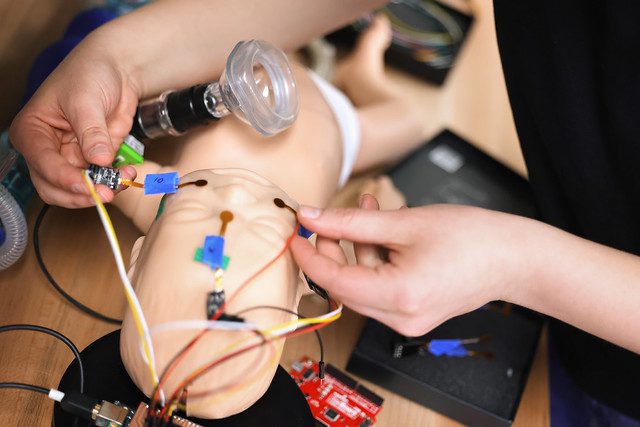
A team from University of Michigan Engineering and the U-M Medical School set out to determine the safest way to provide positive pressure ventilation. With ultra-thin force sensors on a manikin, they discovered that the T-piece device poses less airway risk and is easier on clinicians’ hands compared to the bag. And crucially, they found that clinicians can get a good seal with a gentle touch.
“We were able to show that you can apply a low level of force and still get a low level of air leakage,” said Leia Stirling, professor of industrial and operations engineering and robotics. “That led us to developing strategies that can allow the clinician to get an improved seal without high force. “A lot of that comes down to how they hold the baby’s head and how they hold the mask.”
The team then developed software that provides force measurements in real-time for clinicians learning proper technique. The team has applied for patent protection for their hardware and software system. AI contributed to this human-edited-summary of the article Helping babies breathe easier from their very first moments by Jim Lynch.