Harnessing intricate, self-organized plasma patterns to destroy PFAS
The first images of plasma-water interactions reveal the electrical forces that could help manipulate patterns to treat larger volumes of drinking water more affordably.

The first images of plasma-water interactions reveal the electrical forces that could help manipulate patterns to treat larger volumes of drinking water more affordably.
Increasing the surface area when plasma and water interact could help scale up a technology that destroys contaminants such as PFAS, detergents and microbial contaminants in drinking water, new research from the University of Michigan shows.
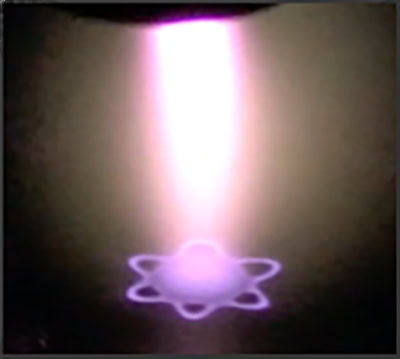
Under certain conditions, when plasma comes in contact with water, it can self organize, forming intricate patterns resembling stars, wagon wheels or gears that expand the contact area. While the physics of plasma self organization remains elusive, a better understanding can help harness it for more efficient water decontamination.
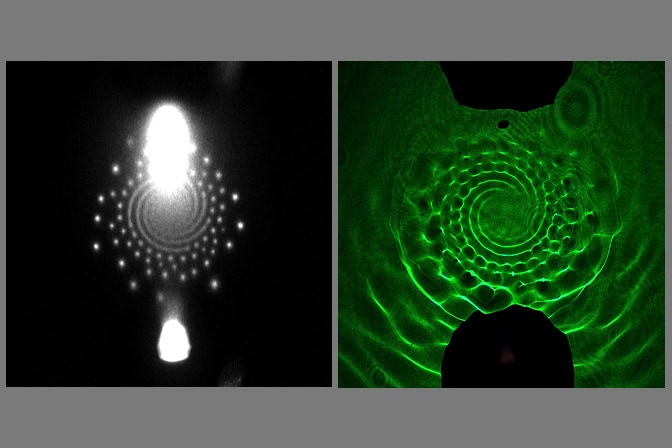
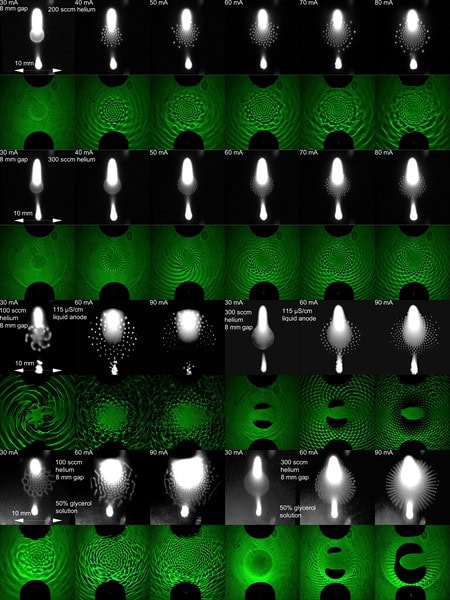
The U-M research team captured the first images of the water surface below the self-organizing plasma, revealing that the plasma exerts an electrical force on the water that distorts the surface and also generates surface waves.
Results suggest that the shape and size of the waves are affected by the gas heating rate and the water’s electrical properties, which could be manipulated to favor larger plasma surface areas to treat more water at once. The study, published in Plasma Sources Science and Technology, was funded by the National Science Foundation and the Department of Energy.
PFAS, known widely as forever chemicals, were introduced into products for their heat and stain resistant properties. It is a key component in fire fighting foams and non-stick coating on pots and pans. However, these same properties, driven by strong carbon-fluorine bonds, make the compound resist breaking down once discarded. As PFAS seeps into the environment into ground and surface water sources, this water is uptaken by crops and animals. It accumulates in human tissue and over time increases the risk of cancer formation and other negative health effects such as endochrine disruption.
Recent research has shown that plasma can destroy PFAS when injected into contaminated water. The plasma, an activated gas made in regular air at atmospheric pressure, is made of energetic electrons, ions and excited species. The energy lies essentially in the low mass electrons, ions and photons. In this case, nonthermal plasmas are produced by fast high voltage pulses. The water in contact with such plasmas is therefore not heated and in fact these plasmas are even gentle enough to treat biological tissue in a field called plasma medicine.
Upon contact with water, the cold plasma produces ions, solvated electrons, excited molecules, ultrasound waves, shockwaves and UV light that can break the fluorine-carbon bond. This feat is impressive given that the carbon fluorine bond is the strongest bond in organic chemistry. The energetic plasma processes also break the backbones of the carbon chains that make up PFAS compounds creating smaller molecules, mineralizing the PFAS into harmless remnants. Conventional water treatment methods cannot destroy this toxin, so advanced methods are critical.
“Laboratory demonstrations show cold plasma can get rid of a lot of contaminants in water, removing them almost completely. It opens up a new opportunity to treat these legacy chemicals,” said John Foster, a professor of nuclear engineering and radiological sciences and aerospace engineering at U-M and senior author of the study.
While the approach is effective, plasma injection is energy-intensive and expensive, making it challenging to introduce on the industrial scale.
Instead of dissipating like the ripples from a raindrop on a pond’s surface, plasma patterns become more complex as they radiate outwards. In these entropy-reversing patterns, more of the water’s surface area comes in contact with the plasma.
“These processes are governed by non-equilibrium thermodynamics. Here energy and reactive species are deposited by the plasma locally in an open system such that deposited species concentration never approaches thermodynamic equilibrium as reactants cannot build up. Without reactant depletion, these open systems are susceptible to self organization. These pattern footprints are larger and thus can be used to increase plasma contact area,” Foster said.
If it’s possible to manipulate the patterns, they could help treat larger volumes of water more efficiently.
When studying the self-organized patterns, a ceiling light caught a researcher’s eye helping to notice the water beneath the plasma was textured—similar to how the sun’s glint on the ripples of a pool shows the surface is not flat.
“The deformed liquid surface had always been there, but I suddenly realized while looking at the liquid surface at a certain angle. Science is everywhere, pure and coherent,” said Zimu Yang, a doctoral graduate of nuclear engineering and radiological sciences at U-M and first author of the study.
As the plasma-water interactions happen within about 10 microseconds, or 10 millionths of a second, the research team developed a specialized, high-speed camera setup to capture the moment of surface perturbation.
In the experimental setup, a plasma jet is positioned just a few millimeters above the water surface. A speckled laser points down at the water from an angle, ensuring the camera will capture how the resulting wave patterns reflect the light.
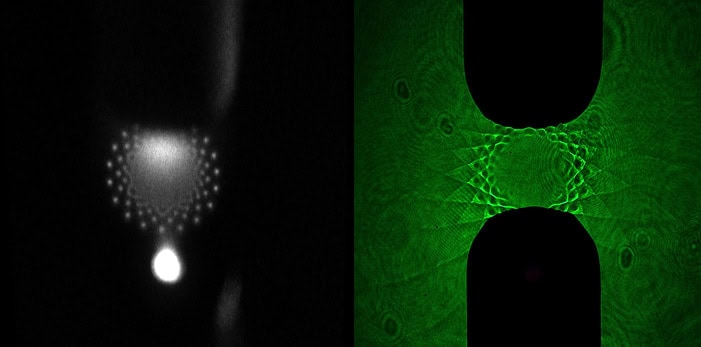
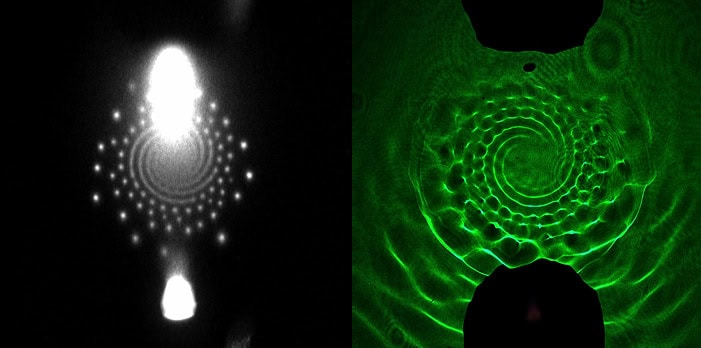
The researchers synchronized the high-speed camera to the fast, high-voltage plasma jet pulses to capture the exact moment the plasma and water interact. The images revealed that the plasma pushes the water away via an electrical field, creating a mirror image of the electrical forces coming from the plasma pattern above it.
To understand how the patterns evolve, the researchers repeated the experiment many times while increasing the time between pulse and camera capture. Precisely timed shots confirmed that the plasma pattern causes the water deformation, not the other way around. At the pattern boundary surface waves form. The resulting waves are driven by the plasma pattern and could be altered by adjusting the gas flow rate and heating rate of the plasma.
“If this could be controlled and perhaps enlarged, plasma methods can be scaled up to treat larger volumes and ultimately be integrated into water treatment plants to remove contaminants, including PFAS,” said Yang.
This research was funded by the National Science Foundation ECosystem for Leading Innovation in Plasma Science and Engineering (ECLIPSE) program (2206039) and the Department of Energy (DE-SC0025624).