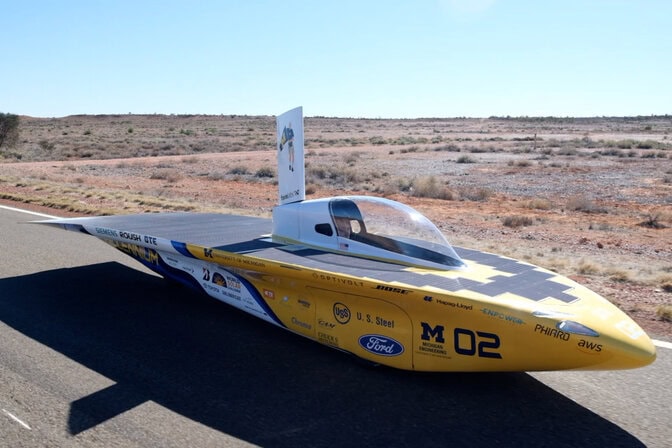
U-M finishes as top North American solar car in international race’s first Australian winter
The Wolverines placed seventh overall in this year’s Bridgestone World Solar Challenge.

The Wolverines placed seventh overall in this year’s Bridgestone World Solar Challenge.
Racing under reduced winter sunlight for the first time, the University of Michigan solar car was the leading North American car during the 2025 Bridgestone World Solar Challenge. They crossed the finish line in Adelaide, Australia this afternoon, marking the end of their four-day endurance race across 1,800 miles of the Australian Outback.
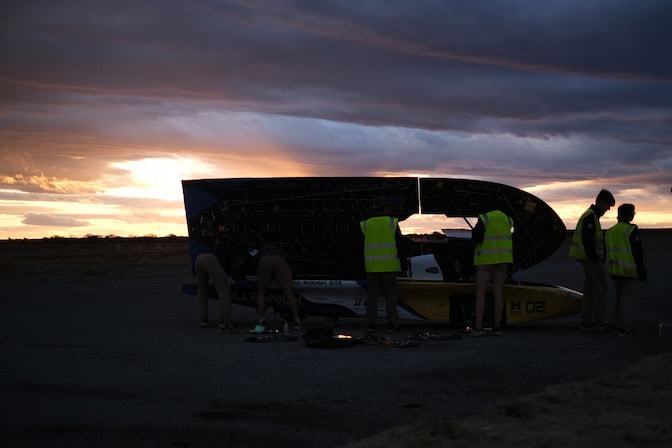
The Wolverines placed seventh overall, in what was a neck-and-neck battle with the fifth and sixth place teams—Tokai University and Western Sydney University. U-M and Tokai traded fifth and sixth positions on the fourth day of the race, and both arrived at their final control stop in Glendambo only one minute apart.
But the weather turned overcast and crosswinds picked up speed on U-M’s final stretch. The team deployed their car’s new retractable aerodynamic fin, in an effort to help keep the car stable and push ahead. Another key improvement for the new ‘Millennium’ car was its larger solar array with new hardware and software systems, allowing the vehicle to tap into each cell individually and maximize power output.
But Tokai and Western Sydney managed to overtake them. U-M crossed the finish line 30 minutes after Tokai, who only finished a minute ahead of Western Sydney.
Canada’s Eclipse ETS, from the École de technologie supérieure (ÉTS) in Montreal, was the only other North American team to officially compete in the same race class as U-M. They finished in ninth place, a little over an hour after U-M.
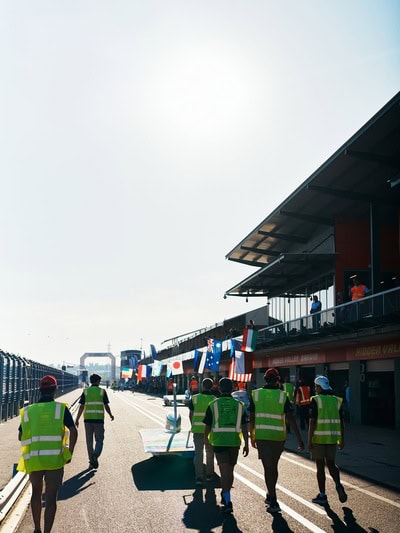
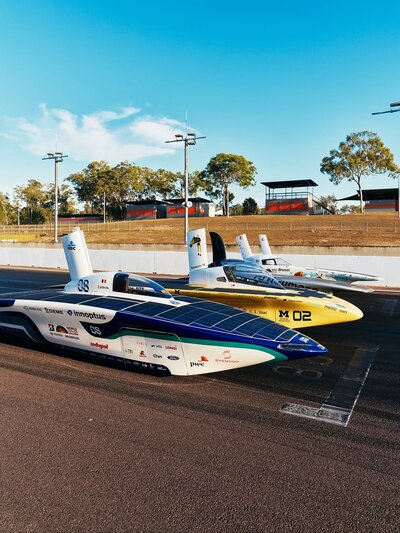
The top contenders from the previous challenge, in 2023, defended podium positions this year. Dutch teams Brunel and Twente placed first and second, followed by Innoptus from Belgium.
U-M Solar Car is a student-led engineering project team. They have won the American Solar Challenge ten times, had podium finishes in the Bridgestone World Solar Challenge seven times, and won their first international championship in 2015 at the Abu Dhabi Solar Challenge. With more than 170 students from schools and colleges across the university, it’s one of the largest student organizations on campus.