National champs: U-Michigan Solar Car Team takes first in American Solar Challenge
After a major setback, the students’ indomitable spirits and another team’s generosity propelled them to the finish.

After a major setback, the students’ indomitable spirits and another team’s generosity propelled them to the finish.
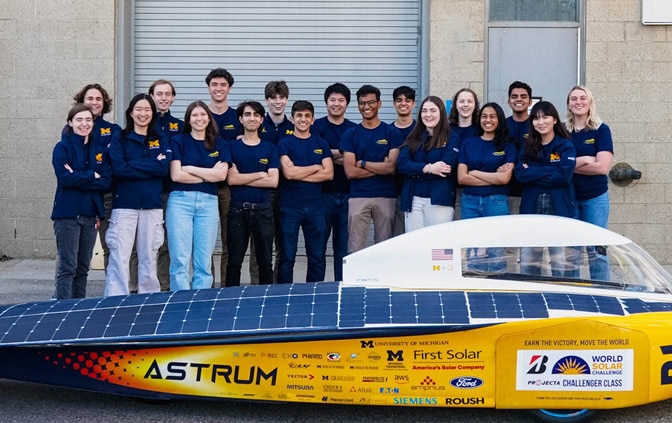
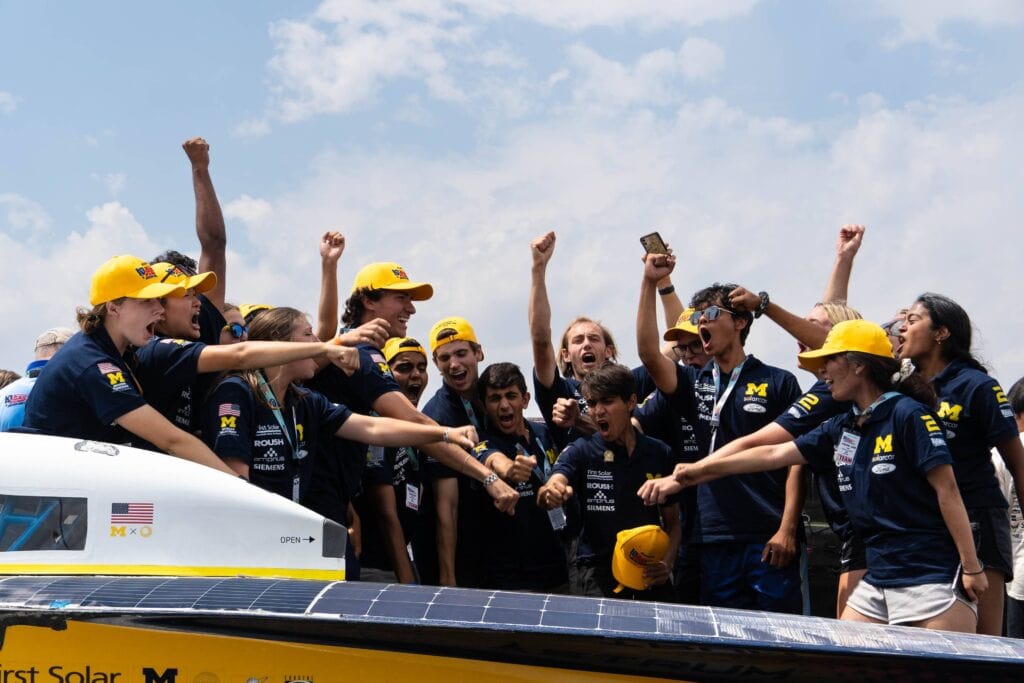
With dedication, caffeine and the kindness of a competitor, the University of Michigan Solar Car Team on Saturday won the American Solar Challenge, an 8-day, distance-based race from Tennessee to Wyoming.
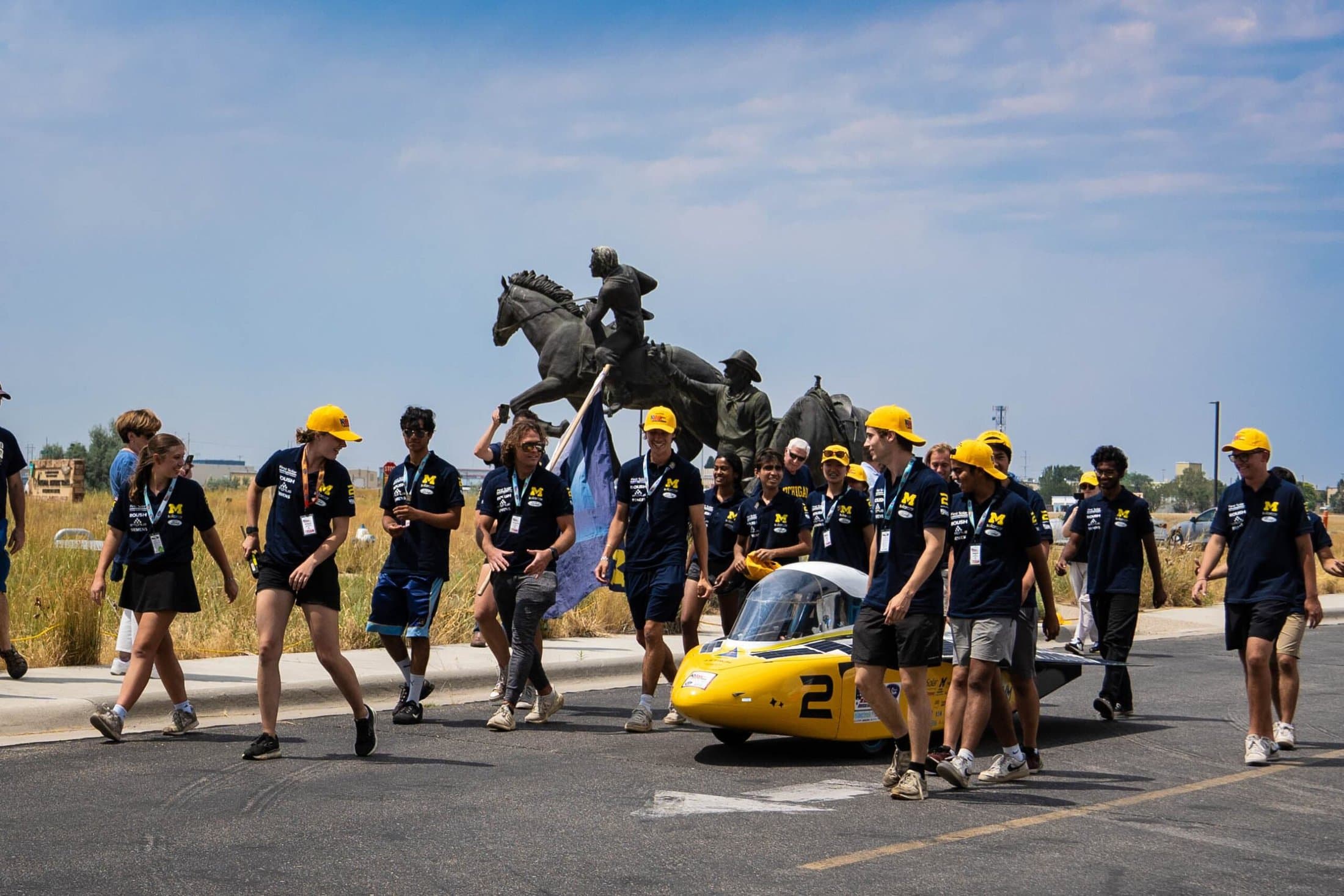
The U-M team covered 2,120 miles before crossing the finish line in Casper, Wyoming, taking advantage of many of the route’s opportunities to add distance through optional loops along the way.
The performance reclaims the team’s title as national champions. U-M had won six consecutive American Solar Challenges, held every other year, until finishing second in 2018. This is the first U.S. race they’ve competed in since then, due to the COVID-19 pandemic.
It tested their endurance, both on and off the course.
“It feels outstanding to be national champions again,” said Daniel Benedict, the team’s project manager and recent U-M computer science graduate. “For the past year, all of our consciousness has been dedicated toward this vehicle. All that hard work paid off, and I couldn’t imagine a better ending.”
The start could have gone smoother. One of the steps toward qualifying for the race is the Formula Sun Grand Prix, a track event that requires teams to complete a set number of laps. Eighteen laps in, while going around a sharp corner, Astrum tipped and rolled.
“It was scary, but because of how we had designed the car, I wasn’t injured at all,” said driver Naman Kabra, a rising junior studying electrical engineering.
The team had recently reconfigured the roll cage to comply with regulations. Astrum was built to first compete in the 2023 World Solar Challenge in Australia, where it finished fourth. The two competitions have different vehicle requirements.
“Retrofitting was an intense challenge,” Benedict said, “but we clearly did it effectively. The new roll cage proved itself.”
Ian: There’s something very special about a group of people who are brought together not to make money, but by a shared passion for engineering and for building something truly world-class. You really do pour everything you have into these cars for months on end.
Terry: Coming into college, if you told me, “Hey, go design a battery pack,” I’d have no idea where to start. Same with a solar car—I’d have no idea. But I learned how to approach real-world engineering problems.
Ian: You need a lot of people working together exceptionally well to make a car that’s going to cross the desert, like in the World Solar Challenge.
[Voice off camera] Bakker, you ready?
[Solar car drives by]
Terry: We knew it was going to be hard. It’s never what you expect. No matter where you finish, there’s always going to be something unexpected.
{Announcer speaking}
Daniel: It looks like we had some electrical issues. The car turned off and we tried to switch between our coils. We’re checking to see if there’s a short in the circuitry, considering all the options for how to continue.
Ian: The hot lap was really disappointing—especially for the electrical team. After a full day of testing, we were excited to see where Ethan could place. But when he radioed back halfway around the track, “The car’s not turning on,” we were like, “Oh no.”
Terry: As soon as he started slowing down around turn 7 or 8, I knew something was wrong. Either we wouldn’t get the time we wanted, or we wouldn’t finish. And unfortunately, we didn’t finish.
Ian: He limped the car back, we took it into the garage, and realized we’d blown a fuse. That put us in a really bad spot to start the race. You never want to be last.
Terry: After the hot lap, the team came together. We knew the car was capable. We knew the first day would be chaotic.
[Off camera] Hey Bakker, no matter what, kick some [omitted], dude.
[Music]
[Crickets chirping, water trickling]
Shourya: I think we passed 10 cruiser cars?
Joey: My tally was 23.
Shourya: Total cars?
Joey: Total cars.
[Music]
Chris: These students have experiences similar to new engineers on distributed teams. They own a small part of a larger project. Our philosophy at Michigan is to make these organizations as independent as possible. We provide support and sponsorship, but beyond that, the students manage things on their own.
Ian: Ready to drive another 350 kilometers in a solar car.
Sam: It’s an opportunity to experience industry before industry. There’s a budget, a team, an organizational structure. There’s no ideal solution. You could do the best option, the cheapest option, or the most robust option. It’s about optimizing, committing money you’ve raised, and working with sponsors. It’s kind of like a mini startup incubator.
Chris: The most important quality is resilience. Students will have setbacks, and it’s about being able to collect themselves, analyze the problem, and apply what they’ve learned. Giving up isn’t an option.
Sam: Time on project teams is equivalent to time in industry. If a student has three or four years of project experience, I consider that two to three years of industry experience. It shows they can collaborate, hit deadlines, and recover when things go wrong.
Terry: I never thought we were out of it.
[Voice off camera] Yeah, I hear it knocking.
Terry: I knew we had a good car—capable of making passes. When we passed Sonnenwagen, that was the moment I realized we actually had a shot at the podium.
[Parrots calling]
[Generator running]
Will: Just one step at a time. Run our race like we’re in it for the world championship. Guys, Go Blue on three! One, two, three—Go Blue!
[Music]
Ian: Our spirits were higher than ever. Even if we didn’t make podium, we showed we deserved to be here, despite starting last. We were proud of what we accomplished together.
[Music]
Nathan: I’m incredibly excited to be here at the end of a very long journey. It’s been full of triumphs, setbacks, and growth. I couldn’t be happier. Spirits are high. We gave it our all. We didn’t bring home first place, but none of us regret anything.
Ian: In our 30+ year history, we’ve yet to be the best. But the process of trying teaches you so much about yourself and what it means to be an engineer. You carry that forward into everything else you do.
Terry: I’ve found my limits. I’ve grown so much as a person and an engineer. It’s truly invaluable, and I’m so thankful I did this and kept pushing.
Chris: At the end of the day, it’s not about cars or planes or trains—it’s about the students, their experiences, and what they take away. You think you’re building a car, but really, you’re building engineers, business professionals, and leaders who can execute under pressure.
Ian: There are so many lessons here: how to do your job as an engineer, a teammate, a human being.
Nate: Alright, you guys got this!
Ian: These are lessons you can’t teach in the classroom. To me, there’s no question that solar car is the best thing I’ve ever done in my life—and I don’t know if that will ever change.
[Music]
But the car was damaged. The team spent the rest of the day and all night fixing it. On Day 2, Astrum was back on the track. After a dozen laps in the rain, it became clear the motor had additional damage. Sidelined again, they worked around the clock.
“At 4 a.m. on the last day, we had to decide if we were going to pack up and go home or stay and figure out what to do,” Benedict recalls. “Everyone had to dig deep and find every ounce of motivation.”
They came up with two potential solutions: fly a teammate from Ann Arbor with a motor in his suitcase, and ask for help getting the parts they needed. Much to their amazement, the second option panned out. Other teams offered support, and Principia College loaned them a spare motor and motor controller. (The Illinois-based squad had decided not to compete in the cross-country contest.)
“Principia effectively saved our race,” Benedict said. “We’re so grateful they were willing to root for us.”
Principia went on to take second in the Formula Sun Grand Prix.
The U-M team got Astrum in shape and driver Kabra took it smoothly through another 31 laps before time was up. They hadn’t qualified with laps alone, but race officials make the final determination based on a number of factors.
What they saw in Michigan convinced them that Astrum was a reliable car, and the students were capable of navigating difficult, high-pressure situations. The U-M team was cleared to race.
Over the next week, the American Solar Challenge route took them along seven national historic trails. Local families—and Solar Car alums—cheered them on. Steep grades didn’t phase the car or its drivers, electrical engineering students Charlie Tate, Daryl Day and Kabra, who was thrilled to be back behind the wheel.
“Our crew chief asked if I was feeling up to it,” Kabra said. “I never hesitated. I felt even more ready to get back on track and show everyone we’re still here.”
Astrum is the 17th car made by the Michigan Solar Car Team since its founding in 1989. The team has won the American Solar Challenge ten times, had podium finishes in the Bridgestone World Solar Challenge seven times, and won the Abu Dhabi Solar Challenge in 2015. With more than 90 students from schools and colleges across the university, it’s one of the largest student organizations on campus.