A hybrid metasurface boosts interactions with infrared light
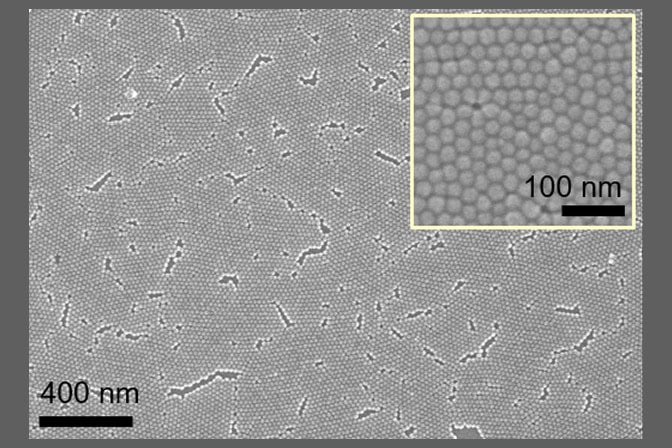
Randomly mixed indium tin oxide nanocrystals doped with 1% or 3% tin absorb and concentrate infrared light based on interactions among neighboring crystals.

Randomly mixed indium tin oxide nanocrystals doped with 1% or 3% tin absorb and concentrate infrared light based on interactions among neighboring crystals.
A one-crystal-thick sheet made from two types of nanocrystals mixed in solution can amplify or suppress infrared light beyond the sum of its parts, according to a study led by University of Michigan Engineering and primarily funded by the U.S. Army Research Office.
Known as a metasurface, the randomly mixed nanocrystals—made of indium oxide doped with 1% or 3% tin—interact with one another and infrared light to produce the superlinear optical effect.
Experimental results helped the team build a model that other researchers can use as a design tool, allowing them to choose the optimal doping levels and mixing ratios of nanoparticles to achieve certain light-matter interactions.
Specifically, incoming infrared light stirs up waves of electrons, called plasmons, on the metasurface that trap light on the nanocrystals and in the tiny gaps between them. Depending on the infrared light’s frequency, the mismatched electron waves of neighboring 1% and 3% indium tin oxide (ITO) nanocrystals either boost or suppress that trapped energy.
“We used different techniques and different theoretical backgrounds, and even though we studied them independently at first, eventually everything pointed toward a single theory and a single phenomenon,” said Yujin Park, a postdoctoral research fellow of chemical engineering at U-M and lead author of the study published in ACS Nano.
This collaborative study included researchers from Oak Ridge National Laboratory, Lawrence Berkeley National Laboratory, University of Texas at Austin, University of Colorado Boulder and Institució Catalana de Recerca i Estudis Avançats (ICREA) in Barcelona, Spain.
The U-M team first observed the deviations from linear optical effects with a far-field infrared spectroscopy technique. An infrared light source shines on the material as a whole, effectively averaging out the interactions among all the tiny crystals.
The researchers brought the light source closer, known as a near-field technique, to understand how optical responses vary across the metasurface in small clusters of nanocrystals using Synchrotron Infrared Nanospectroscopy, or SINS for short, at Lawrence Berkeley National Laboratory. SINS revealed that absorption varied from spot to spot depending on each particle’s immediate neighbors.
The electron beam in a powerful electron microscope at Oak Ridge National Laboratory zoomed in even closer with sub-nanometer precision. The technique mapped plasmon energy patterns around individual nanocrystals, confirming that the 1% and 3% ITO nanocrystals were truly randomly mixed and showing how neighboring particles interact to change how the material absorbs light.
The 3% ITO nanocrystals produce higher energy plasmon waves compared to 1% ITO nanocrystals. Like tuning forks of two different pitches vibrating in water, their ripples overlap in the 2.5 nanometer gaps between nanocrystals—reinforcing each other at some incoming infrared light frequencies and dampening each other at others.
“There are things that are invisible to light that become very obvious in the electron beam. We could readily differentiate the nanocrystals doped with 3% tin from the ones doped with 1% tin based on the way they interact with the electron beam, an interaction that’s completely invisible with light,” said Delia Milliron, the James and Judith Street Professor of Chemical Engineering at U-M and a senior author of the study.
“The experimental data from this study validates the physical picture predicted from electromagnetic simulations, paving the way for computation-guided engineering of nanocrystal-based plasmonic metasurfaces,” said Thomas Truskett, the Vennema Professor of Chemical Engineering at U-M and a senior author of the study.
Importantly, manufacturing metasurfaces in solution side-steps the limitations of expensive, top-down manufacturing like etching microscopic patterns on a surface, helping scale up the technology.
“Moving forward, it’s a question of how we use near-field interactions as a further design tool for how metamaterials manipulate light, potentially converting light between frequencies or polarizing light in unusual ways,” said Milliron.
Though in the early stages of development, ultrathin nanocrystal coatings could open the door for a variety of applications, including anti-glare coatings, thermal camouflage, or surfaces that cool themselves with light.
This research was supported by the U.S. Army Research Office (W911NF262A117; W911NF-23-1-0387), National Science Foundation (CBET-2323482), European Research Council (101141220-QUEFES) and Spanish Ministry of Science, Innovation and Universities (PID2024–157421NB-I00; CEX2024–001490-S).