Most powerful laser in U.S. renewed for five years
The U.S. National Science Foundation provides $33M to make key upgrades and keep the laser in service for a growing group of U.S. and international users.

The U.S. National Science Foundation provides $33M to make key upgrades and keep the laser in service for a growing group of U.S. and international users.
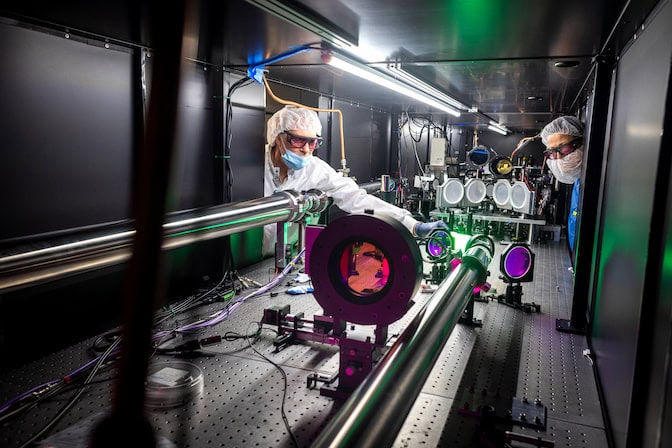
The most powerful laser in the United States received $33 million in its second round of operations funding from the U.S. National Science Foundation, helping the University of Michigan Engineering team make crucial upgrades and run roughly 150 weeks of experiments for laser and plasma science teams from across the U.S. and around the world.
Already, the team has run 72 weeks of experiments designed by researchers outside U-M—exploring a range of topics, from the extremes of physics to fundamentals that could underpin practical applications. On the practical side, researchers explore how to use laser systems to generate X-rays capable of imaging soft tissues at low doses, or produce particle beams that could be used to fight cancer or discover nuclear weapons materials hidden in cargo.
In what is known as laboratory astrophysics, the NSF ZEUS facility can recreate tiny versions of the physics at the edges of black holes and surfaces of neutron stars. It also probes the quantum realm, testing out how well the theory of quantum electrodynamics holds up in these extreme conditions.
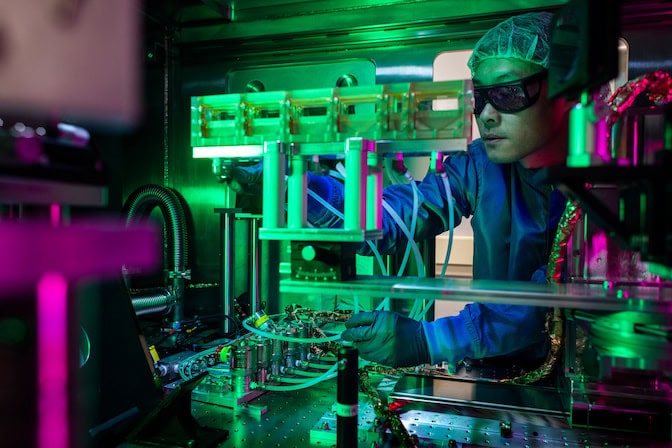
“With this renewal, we can continue rebuilding U.S. leadership in laser science, serving a growing community of researchers who explore the extremes of light and matter as well as the new technologies those findings could enable,” said Louise Willingale, director of the ZEUS laser facility.
The ZEUS team shifted into operations mode in 2024, when the facility had matched the power of the previous most powerful U.S. laser at one petawatt, or a quadrillion watts. Research groups around the world submit proposals for experiments, which are selected by an independent review panel. Last year, ZEUS established an advisory user group that provides feedback to shape future upgrade plans and ensure the facility delivers what users need and expect.
During the previous operation period, the ZEUS team continued increasing the laser’s power, hitting 2 petwatts in April 2025. ZEUS achieves its high power by adding energy to a stretched pulse, about 3 feet in length, and then shrinking it down to a short pulse, about 0.007 millimeters long.
To reach ZEUS’s design power of 3 petawatts, expected early in this operation period, the team has been working to make the beam more uniform. This prevents hotspots that might otherwise pit or permanently darken the million-dollar optical components that compress, transport or concentrate the laser pulse. This risk is why the team has been cautious in raising the power.
“At full power, NSF ZEUS will unlock a new class of experiments that cannot be done anywhere else in the United States,” said NSF Mathematical and Physical Sciences Directorate Head Tie Luo. “Researchers across the country will use this versatile facility to test some of the most promising and innovative ideas involving light-matter interactions, plasma physics and the quantum properties of vacuum itself.”
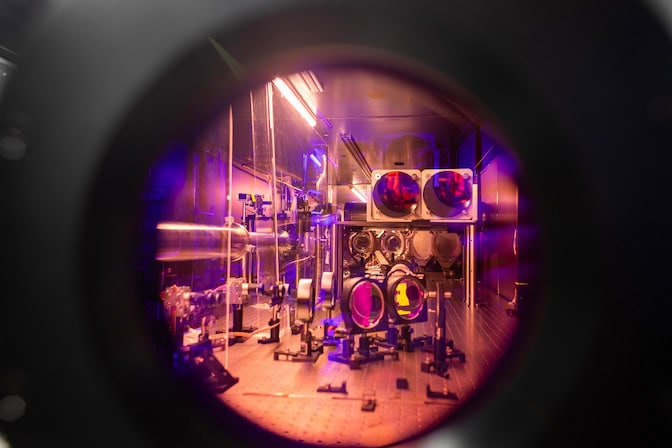
Another key upgrade is in the short-focal-length target area, also known as target area two, which houses experiments that need ZEUS’s highest intensities. The other two target areas focus light over longer distances.
The intense laser pulse hitting solid targets, such as metal foil, produces particles and X-rays. Rather than making particle and X-ray beams with conventional particle accelerators, which require very large rooms, laser physicists are demonstrating equally powerful tabletop particle accelerators, and findings from ZEUS can help advance that technology.
ZEUS originally reused the short-focal-length target chamber designed for its predecessor, HERCULES, which maxed out at 0.5 petawatts because of its smaller beam diameter. In addition to the larger target chamber, the team will use a technique to remove stray energy that runs ahead of the main laser pulse, making experiments cleaner and easier to interpret.
“The upgraded ZEUS Target Area Two will enable a wide range of cutting-edge experiments,” said Anatoly Maksimchuk, a research scientist in electrical engineering and computer science who leads the renovation and designed the beam-transport system and interaction chamber. “With its combination of high intensity, high contrast and three-pulse capabilities, Target Area Two will provide a unique experimental platform bridging high-field laser physics and laboratory astrophysics.”
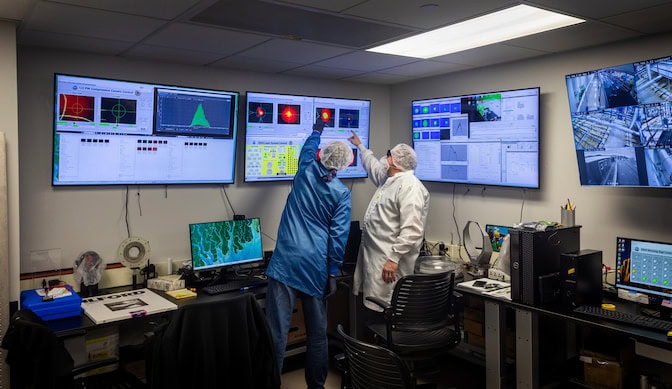
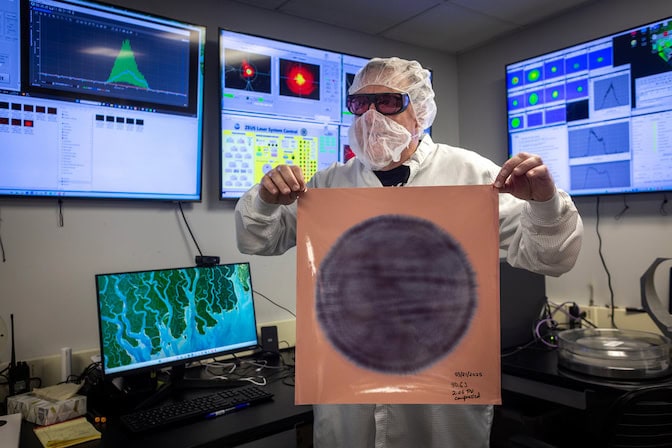
In this second operations period, the ZEUS team is integrating AI and machine learning tools to optimize laser operations. For example, the spot where the laser pulse focuses inside the target chamber needs to be extremely precise in order to overlap with another laser pulse or an electron beam.
Because the laser pulses travel hundreds of meters through the lab, temperature variations and vibrations can make them drift. To combat this problem, the team will send bursts of low-power pulses just ahead of the main pulse, using an AI model to predict any offset and adjust a mirror in the system to put the main pulse in the right place.
AI could also help analyze data sets generated through ZEUS experiments. The data are complex and influenced by many factors, including laser characteristics, target design, and experimental configurations. To make the most of AI’s ability to pick out connections overlooked by humans, the team will prepare the data sets to be easily ingested by AI models.
To help improve American laser science more broadly, ZEUS researchers are partners on a project led by the University of Nevada, Reno, to better understand extreme lasers and the data they generate.
Looking further ahead, ZEUS is also helping train researchers who could eventually operate a proposed 25-petawatt, two-beam laser facility. The proposed project, known as NSF OPAL, is an exploratory effort led by the University of Rochester. If built, it would represent a major expansion of U.S. high-power laser capabilities. The highest-power laser currently operating is Europe’s 10-petawatt Extreme Light Infrastructure.
ZEUS is housed in the Gérard Mourou Center for Ultrafast Optical Science, named for the center’s founder, a Nobel laureate who co-invented the laser pulse amplification approach that the world’s most powerful lasers rely on today.
Willingale is also an associate professor of electrical engineering and computer science and nuclear engineering and radiological sciences.