Ultrashort laser pulses achieve stronger photoemission
A new theoretical study finds shorter laser pulses achieve higher quantum efficiency for photoemission from a solid surface without increasing power or intensity.

A new theoretical study finds shorter laser pulses achieve higher quantum efficiency for photoemission from a solid surface without increasing power or intensity.
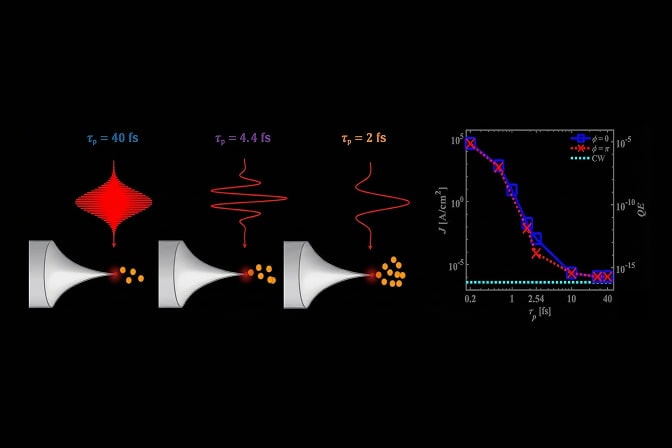
Using light to knock electrons loose from a surface—known as photoemission—may soon be achievable more easily in smaller labs with smaller lasers. Shortening the length of a laser pulse can increase the emitted electrons by several orders of magnitude without increasing the laser intensity or power, according to a University of Michigan Engineering study.
The study is published in Physical Review Research and was funded by the Office of Naval Research, Air Force Office of Scientific Research and National Science Foundation.
Efficient, low-power photoemission could make particle acceleration and high-resolution imaging techniques to visualize cells and atoms more accessible. It could also help researchers develop lightwave electronics, which use light to move charge carriers, for ultrafast computing.
“Many advanced technologies need electron emission, but the process is usually very inefficient. We want to find alternative ways to improve this efficiency without using stronger lasers,” said Peng Zhang, an associate professor of nuclear engineering and radiological sciences at U-M and corresponding author of the study.
The research team built a mathematical framework to study how electrons break away from a solid surface when struck by a laser pulse. Specifically, they developed a precise quantum model by exactly solving the time-dependent Schrödinger equation, which predicts how a system’s quantum state changes over time.
Using the model, they tested how adjusting the laser pulse length changed quantum efficiency—the number of electrons released per photon—when laser power and intensity were kept the same. Shortening the laser pulse length from 15 cycles down to a subcycle (duration less than one laser cycle) increases the quantum efficiency by about 10 orders of magnitude. The subcycle pulse, part of a broader category known as few-cycle optics, is so brief that it is shorter than a single oscillation of the light wave itself.
“We were honestly pretty surprised by how large the increase in quantum efficiency turned out to be. To sanity-check it, we compared our model predictions against representative experimental results in the literature, and they actually fall in a similar range. So it seems plausible, but of course, it really needs experimental validation. Hopefully, this motivates some follow-up work to test and explore what is going on,” said Lan Jin, a graduate student of nuclear engineering and radiological sciences at U-M and lead author of the study.
Typically, low-intensity lasers struggle with quantum efficiency because photons are not energetic enough on their own to shake an electron loose from the surface material. In this calculation, gold requires 5.1 electron volts (eV) to release an electron, but the laser emits photons with an energy of 1.55 eV. Four photons must be absorbed by a single electron almost simultaneously to surpass gold’s energy barrier, which is less likely when photon density is low.
Squeezing a laser pulse into an ultrashort time window naturally broadens its range of frequencies. This is a consequence of the quantum uncertainty principle: a wave that exists only briefly cannot have a single, perfectly defined frequency. As a result, an ultrashort laser pulse always contains a spread of photon energies rather than just one. The wider spectrum introduces higher energy photons, close to or even higher than 5 eV, which are able to release an electron from gold on their own.
“This macroscopic boost in photoemission under few-cycle optical fields is yet another manifestation of macroscopic quantum physics, the very class of phenomena honored by the 2025 Nobel Prize in Physics,” said Zhang.
As a next step, experimental validation can help confirm that efficient electron emission may be possible even with low-power lasers.
This research was supported by the Office of Naval Research Young Investigator Program (N00014-20-1-2681), Air Force Office of Scientific Research (FA9550-20-1-0409; FA9550-22-1-0523) and National Science Foundation (2516752).