Designing memory-centric chips for future space telescopes
An SRAM chip design could avoid data-movement bottlenecks, helping next-generation telescopes image Earth-like planets orbiting distant suns.

An SRAM chip design could avoid data-movement bottlenecks, helping next-generation telescopes image Earth-like planets orbiting distant suns.
Two proposed computer chip designs could efficiently process data on future space telescopes while they search for Earth-like exoplanets, according to a University of Michigan Engineering study that will be presented at the IEEE Space Computing Conference in August.
[Music throughout]
The stars above.
What secrets do they keep?
[Narrated by John Rhys-Davies]
One of our biggest questions has always been: are we alone?
We’ve now discovered thousands of planets beyond our solar system. But how many of those distant worlds have the conditions for life as we know it?
How many have water vapor, a beacon indicating that oceans might be present?
How many have gases like oxygen and methane, possible signs of life itself?
And of those, which might truly have life?
After decades of asking, a future NASA telescope could bring us the answers.
The Habitable Worlds Observatory is a future mission designed in the tradition of the Hubble and Webb Space Telescopes.
It will use its unique and sensitive eyes to see planets like our own, hiding in the light of their distant stars.
Astronomers could then point this mighty space observatory to the most promising planets: those that may hold liquid water.
With the help of its coronagraph instrument, which blocks out the dazzling starlight, the telescope will look for undiscovered Earth-sized planets in the star’s habitable zone, where liquid water could exist.
The light from each planet will be split into a vibrant spectrum of colors, revealing clues to the chemical signatures we seek.
From there, we can attempt to discover if a planet’s atmosphere contains water, and from there, other signals like oxygen or methane.
Should all these signs align, the Habitable Worlds Observatory would delve deeper to reveal other hidden clues of life.
With further study, we could find signs of sprawling oceans and rugged continents.
And if signs of life are revealed, keep a watchful eye for changes over time.
This magnificent observatory could discover dozens of worlds akin to our own in its first five years.
The telescope will gather data on a wide variety of worlds, placing our own solar system in context within the grand tapestry of existence.
And the Habitable Worlds Observatory will — like the other great cosmic watchers Hubble, Chandra, Spitzer, Webb, and soon Roman — also conduct a wide range of revolutionary observations of our cosmos, improving our understanding of how our universe led to potentially habitable worlds.
Thus, the Habitable Worlds Observatory will help us embark on a quest as grand as any: to tell the story of life in the cosmos and whether or not we are alone.
[Habitable Worlds Observatory]
[Telling the story of life in the universe]
[NASA]
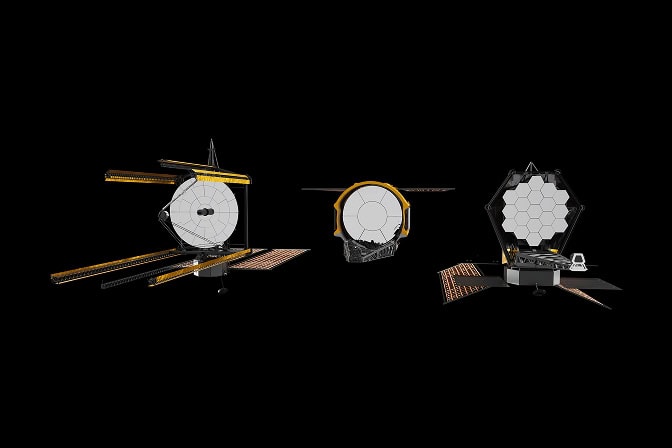
The research team evaluated their designs in the context of the Habitable Worlds Observatory, a proposed NASA space telescope designed to search for signs of life on planets outside of our solar system. The advanced telescope would orbit the Sun-Earth L2 point, the same band the James Webb Space Telescope orbits, which is about 1.5 million kilometers away from Earth. This spot keeps the Sun, Earth and Moon aligned behind the spacecraft, allowing a single sunshield to block out light and heat from all three.
To image Earth-like exoplanets, future space telescopes must process data in real time as they constantly correct tiny optical distortions to block out starlight and reveal faint planets nearby. Today’s radiation-hardened space processors are too slow for this task, and powerful GPU-based systems require too much power to be cost-effective in space.
“The key insight of our research is that future space missions don’t just need more computing power; they need the right kind of computing power. For these workloads, the bottleneck is moving data, not doing calculations,” said Nathaniel Bleier, an assistant professor of computer science and engineering at U-M and co-corresponding author of the study.
The research team showed how custom memory-centric chips could dramatically reduce power use, with the strongest design, Static Random Access Memory also known as SRAM, using up to 59 times less power than GPU-based alternatives.
Imaging exoplanets would require dense matrix operations and low arithmetic intensity. The data movement bottleneck is kind of like needing to drive 10 miles to a warehouse to pick up a single box, returning to an office to open it, writing a check mark on a piece of paper within and then driving back to get the next box.
To overcome this issue, the research team designed two custom hardware architecture solutions. The high-bandwidth memory (HBM) approach lays out 27 HBM chips horizontally—each made of a stack of 16 dynamic random-access memory (DRAM) chips—and connects them to a custom-designed processor. This creates a super highway from the hypothetical warehouse to the office in place of a one lane road to allow more box pickups at once.
Their second architecture splits the data and processing across 56 custom “chiplets” each with about 2 GB of distributed SRAM. This solution brings the office to the warehouse, splitting the boxes up into individual rooms each with a calculator that reports their solution to a central manager.
A chip design software, called Synopsys Design Compiler, helped the researchers simulate each chip’s power, speed and size. To assess how the chips would fare in space, the team ran 10,000 simulations injecting errors that cosmic radiation would cause—flipping a binary 0 to 1 during a calculation. Their mathematical safeguard, called Algorithm-Based Fault Tolerance or ABFT, caught with zero false alarms all dangerous faults that would have blurred images.
Plugging the chip data into established aerospace formulas helped the researchers determine how the chips would affect an actual spacecraft. A standard GPU setup would demand 3,000 watts (W) of power, while the 27-stack HBM design cut the power demand to 928 W. The 56-chiplet SRAM design further cut power consumption to 90 W.
Adding a mathematical shortcut to round the data to the equivalent of seven decimal places helped the SRAM design require just 51 W—a 59 times power reduction compared to the GPU.
For spacecraft, every extra watt of power requires larger solar panels, heavier batteries and cooling radiators to keep the satellite from melting. The researchers calculate that shrinking the computing power needed from 3,000 W to 51 W would shrink the satellite from 1,100 kg (the weight of a small car) to just 193 kg (the weight of a motorcycle). Over a 25-year space mission, that reduction in weight would save $430M.
“We want computing to expand what space science can achieve, not set the limit. By designing hardware around the workloads, we can make the real-time processing required by future missions practical,” said Barry Lyu, a doctoral student of electrical and computer engineering at U-M and co-corresponding author of the study.
As a next step, the researchers plan to manufacture the SRAM chiplets and test them in a laboratory setting.