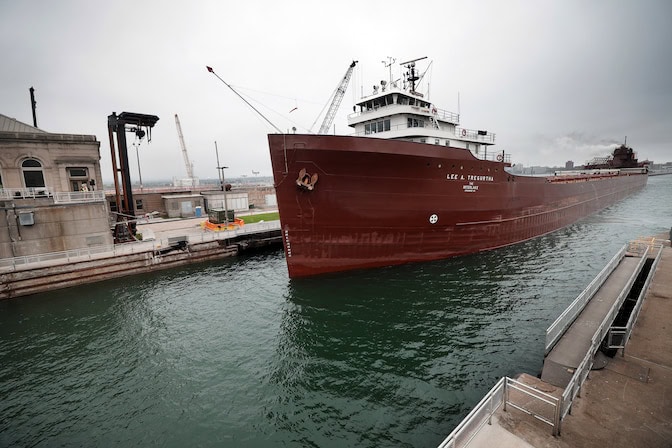
New master’s dual degree program in naval architecture and sustainable systems
The program is a streamlined, integrated experience for master’s students interested in the intersection of sustainability and naval architecture and marine engineering.

The program is a streamlined, integrated experience for master’s students interested in the intersection of sustainability and naval architecture and marine engineering.

Explore more shipbuilding and maritime innovations from Michigan Engineering
Beginning in Fall 2026, master’s students at the University of Michigan can simultaneously pursue degrees in naval architecture and marine engineering and in sustainable systems through a new dual degree program.
The new program is launching at a time of emerging environmental regulations and challenges. The International Maritime Organization, which regulates global shipping, approved net-zero regulations to set mandatory fuel standards and emissions pricing for large ocean-going ships in an effort to achieve net-zero emissions by 2050.
At the same time, offshore renewable energy systems continue to expand. Offshore wind energy growth for 2025 through 2030 is expected to double deployments of the previous five years, according to the International Energy Agency. Solar, representing 42% of the total projected renewable energy growth, is also expanding offshore. Floating solar projects have been launched in Japan, Taiwan, China, Europe, and the United States, and studies suggest they outperform land-based farms.

“The status quo for the last two and a half decades—where we use heavy fuel oil and diesel engines—is now changing,”said Thomas McKenney, an associate professor of practice in naval architecture and marine engineering and co-director of the Great Lakes Maritime Initiative. “Because of that, we need a closer connection between ship design and sustainable systems.”
By combining both disciplines, students will be better prepared to navigate emerging trends and technologies and to design effective solutions to environmental challenges.
“I think the program will really differentiate naval architects and marine engineers. Engineers who focus on sustainability and have systems-level thinking are very in demand,” said Owen Baldwin, a contributor to the State of Michigan’s Maritime Strategy. He’s also a 2026 dual degree graduate, with master’s degrees in environment and sustainability and civil and environmental engineering.
“I’m excited for the new dual degree,” said Baldwin. “I loved my experience, and if that can be expanded to other combinations of disciplines, that only strengthens what a Michigan degree is worth.”


In the new program, several courses offered in the Department of Naval Architecture and Marine Engineering and the School for Environment and Sustainability now count toward the degree requirements of each school. By double-counting credits, students will be able to pursue a multidisciplinary education without extra burden and cost.
“We have seen a lot of interest from students seeking to apply engineering skills to solve sustainability challenges. This is especially true at the intersection of ship design and sustainability,” said Greg Keoleian, the Peter M. Wege Endowed Professor of Sustainable Systems. “The time and cost for students to separately pursue two degrees is quite high, but there is overlap in the curriculum. In the end, students will have fewer credit requirements than if they had separately pursued each degree.”
All students admitted to the dual degree program automatically receive fellowship support to further reduce enrollment costs, contingent on successfully completing the program.
Students have two curriculum options: one including a capstone project and the other requiring additional coursework. The core curriculum includes the following courses:
Students will graduate with a Master of Science (MS) in environment and sustainability and a Master of Science in Engineering (MSE) in naval architecture and marine engineering. Students can choose one of two sustainability specialties—sustainable energy systems or sustainable design and manufacturing.
The new program makes naval architecture and marine engineering the fourth engineering department to have a formal dual degree program with the School for Environment and Sustainability. The other engineering departments with formal programs are chemical, mechanical and civil and environmental engineering.
There are also pathways for student-initiated dual degrees in sustainability and engineering and the following departments: robotics, aerospace engineering, electrical engineering, materials science and engineering, and climate and space sciences and engineering.
To apply for a dual degree, students must separately apply, and be admitted, to the College of Engineering and the School for Environment and Sustainability. For more details on the application process, visit the Rackham Graduate School’s admissions webpage.
Keoleian is also a professor of civil and environmental engineering and a co-director of the Center for Sustainable Systems.