Detecting neutron sources by borrowing inference tools from cosmology
A Bayesian approach that identifies neutron sources with high confidence from sparse data could improve radiation detectors for nuclear security and non-proliferation.

A Bayesian approach that identifies neutron sources with high confidence from sparse data could improve radiation detectors for nuclear security and non-proliferation.

Advancing nuclear energy
from discovery to deployment
Neutron sources can be directly identified from measured spectra rather than proxies using inference tools adapted from cosmology, according to a University of Michigan Engineering study published in Physical Review Applied. This research was funded by the Department of Energy.
The method can improve nuclear security, helping intercept materials at ports or borders, or guide first-responders during emergency response. Directly detecting and characterizing a neutron source remains a challenge as most nuclear materials emit neutrons with energy patterns, called neutron spectra, that look similar to one another—whether it is a benign industrial isotope or fissile material.
“This problem sits at the intersection of fundamental physics, statistics and real-world nuclear security. There is a very practical need to identify unknown neutron-emitting materials, but there is also a deep scientific challenge: how do you extract reliable information from signals that are weak, noisy and highly similar?” said David Breitenmoser, a postdoctoral research fellow of nuclear engineering and radiological sciences at U-M and lead author of the study.
Up to this point, detectors have relied on indirect signals, like x-rays and gamma rays, but signals can become quiet or lost altogether as they pass through surrounding containers or shields. Compared with proxy-based methods, the new approach is more direct, quantitative, statistically rigorous and effective in low-count measurements.
To map cosmic collisions or planets outside our solar system, cosmology and gravitational-wave astronomy must rely on probabilistic inference to figure out how weak signals fit best within competing physical explanations. These fields harness Bayesian modeling, a statistical method where you update your confidence in hypotheses when new data becomes available.
Leveraging this framework, the research team fed the messy data from a radiation detector into a model with a library of known neutron sources, like californium-252 or plutonium-beryllium. The model creates several scenarios—for instance, the source may be californium-252, plutonium-beryllium or a mixture of the two.
The model then calculates how well the data matches each scenario, giving it a number called the Bayesian Evidence. It then identifies the most likely source, attaching a mathematical certainty to the output.
“The most exciting part is the cross-disciplinary nature of the result. It shows that methods developed to understand the universe can also help us solve urgent problems here on Earth,” said Breitenmoser.
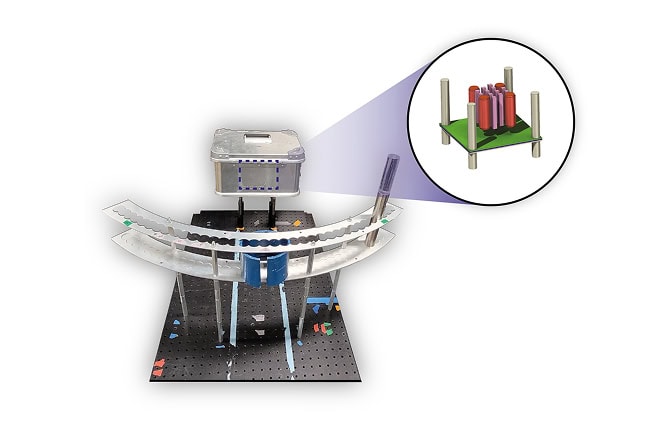
The research team then put the math to the test in the laboratory. They placed a radiation detector with 12 organic glass scintillator bars, a material that lights up when neutrons interact with it, in front of neutron-emitting materials.
A series of experiments collected data from a single source, either californium-252 or plutonium-beryllium, and both sources combined. To emulate a real-world scenario in which a package is shielded, they repeated the experiments with a lead sleeve placed around the material to see if the algorithm could work through the intentional distortion. Even when data was sparse, the model correctly identified californium-252, plutonium-beryllium or a mix of both with greater than 99% confidence level.
When comparing two methods of measuring neutron energy, recoil spectroscopy—which measures energy in protons after they are struck by incoming neutrons—outcompeted time-of-flight spectroscopy, which measures how long it takes a neutron to travel from one scintillator to the next. Both methods could point to the correct model, but recoil spectroscopy arrived at conclusions faster with less data.
This study provides the first experimentally validated demonstration, under controlled tabletop laboratory conditions, that neutron sources can be identified directly from their measured spectra with quantified confidence. It paves the way for detection and identification of unknown neutron-emitting materials in nuclear security or emergency response situations.
“The next step is to extend this capability to more realistic field conditions, where measurements may be short, noisy, shielded or geometrically complex,” said Sara Pozzi, the Donald C. Graham Professor of Engineering at the University of Michigan Engineering and senior author of the study.
This research was supported in-part by the Consortium for Monitoring, Technology, and Verification under Department of Energy National Nuclear Security Administration (DE-NA0003920).