Smarter diagnostics could extend the lives of silicon EV batteries
A new battery management system uses everyday charging data to diagnose when silicon is most vulnerable, helping guide smarter battery temperature control to protect it.

A new battery management system uses everyday charging data to diagnose when silicon is most vulnerable, helping guide smarter battery temperature control to protect it.
Electric vehicle batteries could last twice as long, preventing costly replacement, with a new diagnostic framework and adaptive thermal management, according to a study led by University of Michigan Engineering. General Motors and Imperial College London also contributed to the study, which was funded by the U.S. National Science Foundation.
The diagnostic approach is designed to work with voltage and charging data that today’s battery management systems already collect, rather than requiring new sensors inside the battery. It is best suited for lower-power Level 1 and Level 2 charging, which is common at homes, workplaces and public parking areas, and is expected to cover most EV charging demand.
“What excites me most is that this work connects battery materials to battery management in a very direct way, when they are often disconnected. Advanced battery materials will only deliver their full value if we can manage them intelligently after they are placed in real products,” said Zhiwen Wan, a doctoral student of mechanical engineering at U-M and lead author of the study published in Joule.
Manufacturers like Tesla and Mercedes-Benz increasingly use a blend of silicon and graphite in their lithium-ion batteries because silicon can store roughly 10 times more lithium than graphite. The catch is that silicon is more sensitive to charge/discharge cycling than graphite.
Previous battery research found that silicon works harder and breaks down faster at low states of charge, while graphite does the brunt of the work at high states of charge. Many EV battery management systems leverage this phenomenon by keeping the charge above a set threshold.
The research team found this silicon transition threshold actually shifts up or down as the battery ages, depending on the usage pattern. This means current practices either overconstrain battery usage, shortening driving range, or underconstrain it, leading to quicker battery burnout and costly replacements.
“Battery management systems today often use fixed voltage, charge and temperature thresholds. Our work opens a path toward management systems with active diagnostics that can look inside the cell, distinguish how different materials are aging and adapt operation accordingly,” said Anna Stefanopoulou, a professor of mechanical engineering at U-M and senior author of the study.
Silicon is high-performance but also high-maintenance because it may expand up to 300% each time the battery charges from empty to full. Over time, this degrades the battery through the loss of active silicon and the loss of lithium.
Similar to Michigan roads at the end of winter, silicon particles crack from the repeated swelling and contraction and break off from the battery’s electrical circuit. Making matters worse, the battery tries to “heal” itself by forming a protective film over the crack, permanently trapping lithium ions.
To examine how degradation pathways influence the transition threshold below which silicon works harder, the research team compared a new battery cell with three end-of-life battery cases: one representing lithium loss, one representing active silicon loss and one with a mixture of the two. The researchers manufactured the silicon-graphite pouch cells at the University of Michigan Battery Lab.
They found how drivers use and charge their EVs can change when silicon becomes most vulnerable. Often, draining the battery to low levels wears out silicon and pushes the threshold lower, while leaving the battery near full for long periods can consume lithium and raise the threshold. In batteries with the same 30% reduction in capacity, the threshold at which silicon became most active ranged from 33% to 73% charge. Those extremes need very different management strategies.
Another series of experiments cycling the batteries in cold, room temperature and hot conditions (32 F, 77 F and 113 F) revealed a surprising trend: in the silicon-graphite cells studied, warmer cycling helped preserve active silicon and nearly doubled cycle life compared with room-temperature cycling. But storage tests showed the opposite effect when batteries were at rest: higher temperatures sped up lithium loss.
That contrast gave the researchers a simple rule for future battery thermal management strategy: heat the battery to 113F while silicon is active and cool it to 77 F when graphite is active or the battery is resting, using the diagnosed silicon active threshold.
“We found higher temperatures are not always harmful. The key is that temperature needs to be applied selectively: it can help when silicon is active, but it should be reduced when the battery is resting or graphite is dominant,” said Jason Siegel, a research associate professor of mechanical engineering at U-M and co-author of the study.
It also checks how reliable its estimate is, giving the system a way to decide when the silicon boundary is clear enough to guide operation. To avoid overloading the car’s onboard computer, the method decreases the amount of data it processes while still maintaining near-perfect accuracy.
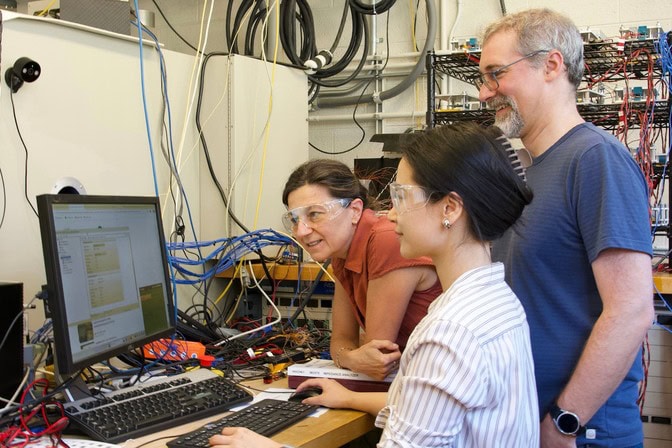
The battery cells were tested in the U-M Battery Control Lab which is operated and maintained with support from indirect cost allocations in federal grants.
This research was initiated by a 2020 project supported by the National Science Foundation (1762247).
Related study: The team’s earlier study examined how temperature, pressure, charge rate and state-of-charge window affect degradation and expansion in silicon-graphite lithium-ion batteries. (DOI: 10.1016/j.etran.2025.100416)