Knee exoskeletons to relieve arthritis pain, preserve mobility
Extending a motorized brace approach to take the load off arthritic knees, a U-M research team shifts from boosting strength to reducing joint contact forces.

Extending a motorized brace approach to take the load off arthritic knees, a U-M research team shifts from boosting strength to reducing joint contact forces.

Michigan Engineering is advancing
critical technologies for a healthier world
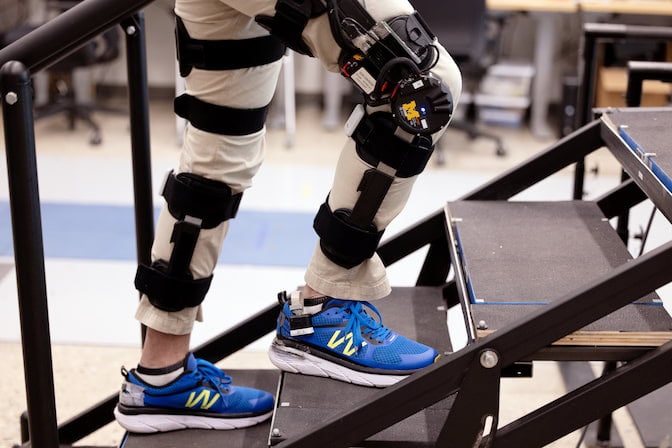
Building on the success of projects to boost strength by adding motors to conventional knee, hip and ankle braces, a University of Michigan team is exploring how well this approach could work for relieving knee pain from osteoarthritis.
(On-screen text): U-M researchers re designing exoskeletons to reduce joint pain. By adding motors to knee braces, they could help relieve knee pain from osteoarthritis, which affects an estimated 14 million people in the U.S. The study builds off past research pairing motors with braces to reduce load on quads, hips and ankles. The exos will help reduce pain by reducing the peak load on the joint, which occurs during walking, climbing/descending stairs, and sit/stand transitions. Pilot study participants with osteoarthritis reported reduced pain while using the exos. A newly awarded $2 million grant will allow the researchers to develop this further.
“This could create an entirely new class of orthotic interventions that don’t exist today, which could potentially delay surgery or spare people from having to undergo it,” said Robert Gregg, U-M professor of robotics and leader of the project funded with $2 million from the National Institutes of Health.
In earlier work, exoskeletons, or exos, developed by Gregg’s team reduced the effort expended by study participants by:
“We ran a pilot study with four people with knee osteoarthritis. They all experienced pain reduction,” Gregg said. “If you reduce peak muscle forces at the joint, you’re reducing the peak loads of the contractile muscles that pull the joint together. You reduce that peak, and you reduce arthritic pain.”
Before inviting study participants to the lab, the researchers will optimize their exoskeletons for arthritis pain reduction. Gregg’s team is very experienced at modeling muscle effort and joint torque, but they have not previously gone into the details of what is happening inside the joints.
Now, they will dig into musculoskeletal models to quantify how exo assistance reduces the bone-on-bone contact forces—and therefore the pain—inside arthritic joints. They will use this information to adapt the exo control algorithm to reduce contact forces rather than just muscle effort, and ultimately assess the effects on participants’ self-reported pain across a variety of activities.
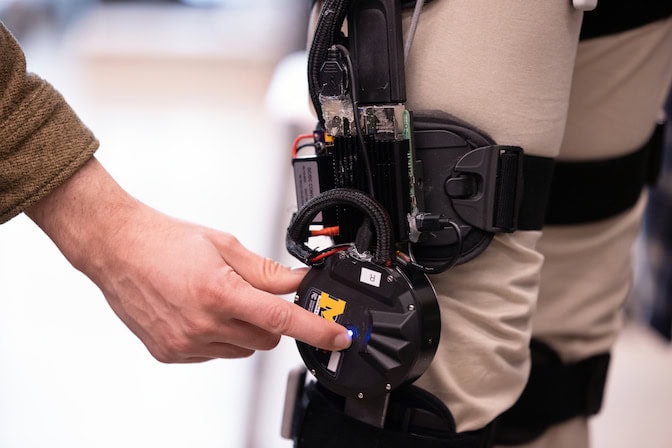
The control algorithm will be based on the “energy shaping” approach championed by Gregg’s group, which contributed to the earlier successes with brace-based exos. Older control strategies often rely on guessing what the user is trying to do, such as walking up stairs or sitting down in a chair. Instead, the energy-shaping algorithm looks at the user’s current motion and predicts how much force is needed in the next fraction of a second. The predictions come from models of human movement made with motion capture data and physics.
The design of the exos themselves will be very similar to the previous effort to boost strength. The team, including co-investigator Elliott Rouse, U-M associate professor of robotics, uses “pancake” motors popularized by the drone industry. The key advantage of these motors is high torque at low speeds, providing a force similar to human joints.
Earlier motors that were small enough to mount on knee braces needed more gears to provide higher torque. Gears are louder and harder to drive backward, resulting in exos that are stiff and noisy, similar in volume to a household drill. Pancake motors provide both the power and smooth operation needed for compatibility with human motion while being nearly silent.
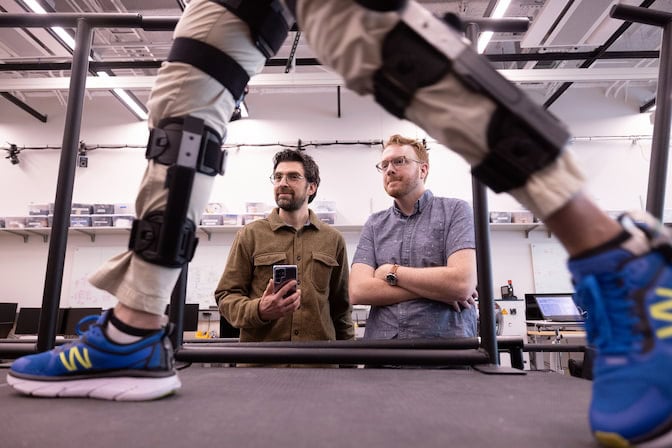
Co-investigators Edward Wojtys, the William S. Smith Legacy Professor of Orthopaedic Surgery, and Damon Bagley-Ayres, a certified prosthetist and orthotist for Michigan Medicine, will recruit participants with osteoarthritis and support the clinical trial. Steven Harte, an associate professor of anesthesiology and internal medicine at Michigan Medicine, will support the rigorous assessment of pain.
While this study is a lab trial, Gregg hopes to eventually send exos home with users to see whether they reduce the vicious cycle of muscle wasting that accompanies osteoarthritis. Because exoskeletons make each step easier, muscle atrophy could get worse if users aren’t moving more. The team is betting that if exo users can move with less pain, they will move more often, and increasing cumulative activity levels could strengthen the muscles of exo users.