Storied U-M manufacturing research space opens after $4.45 million in upgrades
Revamped space clears the way for a new era of cognitive manufacturing.

Revamped space clears the way for a new era of cognitive manufacturing.
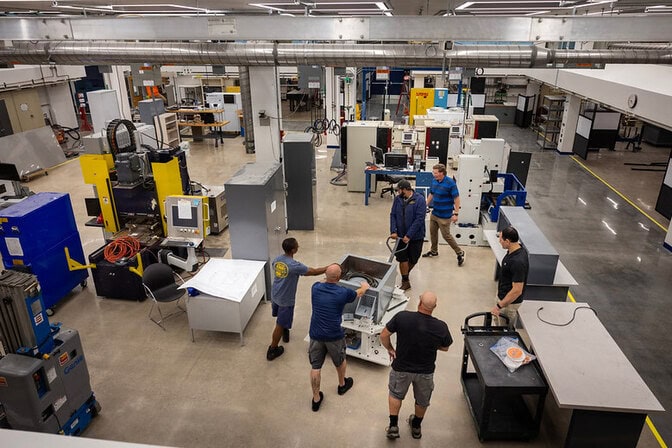
For the students and faculty, it’s simply known as 1100 HH Dow, an open manufacturing research space tucked away in the heart of the Herbert H. Dow Building that can be tricky for first-time visitors to find.
Over three decades, generations of University of Michigan researchers have found their way there to conduct foundational work that helped create and kickstart several eras of manufacturing engineering.
Now, with a $4.45 million renovation complete, 1100 HH Dow is kicking off its next era, one centered on cognitive and adaptable manufacturing. It’s an emerging approach that involves integrating AI as a teammate and decision-making partner.
“To us, 1100 HH Dow is more than just a laboratory—it’s a hub for discovery, innovation and collaboration in manufacturing,” said Ellen Arruda, the Tim Manganello/BorgWarner Department Chair of Mechanical Engineering. “For decades, this space has incubated ideas and trained leaders who have transformed the field, not just here at Michigan, but globally.
“This beautiful and functional renovation ensures our legacy continues, positioning U-M at the forefront of cognitive manufacturing and empowering us to shape the next chapter of industry.”
Ellen Arruda, the Tim Manganello/BorgWarner Department Chair of Mechanical Engineering
The vision for the renovation—the space’s first in two decades—came from a trio of faculty members. Mechanical Engineering Professors Chinedum Okwudire, Daniel Cooper and Albert Shih proposed a new plan in 2021.
“Some aspects of the space weren’t serving our needs as well as they used to,” Okwudire said. “This new setup reflects where we are. The manufacturing faculty are very much into teamwork and collaboration, and this space will allow us to really highlight that mindset.”
This new iteration of 1100 HH Dow features 3D printing equipment that is crucial to additive manufacturing—the digitally-based process that is revolutionizing manufacturing. It provides education spaces and shared equipment for metrology and other advanced processes.
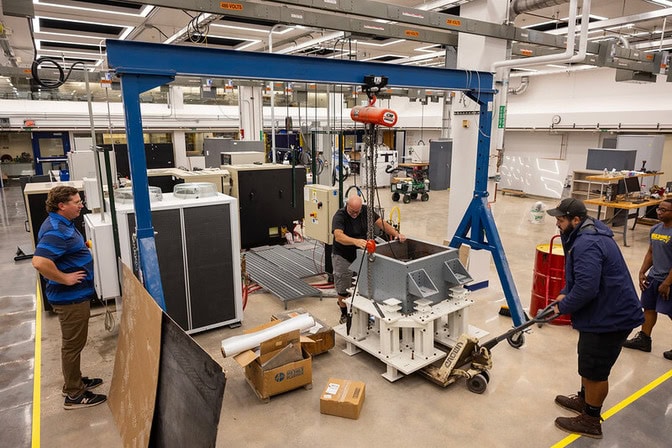
“1100 HH Dow also hosts equipment for conventional manufacturing processes such as agile sheet metal forming, extrusion, cutting and joining as well as large-scale prototyping of new alloy development, adding key tools to the innovative ecosystem for advancing manufacturing at Michigan,” said Miki Banu, a professor of mechanical engineering.
It’s a space designed for both collaboration and learning, with an open-concept design and an undergraduate classroom situated in the lab itself.
“I think this is a way of fostering greater skills for manufacturing engineers while also reinforcing the broader curriculum, because manufacturing is an integrative field,” Cooper said. “By having the opportunity to do labs and teach labs in this environment, we’ll build not only on our manufacturing strength, but across the core of mechanical engineering.”
Michigan Engineering is reinventing U.S. manufacturing for resilience and scale
Jeff Abell, former director of materials and manufacturing systems research at General Motors who recently joined U-M, will be a big user of the new space. His work focuses on cognitive manufacturing, and a key aspect of that is advanced process development—an area where the new machinery will play a key role.
“The term ‘cognitive manufacturing’ is out there being discussed but it’s not a very concrete concept yet,” said Abell, now a professor of practice of mechanical engineering. “It’s at the intersection of cognitive AI and manufacturing. Cognitive AI is a real partnership with a human being, not a replacement, a partnership. It’s teamwork. You might have a team of three people, but add AI as a fourth that can help drive the conversation or begin to make some of those connections.
“Cognitive manufacturing has to do with the ability of an AI to understand its current situation and adapt—not only to improve but to fix roadblocks or disruptions on its own.”
The Dow building opened in 1982, and for its first decade and a half, 1100 HH Dow served as North Campus’ main library. When construction of the James and Anne Duderstadt Center finished in 1996, then called the Media Union, it became the library’s new home, freeing up the space in Dow for something new.
Shein-Ming “Sam” Wu, a pioneer in the use of advanced statistical techniques and analysis in manufacturing research and practice, was the first U-M researcher to put his stamp on the space. He joined the university in 1987 as the first R. and P. Anderson Professor of Manufacturing Technology and quickly ushered in 1100 HH Dow’s “Manufacturing Systems” era.
The space benefitted from an NSF designation as an Engineering Research Center. An early adopter of computers, Wu used them to compensate for errors and conduct precision machining without precision machinery. He also insisted on conducting research that was relevant to industry.
By the time of Wu’s passing in 1992, the work of his team focused on real-world industry concerns and solutions and helped solidify U-M’s expertise in manufacturing engineering. Major contributors during that time were Jun Ni, the Shien-Ming (Sam) Wu Collegiate Professor Emeritus of Manufacturing Science and S. Jack Hu, the J. Reid and Polly Anderson Professor Emeritus of Manufacturing.
The second era for 1100 HH Dow, from 1996 to 2007, focused on reconfigurable manufacturing systems (RMS) and was ushered in by Yoram Koren, the Paul G. Goebel Emeritus Professor of Engineering and the James J. Duderstadt Professor Emeritus of Engineering, and Galip Ulsoy, the CD Mote Jr. Distinguished University Professor Emeritus of Mechanical Engineering.
An RMS is designed to give manufacturers the ability to adjust hardware and software components quickly based on changing demands. It is based on seven characteristics: scalability, convertibility, diagnosability, customization, modularity and integratability.
Like Wu, Koren’s work began with NSF backing through the Engineering Research Center for Reconfigurable Manufacturing Systems. In addition to the RMS, Koren and his team’s work in 1100 HH Dow also led to the reconfigurable machine tool (RMT)—convertible, modular devices that adapt to various uses. Medical devices that rotate around a stationary patient are examples of RMTs in use today.
Beginning in 2014, the space helped launch a third era—this one focused on lightweight materials for manufacturing. Two years prior, Alan Taub, the Robert H. Lurie professor of engineering, joined U-M’s faculty after retiring from General Motors, where his tenure ended as the automaker’s vice president of global research & development. Together with Banu, they worked to bring lightweighting to the fore.
Based on innovations developed in 1100 HH Dow, the team led the launch of the American Lightweight Manufacturing Innovation Institute (now known as LIFT) in Detroit in 2014. The $148 million high-tech manufacturing research center also involves Ohio-based manufacturing non-profit EWI and The Ohio State University.
Across decades, 1100 HH Dow has been a place for seeding manufacturing transformations and it continues to shape the future—a Rosetta Stone of manufacturing at Michigan.