U-Michigan aims to bridge the ‘valley of death’ for manufacturing tech
In this Q&A, Chinedum Okwudire, director of the new U-M Advanced Manufacturing Institute, discusses its unique approach to translational research.

In this Q&A, Chinedum Okwudire, director of the new U-M Advanced Manufacturing Institute, discusses its unique approach to translational research.

Michigan Engineering is reinventing U.S. manufacturing for resilience and scale
Amid a national push to strengthen domestic manufacturing, a new institute led by the University of Michigan Engineering is pioneering a modernized model for manufacturing innovation. The U-M Advanced Manufacturing Institute, or UMAMI, aims to bridge the gap, often called the “valley of death,” between fundamental research and industry impact.
UMAMI will focus on convergence research and developing an integrated translational research ecosystem. And it will center and collaborate with the often-overlooked small- and medium-sized manufacturers that make up 98% of the sector.
UMAMI brings together engineers, behavioral scientists and business experts to develop Industry 5.0—human-centered and resilient—manufacturing solutions that industry needs and knows how to use. In addition to engineering, it includes researchers from the Institute for Social Research, the Ross School of Business, the U-M School for Environment and Sustainability, the Economic Growth Institute, U-M Dearborn and U-M Flint’s College of Innovation and Technology.

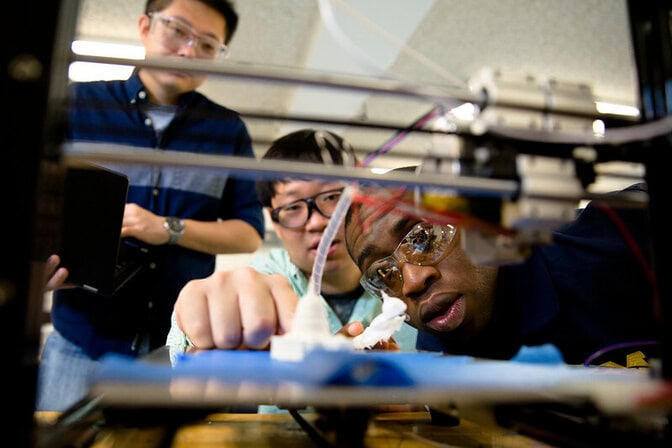
Building on U-M’s history of leadership in manufacturing, the Institute is part of a broader effort to support federal and state efforts to revitalize and advance U.S. manufacturing. Michigan Engineering’s main manufacturing lab was recently upgraded with $4.45 million in equipment and renovations, including an educational lab and a student collaboration space. And U-M is hiring three faculty members focused on the emerging area of cognitive manufacturing.
In this Q&A, UMAMI Director Chinedum Okwudire, professor of mechanical engineering, discusses the Institute’s goals and unique approach to bridging the valley of death for Industry 5.0 manufacturing innovations. Okwudire is also the founder and CEO of Ulendo, a startup that makes software to improve the speed and precision of manufacturing automation systems.
The renovation of our 20,000 sq. ft. advanced manufacturing facility is huge. It puts us on the cutting edge of what’s possible in advanced manufacturing. We’re actually working to make that a user facility that’s open for industry use, like the Mcity Test Facility for connected and automated vehicles and the U-M Battery Lab. That would allow us to engage more meaningfully with industry and give students more exposure as well. I think that will open the floodgates. We’ve seen that happen with these other testbeds. Mcity was instrumental in advancing early automated vehicle technology, and the Battery Lab was recently expanded because its pilot line was consistently booked to capacity.
Another exciting aspect is the hiring of Jeff Abell, former chief scientist of manufacturing at GM Global R&D, who brings 40 years of industry experience. He joined the U-M faculty as a professor of practice in fall 2025. He really understands both sides. He’s the co-director of UMAMI and will be instrumental in achieving our vision.
UMAMI builds on the physical infrastructure and industry partnerships we already have to intentionally translate manufacturing innovations from the research lab to the factory floor. The bridge will be explicitly baked into the educational curriculum. The industry partnerships will be intentionally tied to how students are trained. I believe our model puts us on a very, very promising path to bridging the valley of death between research and industrial deployment in manufacturing.
To begin with, the convergent nature of our research positions us to develop technologies more holistically, and I expect that will give us a head start. But at the core of our translational model is a retooled Doctor of Engineering, or DEng, degree. We’ve reimagined it to focus on translational research and measurable real-world impact. We imagine it attracting a variety of people—those already in industry who want to sharpen their skills in translational research, students who go straight through and want to focus on translational pathways such as being an entrepreneur or working in R&D, or even someone who wants to learn how to do it and then come back and teach that pathway.
The DEng students will work closely with our Ph.D students who are doing basic research, both to understand what they’ve done and to identify pathways that would make industry want to use it. Industry can’t use that work as-is. And it will be a symbiotic relationship. The DEng students can also provide very good practical case studies to the Ph.D. students to inform their research and offer real-world opportunities to test theories. They’ll write papers together. For DEng students, patents and prototypes will also count toward their output.
Going a level deeper, we’ve developed a work-study program to provide on-campus jobs for undergraduate and master’s students to support regional small- to medium-sized manufacturers. They’ll be employed in ways relevant to the degree they’re pursuing. The DEng students will supervise those master’s students, giving them management experience and providing a direct connection to industry.
Yes, we’re not aware of other university manufacturing institutes that focus as much as we do on SMMs, even though they make up the vast majority of U.S. manufacturers. There are so many of these companies right in Southeast Michigan. I see tremendous opportunity in collaborating with them to meet their research needs. Those needs might be more practical. Maybe they want to experiment with a production robot, but don’t have the skilled workforce to pursue it on their own. We don’t want them to be left behind in innovation. And at the same time, we want to show our students paths beyond the big companies.
Convergence is essential because technology alone won’t achieve the vision for a stronger manufacturing sector. While AI and automation are critical, without the deliberate integration of perspectives on workforce, business and sustainability, we won’t be set up for resilience. The National Academies have identified this kind of convergence approach as a critical need, and it’s exactly what UMAMI is built around.
We want to work on challenges like manufacturing for climate resilience and AI systems that make people’s jobs more meaningful without displacing them. Or if displacement occurs, how do you ensure there is a clear pathway for people to find meaningful employment? These are things we have to be very thoughtful about. It’s the kind of work that only happens when you deliberately bring all these perspectives together. We think Michigan, and this center specifically, can offer something important here.