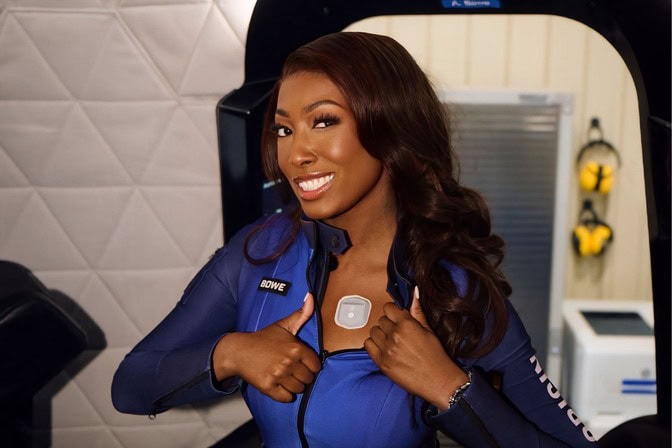
First Alumna in Space
Aisha Bowe (BSE Aero ’08, MSE SED ’09) took flight in a Blue Origin rocket.

Aisha Bowe (BSE Aero ’08, MSE SED ’09) took flight in a Blue Origin rocket.
In 2025, Aisha Bowe (BSE Aero ’08, MSE SED ’09) became the first female U-M grad and the sixth Black woman to cross the Kármánline—the internationally recognized boundary of space. She rode on Blue Origin’s 11th mission with humans onboard and the first all-female mission since Valentina Tereskhova’s solo flight in 1963.
Also aboard were civil rights activist and scientist Amanda Nguyễn, journalist and television host Gayle King, pop superstar Katy Perry, film producer Kerianne Flynn and Emmy-nominated journalist and helicopter pilot Lauren Sánchez.
Bowe partnered with Winston-Salem State University and the company BioServe Space Technologies to fly sweet potato, tomato, chickpea and Arabidopsis seedlings. The mission’s goal was to genetically sequence the plants after exposure to microgravity and compare them to ground controls to better understand how crops adapt to space at the molecular level.
WSSU’s Astrobotany Lab, the only space plant biology lab at a historically Black college or university, leads this research in partnership with NASA’s Kennedy Space Center. The mission also served to flightqualify BioServe’s Fluid Processing Apparatus, which contained and supported the experiment during the flight.
Bowe wore a BioButton, provided by the NASA-backed Translational Research Institute for Space Health (TRISH) led by Baylor College of Medicine, to track her vital signs and other physiological information. TRISH aims to develop approaches for keeping astronauts healthy in space.
“My biometric data was provided to help address gaps in understanding of how women of color physiologically respond to microgravity,” she said.
In addition to contributing to science, Bowe contributed to the tradition of symbolism in space, carrying two flags close to her heart. One was the personal American flag of astronaut Pete Conrad, the Apollo 12 commander who became the third man to walk on the Moon. Flown with special permission from the Conrad family and the Museum of Flight, it represents a bridge between the pioneering spirit of the Apollo era and the new era of commercial human spaceflight. Alongside it, she flew a U-M flag.
“That flag will be returned to the François-Xavier Bagnoud Aerospace Building, where future generations of Michigan Engineers can see it displayed and be reminded that the sky is not the limit,” Bowe said.
Above the Kármán line, she took a moment to appreciate the wonder of seeing the Earth at a distance. Interviewed alongside King on CBS, Bowe said, “I was surprised by how strongly I felt about Earth. When you look out the window, you don’t see any borders, you don’t see any boundaries, you just see beauty…It’s impossible to go through this and not come out changed.”
In addition to her technical work as CEO of the software firm STEMBoard, Bowe makes a point of being visible and inspiring kids, telling Essence magazine she had to learn how to dream. Graduating from high school with an unexceptional transcript, she set her sights on NASA and remade herself as a student, starting at Washtenaw Community College. After completing her degrees in aerospace engineering at U-M, she realized her dream of working at NASA—as a research engineer in aerospace technology, flight and fluid mechanics—before striking out on her own as an entrepreneur.
But she’s not just a role model. During the pandemic, with so many students learning from home, she developed the STEM education kit LINGO, which she reports has reached more than 10,000 students. And she has remained close to U-M as a member of the Department of Aerospace Engineering’s Industrial Advisory Board and as a mentor and sponsor of Black Students in Aerospace (BSA).