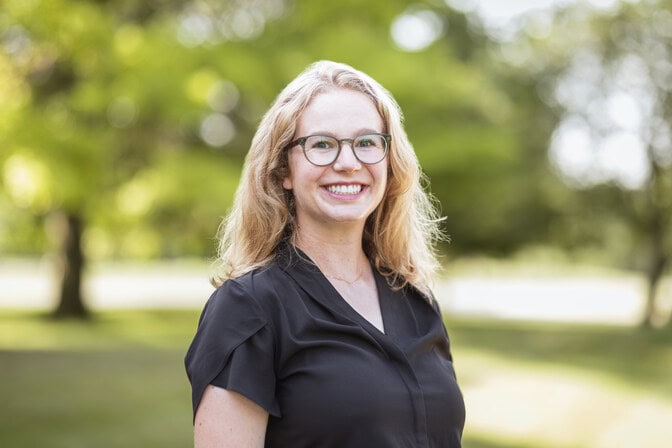
Accelerating pharmaceutical advances with organoid technology
Madeline Eiken (PhD BME ’25) is commercializing organoid technology that could spur new treatments for disease and reduce animal testing.

Madeline Eiken (PhD BME ’25) is commercializing organoid technology that could spur new treatments for disease and reduce animal testing.
A love of science, curiosity and plenty of football Saturdays—those are the ingredients that helped University of Michigan Engineering biomedical alum Madeline Eiken on the path to her current role as co-founder and CTO of biotech startup Intero Biosystems. It also landed her a spot on the Forbes 2026 30 Under 30 list.
Intero is commercializing an accurate lab-grown model of the human intestine for testing potential drug treatments. Originally developed in a U-M biomedical engineering lab, the technology is an example of an organoid—a miniaturized, lab-grown tissue that mimics the function of a human organ. Organoids could offer a better way to test new drugs, bringing more new treatments to patients in less time. They could also reduce the use of animal testing and make clinical drug trials safer for participants.
The company’s organoids first entered the market in 2025; Eiken’s main task is preparing for a broader rollout.
“I’m making sure that we’re getting high quality organoids and thinking about how we can scale and make really reproducible products,” she said. “So our customers can do an experiment this week and get the same results with a new batch of organoids a year from now.”
As part of Intero’s staff of five, she has taken on a variety of other roles as well, from setting up the company’s lab space, fundraising and working with customers to make sure the products meet their needs.
“The business has been such a great way to sort of stretch my brain and really challenge myself to think about science in this much more expansive way,” she said.
Eiken got her first taste of entrepreneurship when, shortly after earning her undergraduate degree, she went to work for Colorado-based stem cell research startup Essent Biologics.
“I was doing research I was really passionate about in the bioengineering space. And I realized that what I wanted to do with my life was my boss’s job, which was running R&D teams. And he had a PhD.”
Eiken’s next stop was U-M, where she found researchers and resources that could help her toward her goal. She also got her first taste of a “big school” experience after doing her undergraduate work at a small private university.
“I think I went to every single football game in the five years I was at U-M,” she said. “I definitely tried to squeeze all of the Michigan out of my Michigan experience. And I just loved getting into the Michigan spirit.”
Working in the lab of biomedical engineering professor Jason Spence, Eiken teamed up with Sophia Meyer and Charlie Childs to refine an organoid technology that Spence had been working on since 2011. A series of breakthroughs that made the intestinal organoid more complex and more consistently reproducible eventually led to the founding of Intero, where all four researchers now hold research and operations roles. Spence is also a professor of cell and developmental biology at U-M Medical School.
Eiken remembers working across the College of Engineering, the U-M Medical School and the Ross School of Business to build her skills as a scientist and entrepreneur.
“What’s amazing about Michigan is that everything is good. You can get top-notch business education, you get a top-notch engineering education and an amazing medical school,” she said.
“It’s not a competitive PhD environment—it’s an environment where we all want each other to succeed. I made a lot of good friends, and I talked a lot of shop outside of work hours and just had great support throughout.”
Eiken envisions that Intero’s technology will eventually be useful in the testing of food, health supplements and chemicals as well as pharmaceuticals.
While there is much work ahead for Eiken and her colleagues, she’s grateful for the broader perspective of the U-M experience, and for the rewarding, impactful—and fun—path it has set her on. And it taught her a valuable lesson:
“Follow your passions, do what you want. It will all be useful later.”