
New technologies for exploring our oceans
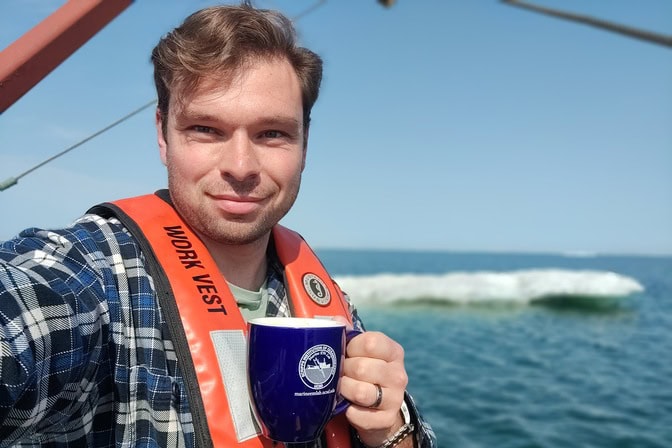
Gideon Billings (BS ECE ‘16, MS ROB ‘19, PhD ROB ‘21) is building underwater robots.
We generally think of robots as tools. But what if they could become collaborators that proactively help researchers explore the natural world and gather insight on global issues? Gideon Billings (BS ECE ‘16, MS ROB ‘19, PhD ROB ‘21) is working toward that goal, helping to develop autonomous underwater robots that are smarter, easier to use, and capable of exploring even the most remote places. It’s a space that’s growing in importance as the underwater world increasingly hosts human activities like off-shore wind farms and deep-sea mineral exploration. And it’s a quest that has carried Billings to opposite ends of the globe as a postdoctoral researcher.
“I love underwater exploration. I’m a recreational diver, and so I want to protect our underwater environments, and I believe it’s just important for the future to conserve what we have in our underwater environment,” he said.
Billings first realized that he could combine his passion for the ocean with computer vision and autonomous robots as a PhD student working in professor Matthew Johnson Roberson’s DROP Lab. He worked closely with Roberson to develop a course of study that would make it happen.
“When I joined the lab, Matt and I sat down together and discussed the goals of my PhD and where I see myself moving forward with different projects,” he said.
Today, he’s putting that plan into action, working with scientist Richard Camilli of the Woods Hole Oceanographic Institute to develop autonomous, submersible gliders that can probe the parts of the Arctic Ocean that lie under ice. Previously, the only way to do this was to drill through the ice into the water—an expensive process that only allows a year of observation before the ice refreezes. More recently, scientists have deployed autonomous robots to survey the ocean, but these robots have their own limitations, including short travel ranges, the need to be tethered to a parent craft or limited navigation abilities.
A glider developed by the Woods Hole team could solve these issues. Using specially developed “wings” and a redesigned propulsion system, it can descend much more gradually than previous underwater robots, enabling it to maneuver through narrow bands of open water between layers of ice. It also enables the robot’s onboard sensors to measure wave activity on the surface. And perhaps most importantly, the slow, gradual movement saves energy, potentially enabling the robot to explore for months at a time without recharging.
”Once you get a glide angle, you kind of reach a steady state, and you don’t need to activate anything to move through the water until you need to change direction,” Billings said.
Billings’ contribution to the project focuses on improving the glider’s navigation mechanism. GPS doesn’t work underwater, and ocean currents can drastically alter the course of a vehicle that’s gliding slowly through the water. Without a way to accurately track the robot’s location, it’s in danger of being lost at sea.
To solve the problem, Billings designed an onboard computer system that measures ocean currents using a sonar-like technology called a Doppler velocity log. The system feeds this information to the glider’s main computer, enabling it to account for ocean currents and report more accurate location information to its users.
Wherever they’re deployed, robots also need to be simple enough to be used by people who don’t have training in robotics. Billings is working on that too. He’s helping to develop a virtual reality interface through which workers and researchers, connected through the internet, could view a 3D picture of what the robot is seeing in real time and use wearable hand sensors to control its movement. The Woods Hole team has also designed a system that enables researchers to give the robot commands using natural language.
“We need autonomous systems that can monitor the environment for environmental impacts, monitor the assets for maintenance, and even do interventions remotely with a human overseeing,” he said. “This work is democratizing access to those systems.”