
Faster, more accurate airborne radiation detection
A new method detects radiation from single or mixed sources during six-second helicopter flyovers, improving the toolkit for radiological emergency response.

A new method detects radiation from single or mixed sources during six-second helicopter flyovers, improving the toolkit for radiological emergency response.

Advancing nuclear energy
from discovery to deployment
Key takeaways
A new radiation detection method correctly identified single and mixed radioactive sources during six-second helicopter flyovers, according to a University of Michigan Engineering and Paul Scherrer Institute study.
The physics-based Bayesian framework pinpointed radiation sources within two meters and estimated their activities within two percentage points of their true values—an unprecedented level of detail compared to previous methods.
In a radiological emergency, such as a reactor meltdown or the deftonation of a nuclear weapon, airborne measurements are sometimes the only way to access an area. The crucial, in-flight radiological information could help first responders determine where people should evacuate, shelter or receive other protection like potassium iodide pills to shield the thyroid.
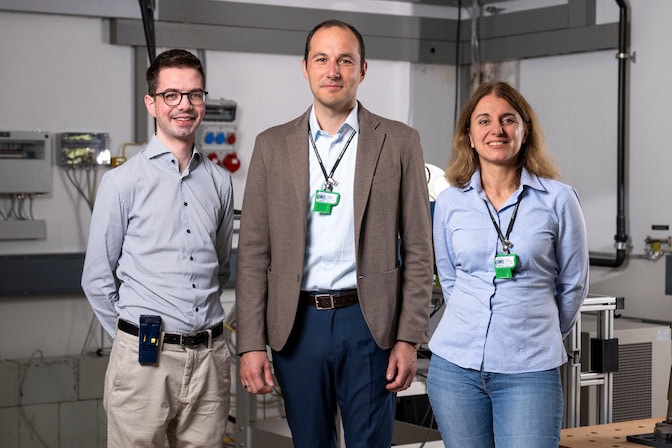
“Knowing that better measurements could help emergency responders make faster, better-informed decisions, and ultimately protect or even save lives, makes this problem so meaningful to me,” said David Breitenmoser, a postdoctoral research fellow of nuclear engineering and radiological sciences at U-M and lead author of the study published in Nature Communications.
The key problem the team solved was resolving the radiation signals blurred on the way to the detector. Each radioactive material emits gamma rays with specific energy levels, creating a unique fingerprint. On the journey to an airborne detector, gamma rays scatter as they collide with the air and aircraft, shifting energy levels and blurring the fingerprint.
Further complicating the problem, airborne detectors only capture a small fraction of emitted gamma rays during a one-pass flyover. Interpreting these sparse signals requires full-spectrum analysis, which matches the blurred data against predicted templates—simulated energy spectra for specific radioactive sources under given flight conditions.
Yet the complex computation to generate these templates often takes hours or days, rendering them impractical for a disaster scenario where there is no time to calibrate with the environment.
The new method reduces simulation time by splitting the gamma rays’ journey into two parts: scattering in the air and scattering within the aircraft.
The atmospheric scattering calculations account for factors like air temperature and humidity while the aircraft scattering portion uses precomputed mathematical functions, specific to the helicopter model used during testing.
“I was surprised how much efficiency we could gain by reorganizing the physics rather than simply using more computing power. Once we separated transport through the atmosphere from the helicopter response, simulations that had taken hours or days could be evaluated in microseconds,” said Breitenmoser.
The newfound speed made a detailed Bayesian analysis possible. By rapidly comparing thousands of previously predicted spectral templates against the blurred, in-flight data, the Bayesian framework continuously updates its statistical confidence to pinpoint the exact radioactive source below.
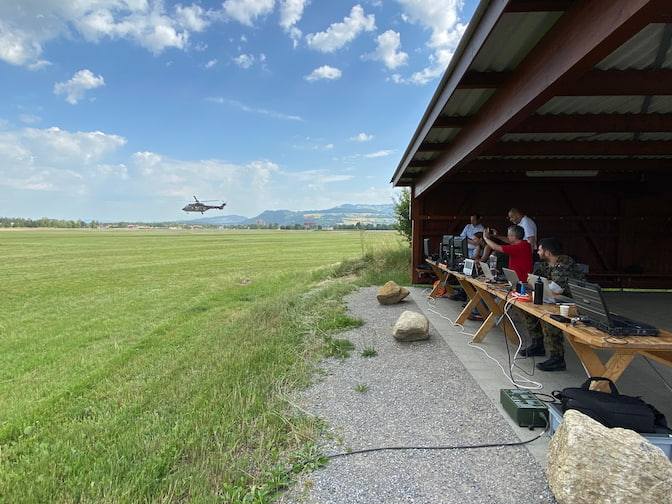
The research team field-tested their method in Switzerland using a military helicopter with a radiation detector installed in the cargo bay. Known radiological sources were placed on the ground, some including mixed sources. During single-pass flyovers flying 30 meters above the ground, the method detected radionuclide identity, activity, and location, even when the measured signal is weak and heavily distorted.
“What excites me most is the combination of speed and quantitative detail could make airborne measurements substantially more useful in both emergency response and routine monitoring,” said Breitenmoser.
Beyond emergency response, the new method could help routine radiological monitoring around nuclear facilities, environmental monitoring and remediation or mineral-exploration surveys.
This research was supported in part by the Swiss Federal Nuclear Safety Inspectorate (grant no. CTR00836 and CTR00491).