Cars and planes could avoid hazardous ice and freezing rain with new sensors
Drivers can lose control when they hit invisible black ice, and freezing rain can lead to plane crashes. This pair of sensors could help avert disaster.

Drivers can lose control when they hit invisible black ice, and freezing rain can lead to plane crashes. This pair of sensors could help avert disaster.
Experts
Professor of Climate and Space Sciences and Engineering
Professor of Aerospace Engineering
Pilots, drivers and automated safety systems in cars and airplanes could be alerted to icy hazards by a pair of sensors developed at the University of Michigan.
Ice on roads causes around 20% of weather-related car crashes each year, and ice build-up on planes causes roughly 10% of all fatal air carrier crashes by interfering with aerodynamics and controls. For instance, a flight from Brazilian airliner Voepass Linhas Aéreas crashed near São Paulo on Aug. 9, 2024, after the plane’s de-icing systems failed, according to a report in the Aviation Safety Network. An Air France flight also crashed in the Atlantic Ocean on June 1, 2009, after ice blocked the probes that measure the plane’s speed. In both cases, all occupants died.
“More people are traveling by plane each year, and there’s more pressure to fly in all weather conditions,” said Nilton Renno, a professor of climate and space sciences and engineering who led the development of the technology, with support from the National Science Foundation.
Nilton: When I started flying airplanes in the winter, at night we would come to the hangar to fly. There would be ice everywhere. And then reading that most of the small airplane accidents are due to icing, I realized that that’s something that I could probably do something about. The ice a problem in the air and on the ground.
Narrator: Icing is responsible for nearly 10% of airplane crashes, and sensors in today’s planes are unable to detect when ice impacts critical areas. Pilot and atmospheric scientist Nilton Renno and his team are hoping to change that. By designing a system of sensors that can not only better detect where ice builds up on a plane, but also detect ice before it ever becomes a problem.
Nilton: Ice forms when liquid water droplets are below the freezing point. When they strike an airplane they freeze, forming the ice. The larger the droplets are, the more hazard the icing.
Narrator: These super cooled liquid droplets are especially dangerous for small planes flying in low altitudes, but larger planes can also be at risk. An FAA decision in 2001 put into effect stricter standards for new planes and their ability to fly in icing conditions. Pushing companies to design better systems for detecting ice. Renno’s approach requires using an optical sensor that fires infrared lasers at incoming clouds. Within seconds, the lasers can inform the pilot if a cloud contains liquid droplets, ice, or a mix. if droplets are present. One laser can determine the amount and size, which is critical for detecting supercooled liquid droplets.
Nilton: And with this information, then you can estimate how hazard the icingis, if you should turn around, climb, descend or if the icing protection system is going to be good enough to keep ice from forming on the airplane.
Narrator: An additional microwave sensor was designed to be placed anywhere on the surface of the plane, with the frequency signal changing when the sensor is covered with ice or liquid.
Nilton: Being able to detect that they are flying those extreme weather conditions and get out. We’re going to help new airplanes be certified because in some condition might be nearly impossible to really protect the airplane.
Narrator: Renno is also adapting the optical sensor for cars to warn drivers of black ice and trigger safety systems.
Nilton: You can save lots of lives by just decreasing the speed slightly, when you detect a slippery road. Each year, more and more people are traveling by plane and they want to fly all weather conditions. So the system needs to be as efficient as possible And the technology like the one that we have been developing, would help in that sense.
“Our technology can help airplanes, drones, cars and trucks be as safe and efficient as possible,” he added.
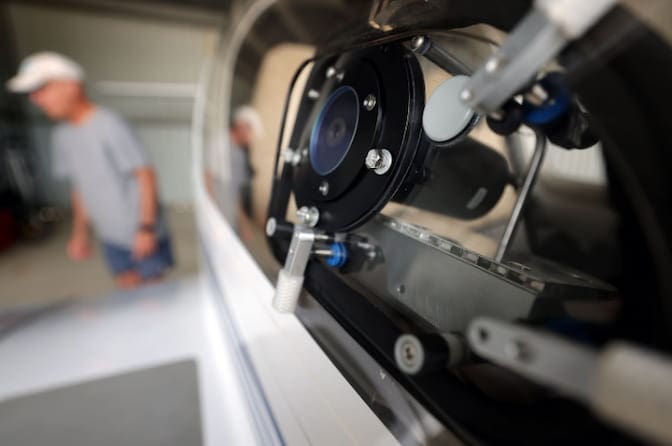
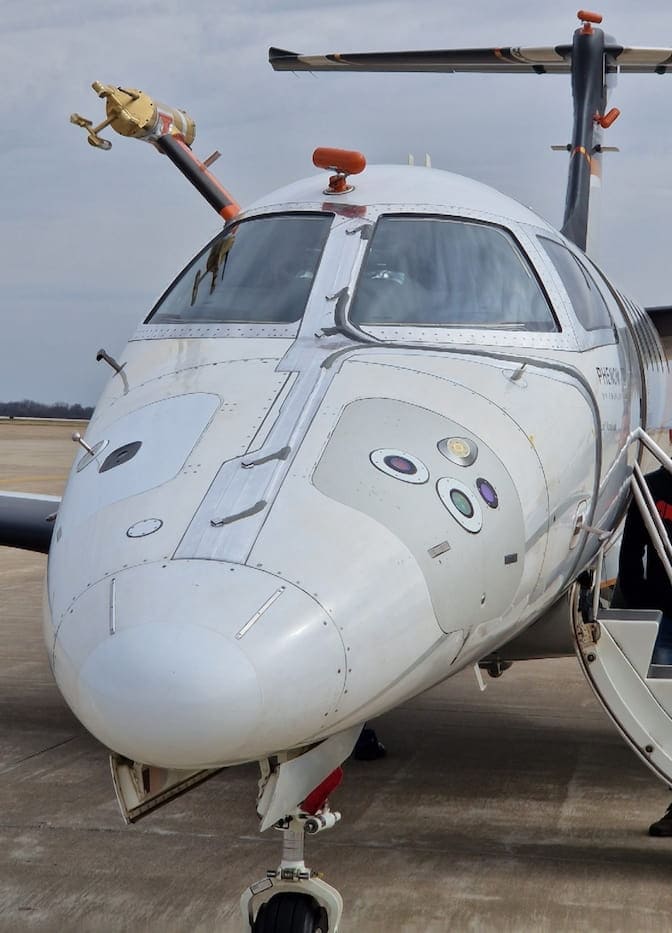
Renno’s team tested their system of two complementary sensors in a single engine airplane, as well as a light business jet equipped with scientific instruments for taking reference measurements. The results of the experiments are described in the journal Nature Scientific Reports. One sensor lies flush against the plane, using microwaves to detect when ice forms on its surface. Another sensor uses lasers to detect freezing rain and large water drops in clouds, alerting pilots of danger in advance. This sensor could also work in cars and trucks, detecting ice on roads.
Development of the microwave sensor began after the Phoenix lander mission, which found evidence for liquid water on Mars. Renno wanted future missions to measure the amount of moisture in soils and differentiate water from ice. But Renno, who is also a pilot, started thinking about how he could help pilots after he found his personal airplane covered in ice one winter. Knowing he couldn’t fly safely, he instead went home and brainstormed solutions.
“Icing of airplanes is a worldwide problem that can happen anytime of the year with aircraft of all sizes, depending on the flight altitude,” Renno said. “I realized that that was a problem that I could do something about because of my background as both a pilot and an atmospheric scientist.”
Airplanes today detect ice with two styles of probes that protrude from the plane, but because they extend above the surface, they don’t provide information about what’s on the plane. The microwave sensor directly detects ice build-up because it’s embedded in the plane’s surface. The frequency of the sensor’s microwave signal changes when the sensor is covered by water or ice.
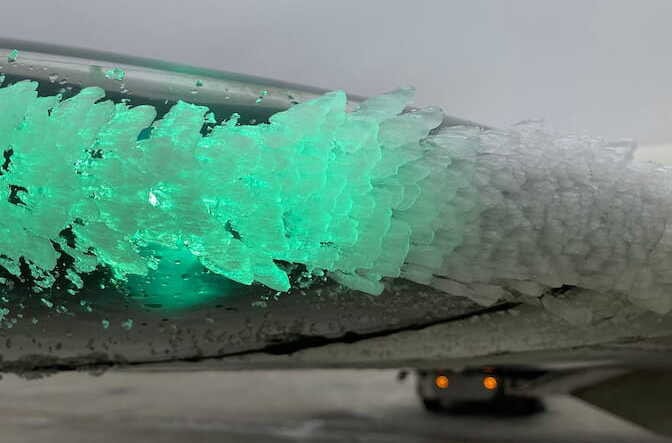
The complementary sensor detects freezing rain within seconds of entering a cloud by firing three infrared lasers with different wavelengths. The first two beams are absorbed by water and ice differently, so the ratio of the return signals tells pilots whether a cloud contains ice particles, water droplets or a mix. Planes freeze when they hit water drops chilled below the freezing point, but ice particles simply bounce off, so the sensor could help pilots identify a hazardous cloud and fly away before the plane ices over
The third laser helps determine the size of the water droplets and the amount of droplets in the cloud by comparing its return signal with those of the other two lasers. Larger droplets are more hazardous because they are more likely to hit the plane while smaller droplets ride the flow of air around the plane.
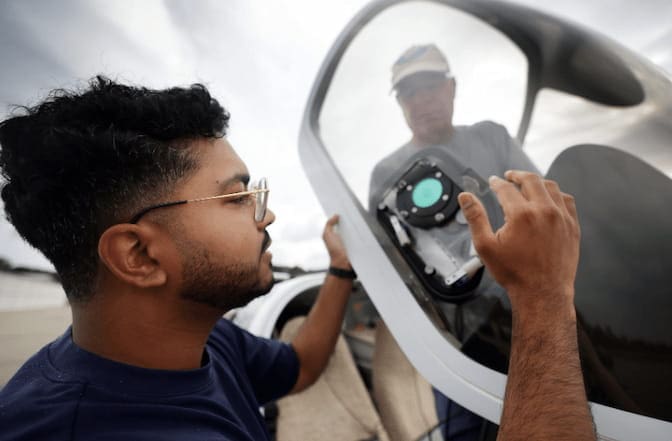
The lasers could also warn drivers of black ice before they start sliding, or perhaps trigger the car’s automatic safety systems. Slowing by 4-9 miles per hour can reduce the risk of serious injury during car accidents by half, research shows.
“You can save a lot of lives by just slowing down when you detect a slippery road ahead,” said Renno.
The device was built and developed in part at the U-M Space Physics Research Laboratory. Intelligent Vision Systems, a U-M startup, developed the optical sensor and licensed the technology with the assistance of Innovation Partnerships, which also has patented the sensors. Renno and the University of Michigan have a financial interest in Intelligent Vision Systems.
Renno is also a professor of aerospace engineering.