A participatory design builds social acceptance for fusion energy
A workshop where community members developed hypothetical fusion energy facilities helps pinpoint values and concerns, forming a new playbook to build public support.

A workshop where community members developed hypothetical fusion energy facilities helps pinpoint values and concerns, forming a new playbook to build public support.
Experts
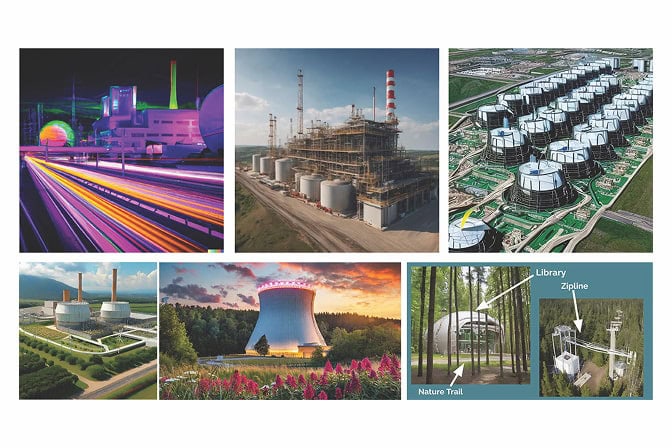
As companies around the world work to commercialize fusion energy—clean power generated by combining two light atoms—not much is known about public acceptance of the emerging technology. In a first-of-its-kind participatory design, Southeastern Michigan community members and students worked together to plan hypothetical fusion energy facilities.
Workshop participants envisioned transparently developed energy projects that connect to local history, respect natural surroundings and safeguard both workers and the community while providing economic benefits. The University of Michigan Engineering study is published in the Journal of Fusion Energy.

Advancing nuclear energy
from discovery to deployment
The study offers a practical playbook to help developers build social acceptance while developing the technology, departing from the controversy-stirring “decide, announce, defend” approach that large energy projects, including conventional nuclear power, have used in the past.
“By involving communities early, we surfaced hopes, worries and creative ideas that engineers or policymakers might miss in a typical engineering design process,” said Aditi Verma, an assistant professor of nuclear engineering and radiological sciences at U-M and corresponding author of the study.
Fusion energy technologies are in the early stages of development. Fusion can generate power by forcing two light atomic nuclei to merge under conditions of extreme heat and pressure, which can be achieved by using lasers or powerful magnets.
Unlike nuclear fission, fusion does not rely on a sustained chain reaction, and if the fusion system conditions are not perfect—such as in the event of technical issues—the fusion reaction simply stops, with no risk of a runaway reaction or meltdown. This strong safety profile makes fusion a promising option for integration within or near communities, but any deployment will require strong local support and understanding, particularly since fusion is an early-stage technology not well understood by the public.
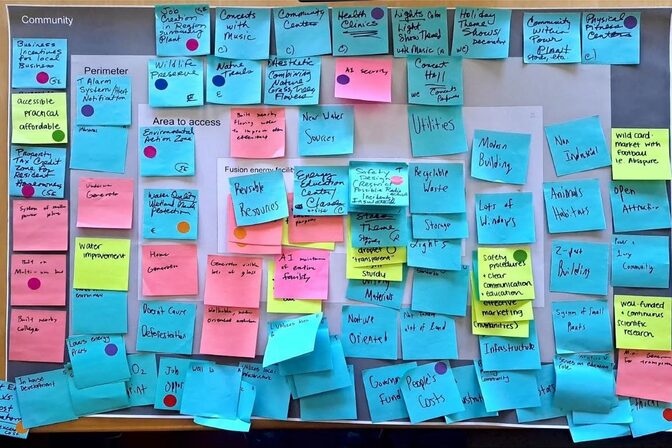
To build a social acceptance model, the workshop brought together 22 community participants and 34 engineering students who were part of a U-M course on the community-engaged design of energy technologies.
“An interdisciplinary approach to engineering that incorporates technical expertise with community engagement can support the creation of technologies that are ultimately better adapted to their use contexts,” said Katie Snyder, a lecturer and adjunct assistant research scientist of technical communication at U-M and co-author of the study.
“Doing this properly requires a fair bit of introspection and work within engineering disciplines—including teaching future engineers how to communicate transparently and ethically, receive input from a wide variety of stakeholders and incorporate that input into their design practices,” added Snyder.
The day-long workshop began with a brief introduction to fusion energy systems, followed by an opportunity for participants to ask questions and discuss pros and cons. Then, groups worked together to plan a hypothetical fusion energy facility for their local community.
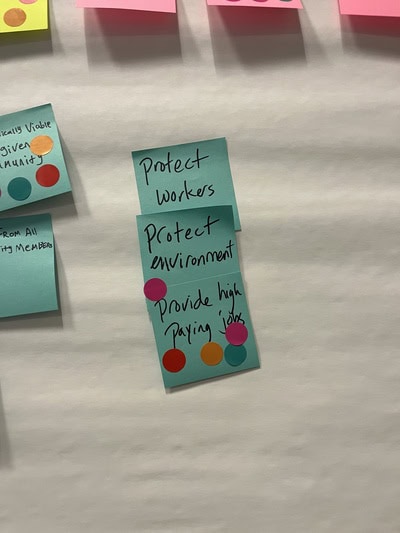
The researchers gathered data from the workshop and used AI clustering and sentiment analysis to distill common themes.
Participants’ hypothetical fusion energy systems centered around:
“By systematically blending community perspectives, participatory design and rapid visualization of ideas, our method provides richer and more actionable insights. It makes it possible for engineers and policymakers to identify local priorities, anticipate concerns and co-create solutions with host communities,” said Verma.
Post-workshop reflections revealed a notable shift in community partner sentiment after the participatory design process, moving from initial uncertainty and curiosity to joy, surprise and hopeful attitudes about fusion and their ability to influence its future.
“The collaborative design method not only surfaced new ideas but also built a sense of ownership and optimism that isn’t typically seen in conventional public engagement processes,” said Snyder.
While timelines for fusion commercialization are potentially long and uncertain, exploring public perspectives ahead of rollout can help avoid obstacles that have historically stalled energy projects.
“Ultimately, our approach can democratize the development of complex technologies, making them more inclusive and context-sensitive. This not only advances fusion energy deployment, but also sets a new standard for responsible and collaborative infrastructure design more broadly,” said Verma.
This research was funded by an Enhancing Engineering Education grant from the University of Michigan College of Engineering, which supported curricular development for the course in which this workshop was implemented.