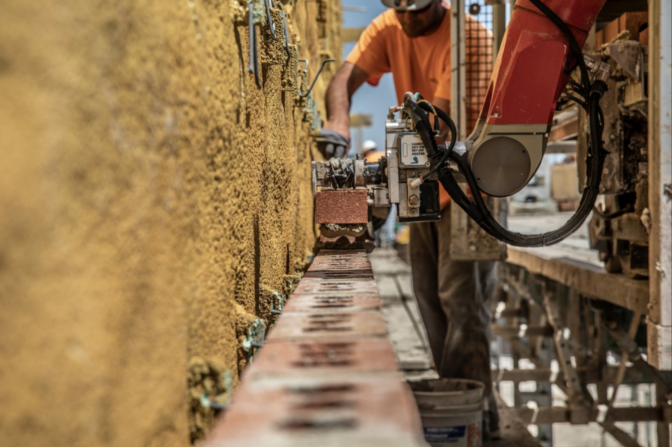
Robotic systems for advanced manufacturing applications
The core of robotic manufacturing is flexibility, adaptability and efficiency.

The core of robotic manufacturing is flexibility, adaptability and efficiency.
Robotics is revolutionizing manufacturing by making it more dynamic and adaptive, enabling customized products and greater efficiency. In the past, factories relied on machines that performed the same repetitive task for years—today’s robots change functions quickly and adjust to people’s needs.
Construction is a kind of messy science.
Materials bend, sizes can be off, and what looked good on paper can end up installed incorrectly on the worksite.
Robots aren’t equipped to deal with these changing elements in real time, so they’ve never made an impact on the construction industry.
Until now.
U-M researchers have developed modeling techniques that will help on-site construction robots with autonomous decision-making.
The robot can adjust to all the differences using real-time sensing data and compare that to the construction project’s original model.
The robot can update its plan of action, all without additional programming.
I actually worked in the construction industry for ten years before coming back to school for engineering.
It took its toll on my body.
It’s a very rough line of work.
What we’re trying to do here is demonstrate that robots can perform construction activities and adapt their plan in order to perform work.
We’re using caulking as our example, but it could represent many different construction activities: caulking, welding, cavity filling (like spray insulation), soldering pipe, so on and so forth.
Robots are good at doing repetitive tasks and doing the same repetitive tasks to the same specification.
In a factory, typically with the way the parts come together, the tolerances are within millimeters of each other; all the parts fit together with a tight accuracy.
In construction, robotics is a little bit more challenging because, unlike a factory floor, on a construction site, you often find it is not uncommon for a large fixture—even such as this staircase or this railing— to be off by a few inches when the work is actually being done.
One example might be a robot trying to install a window panel into a rough opening. It needs to actually sense the work because if it tried to perform the work blindly, it would fail terribly.
We have made some significant progress in this direction, particularly in the area of joint filling, where a robot is expected to discharge a fluid material into joints or gaps of various shapes and sizes.
Maybe it goes from a half-inch wide down to nothing, and maybe the workpieces are staggered in height relative to one another.
As long as that object ends up somewhere within the robot’s sensor window, using the model fitting technique that I developed, it will match models of the workpieces it is looking for to the actual data it has obtained.
Knowing that, it can then adapt its plan and perform work on the object.
Construction is at the very top in terms of workplace injuries and workplace fatalities.
So it is very conceivable that in the near future every construction worker or craftsperson has a robot assistant or a robot apprentice working for him or her, doing all the heavy lifting, the climbing, and the reaching out in dangerous places, while letting the human worker or human responder do the intellectual thinking and problem-solving.
I still have friends and family in the construction industry, and I am sensitive to their concerns about robots taking their jobs.
If there’s work that people don’t really want to do or is hazardous, I think they will openly welcome assistance from robots to perform that work.
Innovations like 3D printing let manufacturers use various materials, shaped and configured in many different ways. U-M startup S3D Precision Dispensing, for example, is advancing technology that allows printing sensors, actuators, and electronics on diverse surfaces at resolutions from 5 millimeters to 50 nanometers.
Michigan Engineering is reinventing U.S. manufacturing for resilience and scale
Smart manufacturing uses data to optimize decisions, with humans remaining central to the process. Michigan researchers aim to “devise rules that balance the trade-off between system autonomy and flexibility,” ensuring effective collaboration between people and machines. Sensors and smart optics now embedded into everyday items help users make smarter choices and supply robots with crucial feedback, resulting in continuous improvement for both manufacturing and product development.
AI contributed to this human-edited-summary of the article Manufacturing Robotics by Dan Newman.